



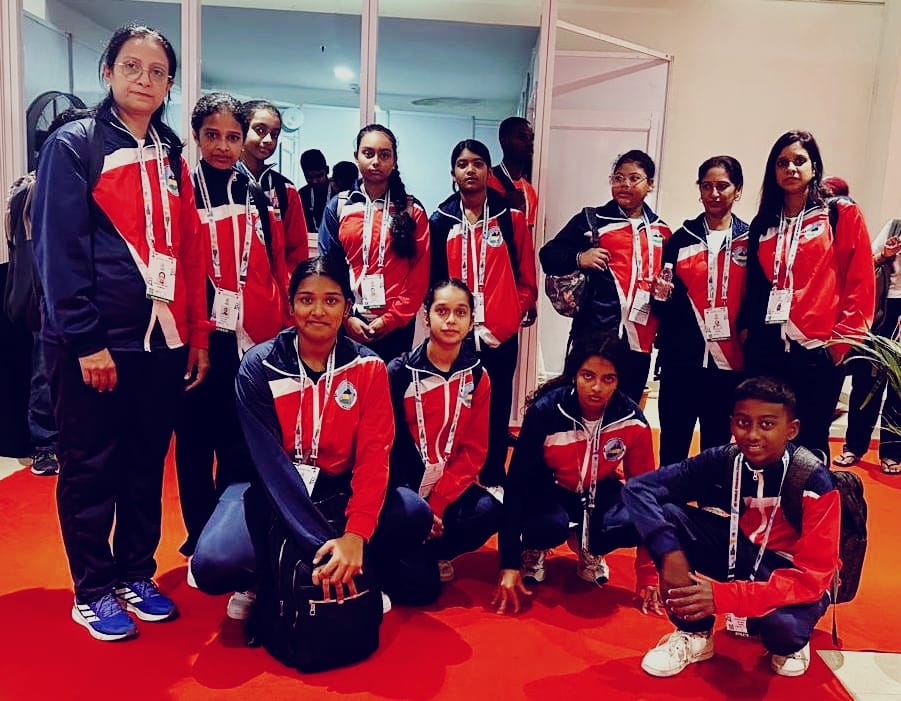
The inaugural World Yogasana Championships in Ahmedabad have emerged not only as a global sporting platform but also as an unexpected cultural bridge, reconnecting young athletes from Mauritius with their ancestral roots in India.
Several members of the Mauritian contingent trace their family origins to Indian states such as Bihar and Tamil Nadu, with many belonging to families whose ancestors migrated generations ago across the Indian Ocean. For many of these athletes, the visit marked their first experience of the country they had previously known only through family stories and inherited memory.
Among them were athletes Chethnaa Reesaul, Parineeti Kalkah and Ganisha Bajah, who trace their lineage to Bihar, along with Aarya Chelumbrun, whose family originates from Tamil Nadu, and Dakshesh Sai Joorun, whose heritage spans both Tamil Nadu and Bihar.
For 19-year-old Chethnaa, competing in the senior category, the championship offered a deeply personal experience beyond sport.
“I know that my family has roots in Bihar, but I don’t know exactly which part of the state my ancestors came from. My grandmother told me about our Indian connection, but I never really looked into it because I was focused on my studies and sports,” she said.
Like many Gen Z members of the Mauritian diaspora, Chethnaa and her teammates grew up with fragments of history passed down through family elders, where India remained more a cultural memory than a lived reality.
That perception shifted during their visit to Ahmedabad, where exposure to Indian languages, traditions and everyday life helped transform abstract heritage into a tangible connection.
“Now that I have visited India, I would definitely like to learn more about my roots in the future,” Chethnaa said. “I would love to come back, visit Bihar and perhaps bring my family with me so we can explore our heritage together.”
For 13-year-old athlete Ganisha Bajah, the experience carried a similar emotional impact.
“Growing up, we always knew that our ancestors came from India, but it felt like something that belonged to the past. Being here has made that connection feel real. It has made me want to learn more about my family history and understand where our story began,” she said.
The connection extended beyond athletes to the coaching and academic staff accompanying the delegation, including Deputy Rector Reena Dewkarun and educator-coach Disha Nekitsing, both of whom also trace their roots to Bihar. Their participation underscored the enduring cultural ties between Mauritius and India, preserved over generations through language, food, traditions and oral histories.
The Mauritian delegation represented the diverse Indian heritage of the island nation. While some athletes identify strongly with Bihar-origin communities, others, such as 12-year-old Aarya Chelumbrun, trace ancestry to Tamil Nadu, reflecting the layered cultural identities that continue to shape Mauritian society.
Interestingly, it was Yogasana—an ancient Indian discipline now evolving as an international competitive sport—that became the medium for this reconnection. Many athletes had taken up the sport only recently, with Chethnaa beginning training earlier this year.
“Yoga has made me calmer, more patient and more focused,” she said. “It has helped me develop discipline and balance in my daily life.”
Beyond competition, the championships offered participants an opportunity for cultural rediscovery. For several young Mauritians of Indian origin, limited documentation and fading generational memory have often made tracing precise ancestral links difficult. Events such as the World Yogasana Championships, however, are increasingly enabling personal and cultural exploration alongside sporting engagement.
While athletes from around the world competed for medals inside the arena, outside it, the Mauritian delegation found themselves engaging with a deeper journey of identity and heritage.
As they return home, the athletes carry not only international sporting experience but also a renewed curiosity about their origins and a strengthened emotional connection to India.
“For me, this is one of the most unexpected legacies of the inaugural Yogasana world championships,” Ganisha said. “It is not just about bringing nations together through sport. It is also about helping a new generation like us rediscover where our story began.”
(With inputs & Pic from WYC 2026)
(Edited by Pratyusha Mukherjee)
