



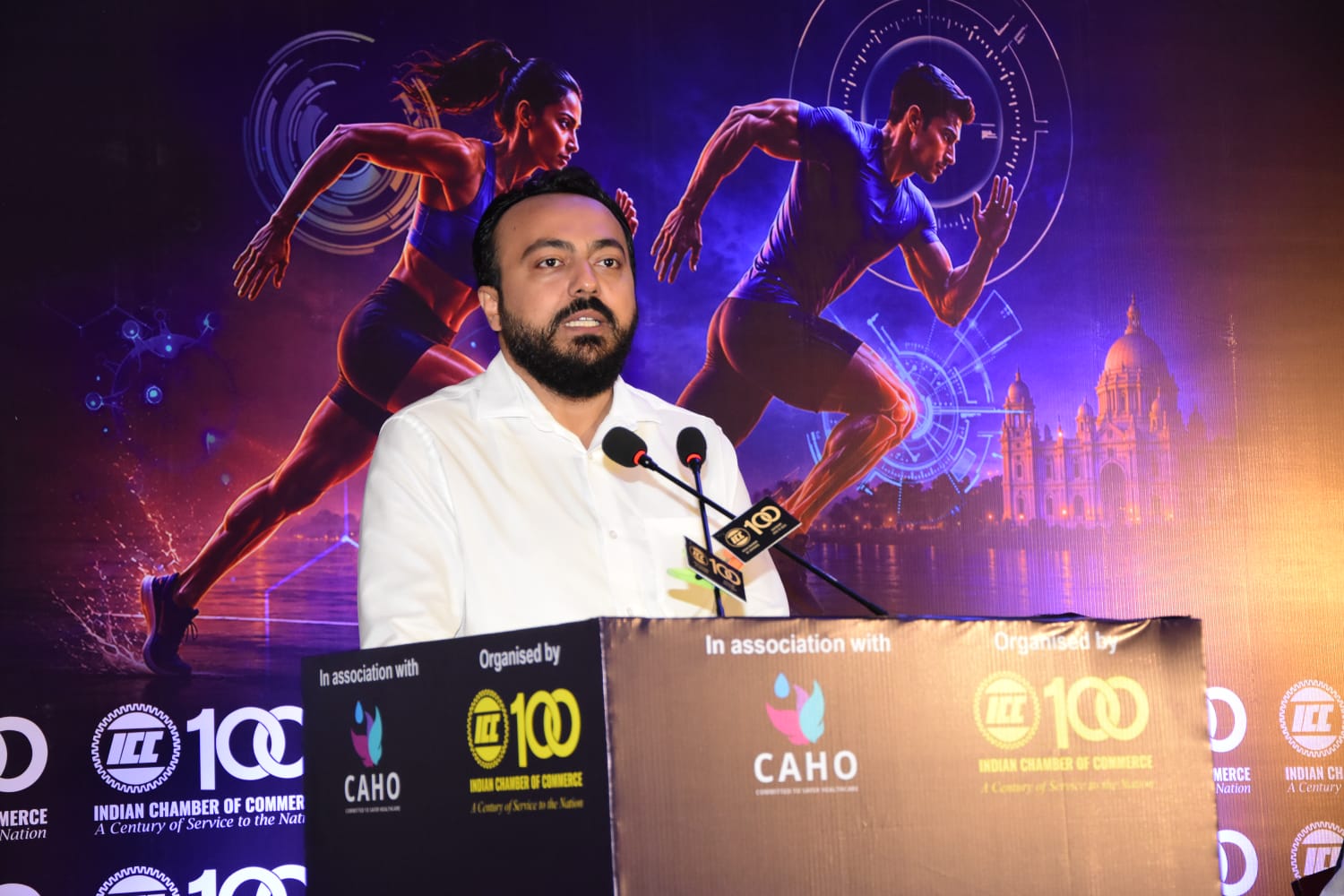
Sports medicine must move beyond metropolitan centers and become accessible to athletes across West Bengal, said Dr. Indranil Khan, Minister of State (Independent Charge), Youth Services & Sports, Government of West Bengal, while addressing ICC SportsMed 2026, a major healthcare and sports science summit organized by the Indian Chamber of Commerce (ICC).
Held under the theme “From Performance to Prevention: Integrating Science, Medicine & Technology,” the summit brought together healthcare leaders, sports medicine specialists, policymakers, hospital administrators, sports scientists and athletes to discuss the future of sports healthcare in India.
Speaking at the event, Dr. Khan emphasized that the state’s sporting ecosystem is poised for significant transformation through initiatives such as Khelo India and increased investment in sports infrastructure. He stressed the importance of providing athletes with professional support during their formative years, including access to coaching, sports medicine, fitness training and injury management.
“Sports medicine is going to witness a major change for the better and will not be restricted to Kolkata—it will be decentralized so that players across West Bengal receive opportunities and support,” Dr. Khan said. He also called upon private stakeholders and entrepreneurs to participate in the development of sports infrastructure and healthcare services.
Focus on Prevention and Athlete Well-being:
Opening the summit, Prashant Sharma, Chairman of ICC National Healthcare Committee highlighted the growing importance of sports medicine as healthcare shifts from a predominantly curative model to one centered on prevention, rehabilitation and wellness.
According to Sharma, a robust sports medicine ecosystem is essential for supporting athletes through preventive care, rehabilitation, injury management, advanced surgical interventions and post-treatment recovery. He noted that the convergence of wellness, longevity and preventive medicine will play a critical role in improving health outcomes for both athletes and the general population.
Quality Standards Critical for Sports Healthcare:
Delivering the theme address, Dr. Sankar Sengupta, Vice President of the Consortium of Accredited Healthcare Organizations (CAHO) and Medical Superintendent of Chittaranjan National Cancer Institute, underscored the need for standardized clinical practices and patient safety frameworks in sports medicine.
He stated that quality healthcare goes beyond accreditation and requires a culture of safety, evidence-based protocols and continuous improvement. Key focus areas include injury prevention, rehabilitation standards, infection control, athlete safety assessments and structured return-to-play guidelines.
Dr. Sengupta also highlighted the importance of clinical audits, outcome measurement, research collaborations and benchmarking to strengthen sports medicine practices nationwide.
New National Sports Policy Expands Focus Beyond Medals:
Sibananda Mishra, Regional Director-in-Charge, National Sports Education and Research Centre (NSERC), Kolkata, under the Sports Authority of India (SAI), highlighted the broader vision of India’s newly introduced national sports policy, Khelo Bharat Niti.
He noted that the policy seeks to leverage sports not only for competitive excellence but also for promoting fitness, inclusion and social empowerment. The framework places significant emphasis on sports science, sports medicine, artificial intelligence and data analytics to support athlete development.
With India aiming to host the 2036 Olympic Games, Mishra said the demand for sports medicine services, injury prevention programs and rehabilitation support is expected to increase substantially.
Shift Toward Corrective and Preventive Approaches:
Former cricketer Ranadeep Moitra discussed the growing role of corrective exercise and preventive medicine in modern sports training.
He observed that sports science has undergone a major shift over the past two decades, moving from a purely performance-driven approach to one focused on injury prevention and prehabilitation. Corrective exercise, he explained, helps identify and address musculoskeletal dysfunctions before they develop into serious injuries.
“Prevention has become a central component of strength and conditioning protocols,” Moitra said, stressing the importance of maintaining mobility and stability for long-term athletic performance.
Experts Highlight Orthopaedic and Cardiac Health:
During a plenary session on advancing athlete care and performance, orthopaedic surgeon Dr. Abhijit Sen emphasized that sports performance depends on maintaining a healthy movement system comprising strong bones, stable joints and healthy muscles.
He advocated a preventive approach to sports healthcare, noting that recovery should be viewed as an integral part of training and long-term performance development.
Meanwhile, Dr. Khawer Naveed Siddiqui, Head of Preventive Cardiology at B.M. Birla Heart Research Centre, highlighted the importance of cardiovascular screening for athletes. He warned that underlying cardiac conditions can pose serious risks even to young and physically fit sportspersons.
Dr. Siddiqui called for greater awareness of pre-participation cardiac evaluations, recognition of warning signs and preparedness through Basic Life Support (BLS) training to ensure safer sporting environments.
Building a Stronger Sports Healthcare Ecosystem:
The summit concluded with a strong consensus on the need for greater collaboration among healthcare institutions, sports organizations, policymakers, researchers and technology providers to create a comprehensive sports medicine ecosystem in India.
Experts agreed that integrating preventive healthcare, rehabilitation science, nutrition, performance analytics and emerging technologies will be essential for improving athlete well-being, reducing injury burdens and supporting India’s ambitions as a global sporting nation.
Organized by the Indian Chamber of Commerce, ICC SportsMed 2026 served as a key platform for advancing discussions on the role of science, medicine and technology in shaping the future of sports healthcare in the country.
(With inputs)
