



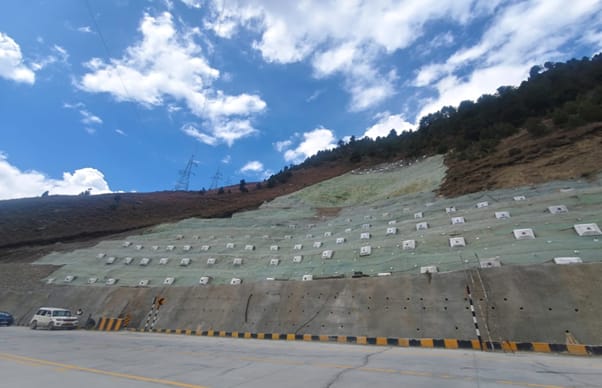
In response to the growing threat of extreme weather events in India’s mountainous regions, the Ministry of Road Transport and Highways (MoRTH) has intensified efforts to strengthen the resilience of National Highways through advanced landslide monitoring, scientific slope stabilization, and strategic institutional partnerships.
Recent disasters, including the devastating cloudburst in Uttarkashi’s Dharali and Sukhi Top regions that triggered flash floods and widespread slope failures, have underscored the vulnerability of Himalayan road networks. Recognizing these challenges, MoRTH is increasingly adopting cutting-edge technologies and risk-based planning approaches to protect critical transport infrastructure.
Advanced Monitoring and Early Warning Systems:
A major initiative currently underway is the deployment of Interferometric Synthetic Aperture Radar (InSAR)-based landslide monitoring along a 100-kilometre stretch of the Char Dham route in Uttarakhand. The technology enables authorities to detect minute ground movements and identify unstable slopes before major failures occur.
In addition, MoRTH is planning an advanced warning and alert system for the Parwanoo–Solan section of NH-5 in Himachal Pradesh. The system will monitor landslides, land subsidence, groundwater movement, and rockfall-prone zones in real time, enabling faster response and preventive action.
These initiatives mark a shift from reactive disaster management toward predictive and preventive infrastructure protection.
Integrating Science into Highway Planning:
To improve infrastructure resilience in geologically sensitive areas, MoRTH has strengthened collaboration with scientific institutions. The Ministry has signed a Memorandum of Understanding with the Geological Survey of India (GSI) to support geological investigations for tunnel projects and facilitate geohazard data sharing.
Geological maps and National Landslide Susceptibility Mapping prepared by GSI are now being incorporated into highway planning, alignment selection, and tunnel design processes in vulnerable hill regions.
With approximately 16,788 kilometres of National Highways located in India’s hill states, safeguarding road infrastructure against landslides, flash floods, rockfalls, and cloudbursts has become increasingly important.
Reforms in Hill Road Construction:
MoRTH has introduced a phased construction approach for highway projects in mountainous terrain. Under the revised methodology, hill cutting and slope stabilization measures are completed first, followed by a monitoring period of at least one monsoon season. Road construction begins only after slope stability is confirmed.
The Ministry is also leveraging satellite-based monitoring technologies through partnerships with specialized organizations. Continuous analysis of satellite data provides early warning indicators, supports targeted mitigation measures, and improves maintenance planning.
Given that mountain highways typically cost between ₹15 crore and ₹30 crore per kilometre to construct, while a single moderate landslide can cause repair costs of ₹10 crore to ₹25 crore and disrupt traffic for several days, proactive monitoring offers significant economic and operational benefits.
Additional policy measures include revised normative construction timelines for projects in the Himalayas, North-East, Western Ghats, and Andaman & Nicobar Islands, as well as provisions for wider right-of-way to facilitate slope stabilization and maintenance activities.
Strategic Partnerships for Resilient Infrastructure:
Recognizing the multidisciplinary nature of geohazard management, MoRTH has expanded collaborations with leading technical and scientific institutions, including THDC India Limited, GSI, Defence Geo-informatics Research Establishment (DGRE), National Institute of Rock Mechanics (NIRM), and IIT Roorkee.
These partnerships support geotechnical investigations, design reviews, safety audits, capacity building, and deployment of advanced technologies.
The Ministry has also partnered with THDC India Limited for specialized landslide mitigation projects in Uttarakhand and Arunachal Pradesh, while DGRE is providing scientific and technical expertise for assessing and mitigating geohazards along National Highways.
Slope-Specific Mitigation Measures:
MoRTH has adopted a scientific and site-specific framework for slope stabilization based on recommendations from an expert committee led by IIT Delhi.
Engineers now evaluate slopes according to local geology, rainfall patterns, groundwater conditions, and terrain characteristics before selecting appropriate mitigation measures. Advanced tools such as drones, LiDAR surveys, and Digital Terrain Models are being used to conduct detailed investigations and identify potential risks.
Mitigation measures include soil nailing, high-tensile steel wire mesh, prestressed cable anchors, retaining walls, drainage systems, terracing, hydroseeding, and rock anchors. Particular emphasis is being placed on effective drainage management, as uncontrolled water infiltration remains one of the primary causes of slope instability.
Successful stabilization projects, including works at Karnaprayag in Uttarakhand, demonstrate the effectiveness of combining engineering solutions with nature-based approaches.
The IIT-led framework also highlights sustainable techniques such as bamboo benching and vetiver grass plantation, which are being implemented in Meghalaya as cost-effective and environmentally friendly slope protection measures.
Raising Standards for Rockfall Protection:
To strengthen safety standards, MoRTH has developed a comprehensive framework for rockfall protection systems aligned with international best practices.
The proposed standards require internationally recognized certifications, including European Technical Assessment (ETA) certification and CE marking. The framework also introduces stringent quality assurance measures such as barcode-based traceability, field validation, manufacturer testing, proof-testing of anchors and nets, and long-term maintenance requirements.
Progress on the Ground:
The Ministry’s initiatives are already producing tangible results. In Uttarakhand alone, mitigation measures have been completed at 58 landslide-prone locations, while work is ongoing at 96 additional sites. Detailed project reports and investigations are currently underway for another 104 vulnerable locations.
As roads in hill regions serve as critical lifelines connecting remote communities to essential services, economic opportunities, and emergency support, MoRTH’s adoption of scientific risk assessment and advanced mitigation technologies is expected to significantly enhance the safety, reliability, and resilience of India’s mountain transport corridors.
