



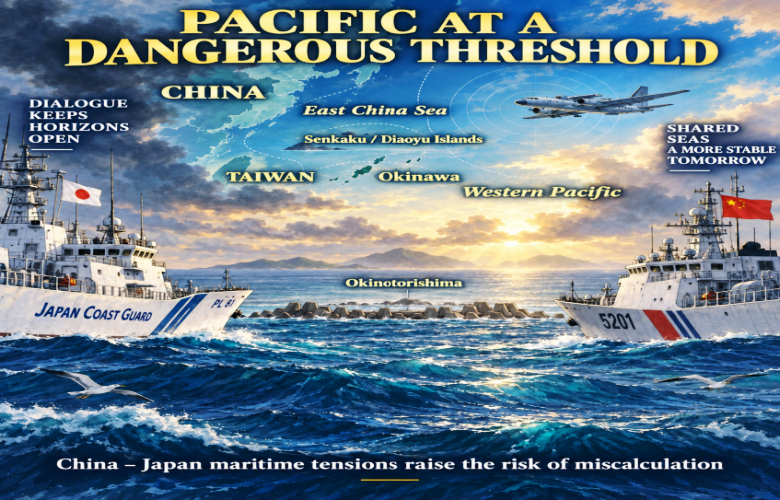
The maritime rivalry between China and Japan has entered a more volatile phase, stretching from the disputed Senkaku Islands in the East China Sea to Okinotorishima in the western Pacific.
Frequent coast guard encounters, naval exercises, competing maritime claims and expanding defence capabilities have transformed a territorial dispute into a broader contest for regional influence. Although neither country appears to be seeking war, the growing intensity of military and law-enforcement activities has heightened the risk of an accidental crisis.
The Senkaku Islands—known as Diaoyu in China and Diaoyutai in Taiwan—consist of five uninhabited islets and three reefs covering approximately seven square kilometres. Japan administers the islands, while China and Taiwan claim sovereignty over them. Situated between Taiwan, Okinawa and China’s eastern coast, the islands lie close to important regional maritime and air routes.
Their strategic importance extends well beyond their limited land area. The surrounding waters contain productive fishing grounds and potential hydrocarbon resources. Their proximity to Taiwan and Japan’s Ryukyu island chain also gives them significance for maritime surveillance, air-defence monitoring and naval access between the East China Sea and the western Pacific.
China primarily deploys coast guard vessels around the islands rather than conventional naval warships. Chinese government vessels were recorded in the contiguous zone on 355 days in 2024 and a record 357 days in 2025—nearly 98 per cent of the year. Armed Chinese coast guard vessels have also entered waters claimed by Japan as territorial waters and approached Japanese fishing boats. On 7 July 2026, Chinese and Japanese coast guard vessels confronted each other near a Japanese fishing boat, with both governments claiming that they had forced the other side to withdraw. China continues its regular patrols, while Japan monitors the area using coast guard vessels and surveillance aircraft.
The rivalry has also expanded towards Okinotorishima. On 19 July, a Chinese Type 052D destroyer conducted a live-fire exercise approximately 180 kilometres southwest of the formation, accompanied by two other Chinese warships and a Russian frigate. Japan described the exercise as the first publicly confirmed Chinese naval live-fire drill within its claimed Exclusive Economic Zone (EEZ).
Okinotorishima lies approximately 1,700 kilometres south of Tokyo and consists of only two small formations that remain visible above water at high tide. Japan classifies the formation as an island capable of generating a 200-nautical-mile EEZ, while China considers it a rock that cannot generate an EEZ under Article 121 of the United Nations Convention on the Law of the Sea. Japan also recorded at least 10 Chinese destroyer transits through a narrow channel near Amami-Oshima during 2026. Meanwhile, China conducted a seabed survey east of Taiwan from 10 to 31 August 2026 and expanded Coast Guard patrols in the area.
Tokyo is responding through a ¥43-trillion defence programme covering 2023–2027. Its investments include upgraded Type 12 missiles, 400 US-made Tomahawk missiles, unmanned systems and reinforced military bases across Japan’s southwestern islands.
As Chinese and Japanese operations continue to expand across interconnected maritime zones, the risk of miscalculation has increased. Effective communication, advance notification of military exercises and clear rules for managing incidents at sea will be essential to prevent a territorial confrontation from escalating into a wider regional crisis.
