



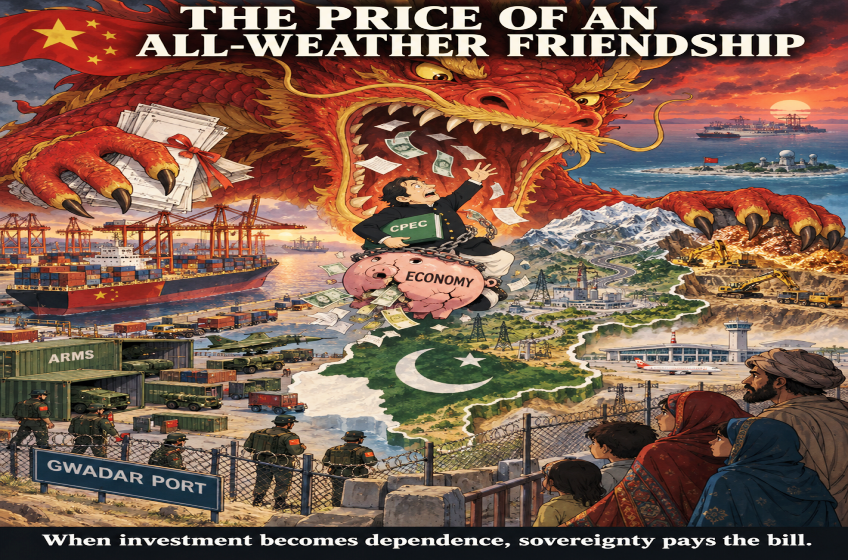
China and Pakistan describe their relationship as an “all-weather strategic cooperative partnership,” but the depth of that partnership deserves closer examination. Beijing’s expanding involvement in Pakistan’s ports, roads, industries, mineral resources and defence sector is creating a relationship marked by increasing economic and strategic interdependence. While Pakistan receives infrastructure, investment and military equipment, China gains commercial access, political influence and a long-term strategic presence near India and the Arabian Sea.
Diplomatic relations, established in 1951, acquired greater strategic importance following the 1962 India-China war. Their shared strategic concerns regarding India helped defence cooperation become a central pillar of bilateral relations. According to the Stockholm International Peace Research Institute, China accounted for 80 per cent of Pakistan’s major arms imports between 2021 and 2025, while Pakistan’s arms imports increased by 66 per cent compared with the 2016–2020 period. Pakistan also received 61 per cent of China’s total arms exports during 2021–2025. This level of dependence provides Beijing with a substantial and reliable market for its defence industry while strengthening Pakistan’s military capabilities.
The China-Pakistan Economic Corridor has expanded bilateral ties beyond defence into infrastructure, energy and industrial development. CPEC has delivered highways, power projects and port infrastructure, but many of these projects have involved Chinese financing, companies, equipment and workers. The relationship therefore operates on two parallel narratives: China promotes the principle of “win-win cooperation” while protecting its commercial and strategic interests, whereas Pakistan presents CPEC as an instrument of sovereignty and development while relying heavily on Chinese capital, technology and expertise. As a result, Pakistan gains critical infrastructure but also faces repayment obligations and deeper economic dependence.
In May 2026, President Xi Jinping and Prime Minister Shehbaz Sharif reached a new agreement to upgrade CPEC, develop Gwadar as a regional connectivity hub and improve the approximately 1,300-kilometre Karakoram Highway. Pakistan also approved an expansion of special economic zones under CPEC Phase II, with the number of approved zones reportedly increasing from seven to 44. The new phase is expected to cover sectors including agriculture, mining, information technology and manufacturing. The scale of cooperation has also raised questions about the extent of Chinese access to Pakistan’s markets, data, infrastructure and natural resources.
Balochistan highlights some of the most serious contradictions surrounding CPEC. The province is home to Gwadar and significant mineral resources, yet it remains one of Pakistan’s least-developed regions. Baloch groups have accused Islamabad and Beijing of exploiting local resources without ensuring an adequate share of economic benefits reaches local communities. Armed separatist organisations have responded with attacks targeting civilians, Pakistani security forces and Chinese nationals and projects. Reports indicated that Baloch militants carried out more than 100 attacks during the first half of 2026, increasing Beijing’s demands for stronger security guarantees. While heavy security around Chinese projects may protect investments and personnel, it does not by itself address the underlying political, economic and social grievances.
Gwadar remains the most sensitive element of the partnership. Its location near the Strait of Hormuz gives China potential access to major energy routes and the Arabian Sea. Although Pakistan and China promote the port as a future regional commercial gateway, Gwadar has so far struggled to reach its full economic potential. The Chinese-financed New Gwadar International Airport, inaugurated in January 2025, has likewise faced challenges in translating infrastructure investment into broader economic activity. The possibility that commercial infrastructure could eventually provide logistical support for Chinese naval operations is therefore a strategic consideration for India and other regional actors.
Pakistan can also draw lessons from Sri Lanka’s experience with Hambantota Port. In 2017, Sri Lanka leased the port to a Chinese company for 99 years amid severe financial pressures. The arrangement became an international example in debates over debt, infrastructure and foreign influence, although Sri Lanka’s crisis resulted from multiple domestic and external factors rather than a single Chinese project. Nevertheless, the Hambantota case illustrates how weak economic planning, financial stress and foreign-financed infrastructure can create long-term strategic and political consequences.
China’s approach to infrastructure and strategic consolidation can also be examined through its actions in the South China Sea. Beijing constructed artificial islands and expanded military facilities in disputed areas despite competing territorial claims. In 2016, an international tribunal ruled that China’s expansive claims based on “historic rights” lacked a legal basis under the applicable law of the sea framework, but Beijing rejected the ruling. Critics argue that this pattern demonstrates how economic engagement, physical infrastructure and strategic consolidation can operate simultaneously within Chinese foreign policy.
For Pakistan, the central challenge is ensuring that economic cooperation does not develop into excessive dependence. Heavy reliance on a single external partner could give Beijing greater influence over Pakistan’s resources, policies and strategic infrastructure. Transparent contracts, sustainable borrowing, local employment, technology transfer and meaningful provincial participation would be essential if CPEC is to produce broad-based economic benefits.
What is presented as an “all-weather friendship” can therefore be understood through two competing lenses: as a long-term partnership providing Pakistan with infrastructure, investment and defence capabilities, or as a relationship in which growing dependence could gradually increase China’s influence over Pakistan’s economic and strategic choices. The outcome will depend significantly on how Islamabad manages its contracts, debt, resources and domestic participation while balancing the benefits of Chinese investment with the preservation of economic and strategic autonomy.
