



– Col (retd) Sujit Dutta
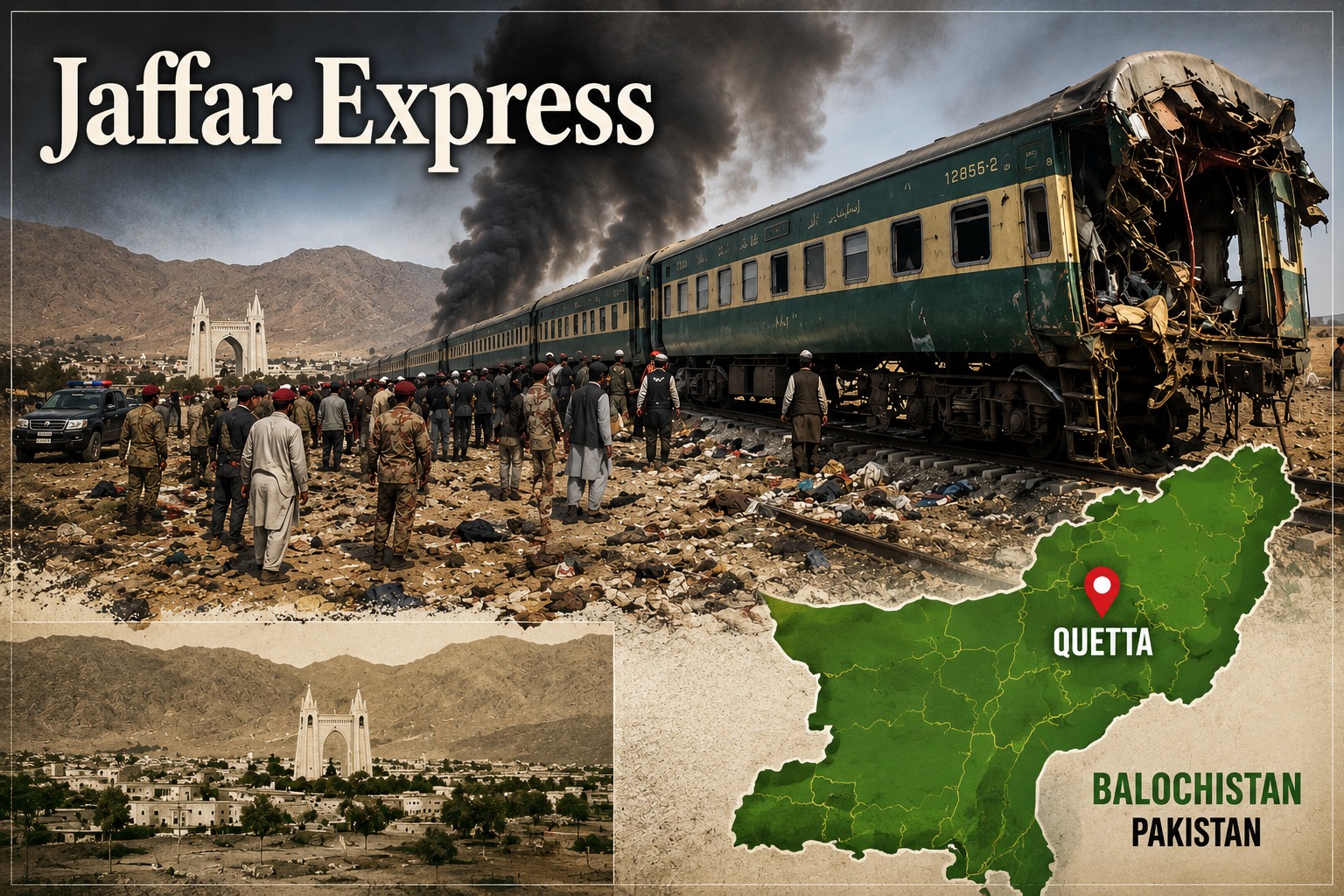
Train hijackings have been rare even when considered over the past century. No wonder the dramatic hijacking of the Jaffar Express by the Balochistan Liberation Army (BLA) last year on 11 March 25, had brought the simmering, indeed almost volcanic, unresolved Balochistan issue to international limelight.
And then again in January 26, there were violent attacks across cities in Pakistan, targeting military and government installations, followed by reprisal attacks by Pakistani security forces, causing extensive casualties on both sides. Recently, this was followed by the suicide bombing of the Quetta railway station by a car borne bomber (possibly of the Majeed Brigade of the BLA) on 25 May 2026, targeting military personnel while returning home on leave for Eid, killing more than 20.
Irrespective of the US designating BLA as a terrorist organization, all of these violent incidents, which are growing frequent each year, highlights the violent outpourings and historical grievances of the people of Balochistan. And the graph, as it appears, is set to climb Northwards, unless there is a fair and equitable deal with all stakeholders. This, however, seems unlikely considering the dark and labyrinthine machinations of the deep state of Pakistan in collusion with its all-weather ally – China and tacitly abetted by the US. All the three have deep economic interests in the region and will keep the “violence threshold” to acceptable limits.
Now, for some historical perspective. Balochistan happens to be the largest of the four provinces of Pakistan covering about 3.5 Lac sq km and is sparsely populated (population of 15 mln to Pakistan’s 240 mln). The province gained Independence on 15 August 1947 (alongside India & Pakistan) too. History is testimony to the fact of the diabolical games played by Jinnah prior to its Independence, which has eventually led to the tinder-box situation prevailing today.
Interestingly, much like the Kashmir situation, Khan of Kalat (Kalat is one of the four provinces of Balochistan and Khan was the then ruler of Kalat) was granted Independence on 15 August 1947. Considering the then prevailing situation, Khan had sought India’s assistance to stave off the impending Pakistani takeover and was prepared to accede to India (Kashmir redux?). However, India did not extend any support and thus the Pakistani Army forced Khan of Kalat to merge with Pakistan after remaining independent for 227 days (it acceded on 27 Mar 1948). And this sowed the seeds of the Baloch uprising, as we have witnessed ever since, now festering for decades.
Here are some of the critical issues which keeps the Balochistan uprising on the boil:
Its Strategic Geography: Balochistan derives its name from the majority inhabitants, ie Balochis, who constitute 52% of the population. It has tremendous strategic value, in that, it is located in between Pakistan, Afghanistan and Iran, with a coastline of 750 km on the Arabian sea. The Gwadar port now being developed by China (as part of BRI or CPEC) is a 3 -phase project, extending till 2045, with a substantial investment estimated to be $ 65 bln. Later the Saudis are also expected to invest another $10 bln. Furthermore, the Chabahar port (being developed by India with Iran and now stalled) is on the same coastline. So, its strategic significance is enormous.
The Mineral Wealth: Official statements indicate that Pakistan has mineral reserves of $ 6 tln, of which $1 tln is in Balochistan. This province has enormous deposits of Gold, Copper, Coal, Marble, Titanium, Chromite and Emeralds. Of the 3 major mines, 2 of these are being operated by the Chinese. It is said, that only 5% of the mining revenue is available to the local government and the rest siphoned off by the Pakistani Govt and Chinese conglomerates. This has obviously led to exploitation of the local populace over decades, with almost no pathway to their economic and social growth — leading to seething anger and thus manifesting into ostensible violent uprisings.
Rare Earth Minerals: It is assessed that there are 12 of the 17 rare earth minerals, critical in the modern technological products in the famous Reko Diq mine. Indeed, the US has announced a $1.25 bln investment for extraction of these minerals, to bypass China’s ban —all ostensibly to boost economic growth in Balochistan.
Alienation of the Locals: History is replete with instances, where forced extraction of the minerals against the wishes of the local communities, have spawned militant groups and eventually spelled doom for the country. Nations with a democratic facade, like Pakistan (with deep state actors playing usurious political games) have consistently upended the genuine development of the local communities, Balochis in this case. This has antagonised the population and is fuelling disquiet and terror activities. Consider this – the literacy rate of Balochistan is 43% compared to Pakistan’s 58%, GDP per capita of Balochistan is half of that of a Pakistani, the HDI of Balochistan is a mere 0.46 compared to that of Pakistan’s 0.54.
So, all in all, these massive disparities in socio-economic indicators have fuelled insurgency-like situation in Balochistan over generations. This is despite the huge wealth being extracted by the Pak -China -US conglomerates from mining valuable resources.
The BLA rightly claims, that although it has the largest land area which is highly resource rich, but remains the poorest province in entire Pakistan. The HDI of their people are extremely low, with even basic amenities, eg sanitation, health and school facilities being almost non-existent. Their stated goal, therefore is to carve out a separate nation. Although, there are some moderate voices in other organizations, but the attraction of BLA to its unwavering cause has attracted large number of educated Balochis within and abroad. Thus, there have many attempts to internationalize the issue politically and ofcourse through violent means in the region. Apart from BLA, there are BRF (also a major Afghan based militant group) and BRAS (a coalition group), which is spearheading these uprisings.
Considering the enormous economic and geo-political stakes of powerful conglomerates and countries in this long and bloody saga, the hope of the common Balochis for a better future for themselves and their children seems distant for now. We are unfortunately, expected to witness more violence in the coming days—rather than a pragmatic diplomatic resolution to the underlying issues.
Editor’s Note:This article represents the views of its author.BOOT BROADCAST has not independently verified the factual accuracy of the allegations or political claims contained therein.
(Author is a retd. Indian Army Colonel of 27 yrs with multiple -role experiences, achieving professional excellence. Subsequently switched to academic management as Director of 23 Army Public Schools and 2 colleges in Eastern Command)
(Pic courtesy: Suman Munshi)
