



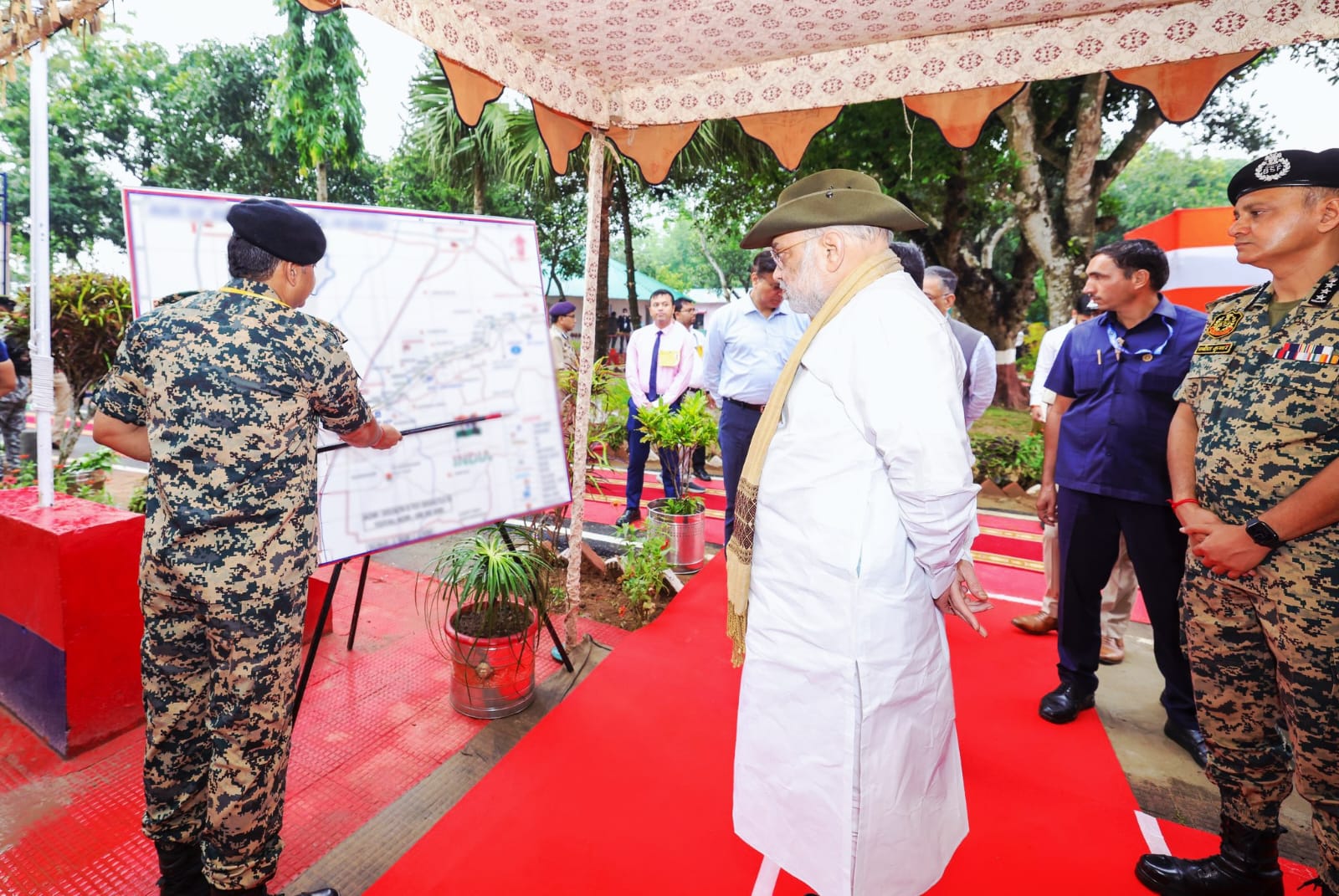
Union Home Minister and Minister of Cooperation Amit Shah chaired a high-level security review meeting in Tripura focused on strengthening border management and enhancing inter-agency coordination along the international frontier. The meeting was attended by senior state officials including the Chief Minister of Tripura, Chief Secretary, Director General of Police, District Magistrates, and Superintendents of Police from all eight border districts.
The deliberations centred on evolving a comprehensive and technology-driven border security framework, with emphasis on real-time coordination between civil administration, state police, and central security forces.
Integrated Border Security Doctrine:
Addressing the gathering, the Home Minister underlined that border security must be viewed as a shared territorial responsibility rather than a segmented operational mandate. He called for the development of a “foolproof security grid” integrating district administrations, local governance structures, frontline enforcement agencies, and the Border Security Force (BSF).
The proposed model seeks to merge conventional enforcement mechanisms with modern surveillance systems, enabling layered monitoring and rapid response capabilities across sensitive border stretches.
Technology-Driven Surveillance Upgrade:
A key directive from the Home Minister focused on the rapid implementation of the Ministry of Home Affairs’ CCTV-based surveillance architecture in Tripura. He also emphasized upgrading and integrating all BSF surveillance infrastructure with district-level control rooms to ensure seamless data sharing and operational coordination.The initiative is aimed at building a unified command ecosystem capable of real-time intelligence fusion and incident response.
Counter-Narcotics and Arms Trafficking Operations:
Highlighting the growing challenge of trans-border narcotics and arms trafficking, the Home Minister called for sustained and aggressive enforcement operations targeting the entire supply chain. He stressed the need for coordinated action involving police, BSF, and intelligence units to dismantle trafficking networks comprehensively.
He also directed the organization of community-level awareness and training camps in border areas to equip local populations with tools to counter drug-related threats, ensuring participation from local administration, police personnel, and BSF units.
Financial and Economic Vigilance in Border Districts:
Expanding the security paradigm beyond physical borders, the Home Minister emphasized strict financial monitoring in border districts. He instructed officials to strengthen oversight of high-value transactions, real estate activities, and suspicious financial flows.
He further directed capacity-building programs for district collectors and GST officials, along with a survey by the Central Board of Direct Taxes (CBDT) to identify instances of counterfeit currency circulation and related financial irregularities. A review of land records over the past five years was also mandated to detect anomalies.
Towards a Unified Border Management Framework:
Reaffirming the government’s strategic priorities under the leadership of Narendra Modi, the Home Minister stated that India’s border security doctrine is being recalibrated towards a holistic and technology-enabled model. This approach integrates physical security infrastructure, digital surveillance systems, and local administrative participation into a single cohesive framework.
The meeting concluded with a reaffirmation of the Centre’s commitment to ensuring robust, multi-layered border security while simultaneously strengthening governance and development in frontier regions.
