



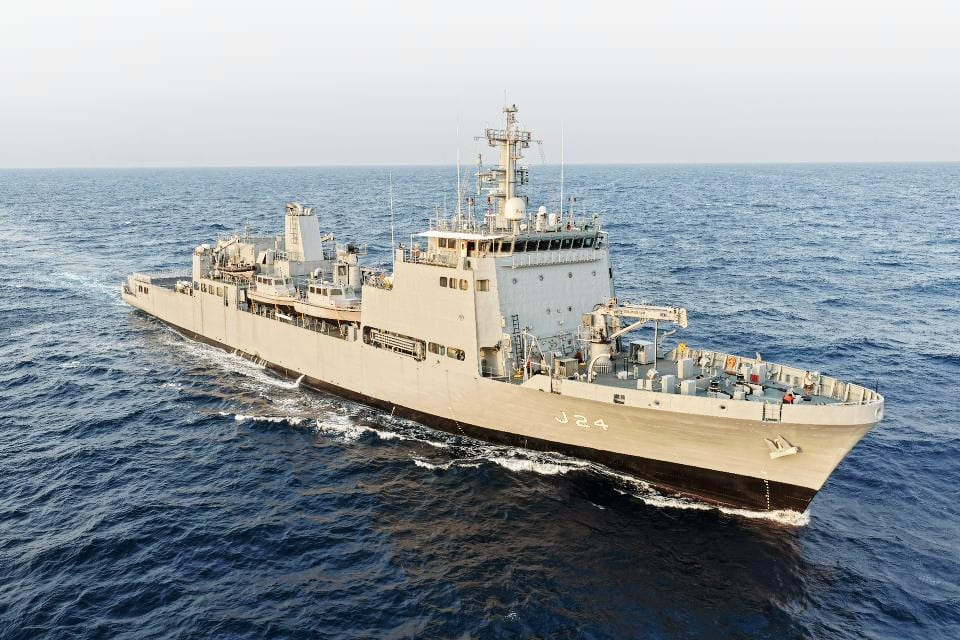
In a significant boost to India’s maritime capabilities and indigenous defence manufacturing ecosystem, the Indian Navy is set to commission three indigenously built naval platforms in Kolkata. The vessels—INS Dunagiri, INS Sanshodhak, and INS Agray—underscore India’s growing self-reliance in warship construction and naval technology under the Government’s Aatmanirbhar Bharat initiative.
Designed by the Indian Navy’s Warship Design Bureau and constructed by Garden Reach Shipbuilders & Engineers (GRSE), Kolkata, the three platforms represent a diverse spectrum of operational capabilities spanning frontline combat operations, hydrographic surveying, and anti-submarine warfare. Their induction is expected to strengthen the Navy’s blue-water reach, enhance maritime domain awareness, and improve coastal defence against emerging underwater threats.
INS Dunagiri, the fifth stealth frigate under the Project 17A programme, is equipped with advanced weapons and sensor suites, including the BrahMos supersonic cruise missile system and the Medium-Range Surface-to-Air Missile (MRSAM) system. The warship significantly enhances the Indian Navy’s multi-dimensional combat capabilities and fleet air-defence potential.
INS Sanshodhak, the fourth Survey Vessel (Large), has been designed to undertake coastal and deep-sea hydrographic surveys while collecting oceanographic and geophysical data for both military and civilian applications. The vessel is fitted with state-of-the-art survey equipment, including Autonomous Underwater Vehicles (AUVs) and Remotely Operated Vehicles (ROVs), enabling advanced seabed mapping and underwater exploration missions.
INS Agray, the fourth vessel of the Arnala-class Anti-Submarine Warfare Shallow Water Craft (ASW-SWC), is specifically designed for operations in littoral waters. Equipped with lightweight torpedoes, indigenous anti-submarine rocket launchers, and advanced shallow-water sonar systems, the vessel is capable of detecting, tracking, and neutralising underwater threats in coastal regions.
The three platforms collectively showcase the increasing sophistication and maturity of India’s indigenous shipbuilding sector, with indigenous content exceeding 75 per cent. Their construction involved extensive participation from the domestic defence industry, including more than 200 Micro, Small and Medium Enterprises (MSMEs), generating significant direct and indirect employment opportunities.
The commissioning of these vessels reflects the collaborative efforts of the Government of India, the Indian Navy, public-sector shipyards, private industry, and MSMEs in strengthening the nation’s maritime security architecture while advancing the objectives of self-reliance in defence production. The induction of these platforms marks another milestone in India’s journey towards becoming a major maritime power with a robust indigenous defence industrial base.
