



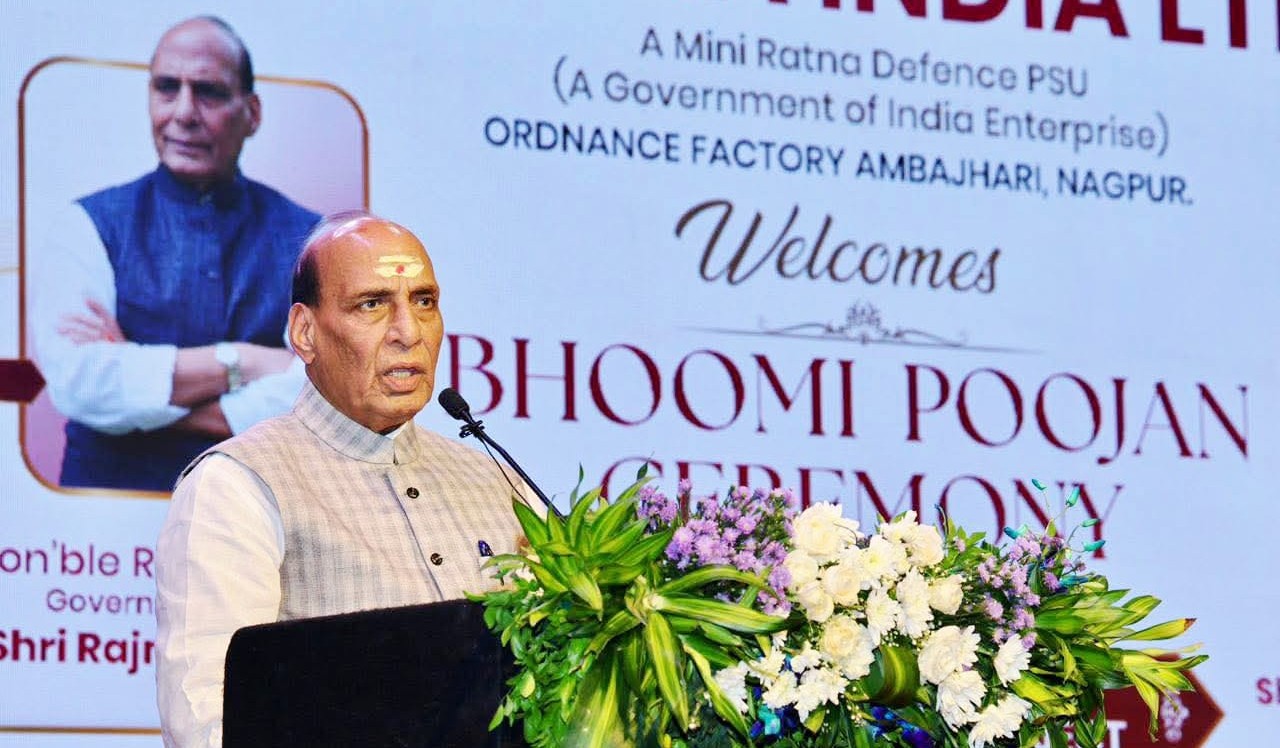
Defence Minister Rajnath Singh today underscored the importance of securing indigenous control over critical defence and security-related capabilities, stating that self-reliance in strategic sectors is essential for India to remain future-ready amid an evolving geopolitical environment.
The Defence Minister made the remarks while performing the Bhoomi Pujan for a state-of-the-art 10,000-ton Aluminium Extrusion Press at Ordnance Factory Ambajhari, Nagpur, a unit of Yantra India Limited (YIL). Maharashtra Chief Minister Devendra Fadnavis was also present on the occasion.
Describing the project as a significant milestone in India’s journey towards defence self-reliance, Singh said the new facility symbolises a transition from dependence on imports to domestic production of critical industrial capabilities. The proposed extrusion press will be among the most advanced facilities of its kind in the country and will manufacture large and complex aluminium alloy profiles for defence platforms, aerospace structures, missile systems, railways, transportation and other strategic sectors.
The project is expected to reduce dependence on imported aluminium extrusions, strengthen domestic supply chains and support future requirements of key strategic industries through indigenous production.
“The facility addresses a crucial capability gap. Modern fighter aircraft, missile systems and advanced space programmes require lightweight, high-strength metals capable of performing under extreme conditions. The quality of these materials directly impacts operational effectiveness,” the Defence Minister said.
Referring to the role of indigenous defence equipment during Operation Sindoor, Singh stressed the need to further expand domestic manufacturing of critical defence hardware. He noted that while major platforms attract attention, their effectiveness ultimately depends on thousands of specialised components, making facilities such as the aluminium extrusion press strategically important.
The Defence Minister observed that although the nature of warfare continues to evolve, conventional military capabilities and the industrial base supporting them remain vital. He stated that a strong military-industrial ecosystem would continue to be a national requirement well into the future, and the new facility has been conceived with long-term strategic needs in mind.
Highlighting the government’s push towards the vision of Aatmanirbhar Bharat, Singh said efforts are focused on four pillars—technology, skilled manpower, knowledge and national confidence. He noted that India’s defence production has increased from Rs 46,000 crore in 2014 to a record Rs 1.78 lakh crore in FY 2025-26, while defence exports have grown from less than Rs 1,000 crore in 2014 to an all-time high of Rs 38,424 crore.
“This growth reflects not only higher production figures but also enhanced national capability and confidence. India is on course to achieve its targets of Rs 3 lakh crore in defence production and Rs 50,000 crore in defence exports ahead of schedule,” he said.
The Defence Minister also highlighted the performance of Yantra India Limited following the corporatisation of the erstwhile Ordnance Factory Board (OFB). He stated that the reform was aimed at creating more agile and innovative defence manufacturing entities capable of responding to emerging technologies and market demands.
According to Singh, OFB production has increased from Rs 12,755 crore in FY 2019-20, before corporatisation, to Rs 26,282 crore in FY 2025-26. Defence exports from the former OFB ecosystem have risen from Rs 81 crore to Rs 4,561 crore during the same period, with YIL contributing Rs 397 crore.
Emphasising the importance of research and development (R&D) and capital investment, the Defence Minister said these remain the primary drivers of industrial competitiveness. He urged defence public sector undertakings (DPSUs) to prioritise innovation, modernisation and the adoption of advanced manufacturing technologies to enhance efficiency, quality and global competitiveness.
“Investment in modern machinery and advanced production systems is no longer optional but a necessity for future competitiveness,” Singh said, encouraging DPSUs to adopt global best practices wherever required.
Speaking at the event, Maharashtra Chief Minister Devendra Fadnavis described the Aluminium Extrusion Press project as a significant step towards the vision of Aatmanirbhar Bharat and Viksit Bharat under the leadership of Prime Minister Narendra Modi and the guidance of the Defence Minister.
Fadnavis noted that India’s defence sector is increasingly gaining global recognition, with the country emerging as a significant exporter of defence equipment. He cited Operation Sindoor as an example of the technological capabilities of New India and highlighted the growing collaboration between DPSUs and the private sector.
He expressed confidence that the new facility would strengthen Nagpur’s position as a key hub in India’s defence manufacturing ecosystem and contribute substantially to the country’s self-reliance objectives.
Senior officials from the Department of Defence Production , the armed forces and industry representatives attended the ceremony.
