



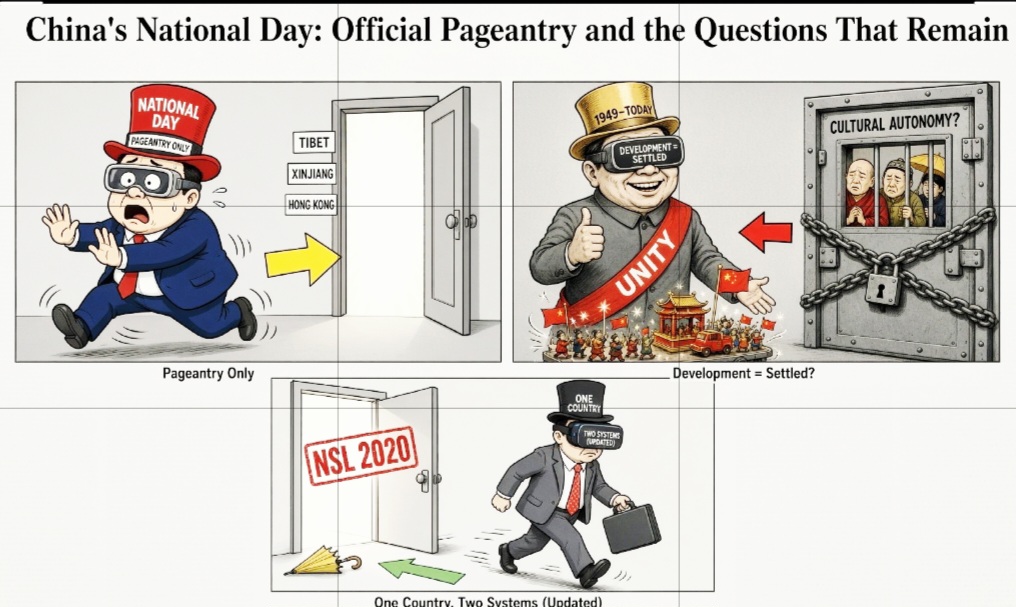
Each year on October 1, China marks the day in 1949 when Mao Zedong proclaimed the People’s Republic. Beijing fills with flags and floral displays, state media broadcast messages about progress and unity, and in landmark years, military parades showcase the country’s strength. For the government, the day is a statement of sovereignty and national renewal.
Away from the ceremonies, however, the anniversary also draws attention to long-running disputes over identity, cultural autonomy, and political rights, particularly in Tibet, Xinjiang, and Hong Kong. Beijing describes its policies in these regions as necessary for stability, development, and national security. Its critics, including rights organizations and diaspora communities, say those same policies have narrowed the space for religious, cultural, and political expression.
Nowhere is the contrast between celebration and memory sharper than in Tibet. For many Tibetans, October 1 recalls the political changes that followed the People’s Liberation Army’s entry into the region in the 1950s and its subsequent incorporation into the PRC. Advocacy groups say that around national holidays, authorities in Lhasa and elsewhere tighten security, restrict movement, and limit public expression, and they argue that efforts to promote a single national identity put pressure on Tibetan language education and religious practice. The Tibetan government-in-exile in India has responded with campaigns to protect Tibetan heritage, including awareness weeks devoted to language and identity.
A similar divide shapes the debate over Xinjiang. Beijing presents the region as a story of poverty reduction, infrastructure growth, and counter-terrorism measures that it says restored security after episodes of violence. Human rights organizations, Uyghur advocacy groups, and several foreign governments describe a different reality, citing reports of mass detention, restrictions on religious observance, surveillance, and pressure on Uyghur language and culture. The dispute has become one of the most closely watched issues in international discussion of China’s governance, and it raises a broader question: can economic development substitute for cultural and religious freedom?
Hong Kong adds yet another dimension. In 2014, tens of thousands of residents occupied major roads for 79 days in what became known as the Umbrella Movement, named for the umbrellas protesters used against police pepper spray. The protests were triggered by a decision from Beijing that set a framework for the 2017 Chief Executive election, under which candidates would be screened by a nominating committee. The movement did not win its central demand of open nominations, yet it endured as a symbol of the city’s aspirations for democratic participation. In the years since, and especially after the 2020 national security law, many activists have been arrested, jailed, or have left Hong Kong. Supporters of the law say it restored order after the unrest of 2019 and safeguards national security, while critics say it undermines the “one country, two systems” framework promised at the 1997 handover.
Taken together, these threads show why National Day means different things to different people. Officially, it commemorates China’s sovereignty, economic transformation, and rising global influence, achievements the government presents with evident pride. But the anniversary also prompts questions that neither side considers settled: how a large, centralized state can balance national unity with cultural and ethnic diversity, whether stability and greater political freedom can coexist, and what safeguards can protect minority identities within a strong central government.
For many Tibetans, Uyghurs, and Hong Kong activists, October 1 is a day to press their concerns and call for recognition. As Beijing showcases its accomplishments, those voices are a reminder that a nation’s story is told not only through its milestones, but through the lived experience of all its people.
