



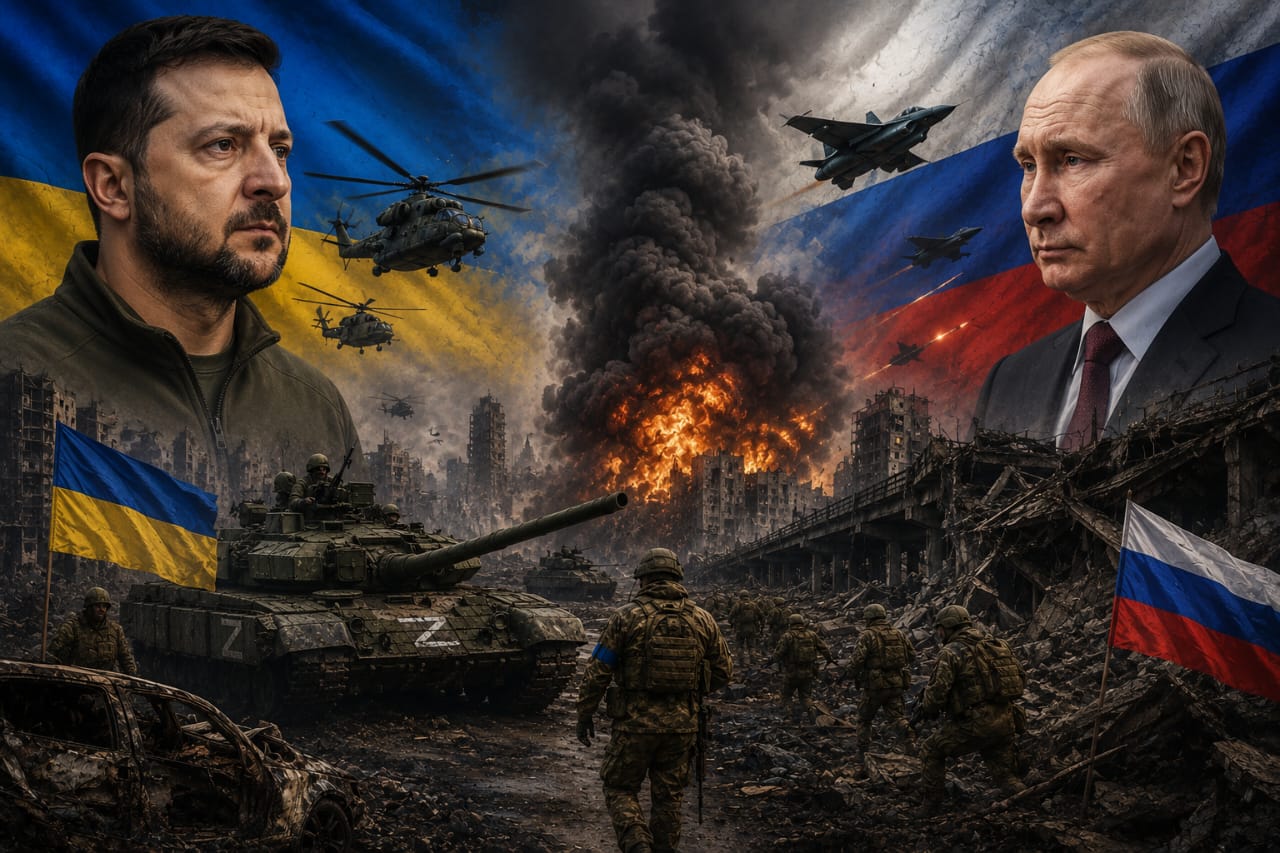
Some wars end swiftly; others persist, reshaping global consciousness. The Russia–Ukraine conflict, which began in February 2022, belongs firmly to the latter. Initial expectations of a rapid Russian victory have long faded. Instead of decisive conquest or a frozen peace, the war has settled into a prolonged stalemate—revealing the complex geometry of modern conflict.
This persistence reflects more than battlefield dynamics. Military capability, surveillance technology, economic endurance, and external alliances interact to sustain the conflict. Tactical gains rarely translate into strategic breakthroughs. The result is a war that continues not because one side can win decisively, but because neither can afford to lose.
The Human Cost:
The toll has been immense. Civilian casualties exceed 60,000, with actual figures likely higher. Combined military losses may approach two million. Displacement has been widespread: nearly seven million Ukrainians have fled abroad, while millions remain internally displaced. Cities like Mariupol and Bakhmut have been devastated. Beyond physical damage, the war has fractured communities, eroding identity, memory, and social cohesion.
A Transparent Battlefield:
The war has transformed the nature of combat. Drones, now central to operations, have made the battlefield highly visible and lethal. Artillery remains dominant but is increasingly guided by real-time intelligence. Movement invites exposure, reducing the effectiveness of manoeuvre.
Both sides have adapted rapidly. Russia integrates drones with electronic warfare; Ukraine uses them to disrupt logistics and target artillery. Yet despite this technological evolution, the strategic map has changed little. Russia retains roughly 20 percent of Ukrainian territory, but advances are slow and costly. Ukraine’s counteroffensives have been determined but inconclusive. Technology has altered the conduct of war, not its outcome.
Economics as Strategy:
The conflict extends deeply into the economic domain. Sanctions, energy flows, and supply chains have become strategic tools. Western sanctions have constrained Russia but not stopped the war. Moscow has adjusted by shifting to wartime production and expanding ties with non-Western partners.
Ukraine faces massive reconstruction costs, estimated at $588 billion over the next decade. The Black Sea Grain Initiative briefly alleviated global food concerns but ultimately collapsed. Economic pressure, while significant, has not forced resolution; instead, it has reinforced endurance on both sides.
China’s Ambiguous Role:
China occupies a pivotal yet ambiguous position. It has strengthened economic ties with Russia, providing markets for energy and industrial goods, while maintaining a formal stance of neutrality. Beijing advocates peace but avoids criticising Moscow. This dual posture limits its credibility as a mediator while ensuring its influence remains substantial. China’s role is thus structural—sustaining Russia economically while shaping potential diplomatic outcomes.
India’s Strategic Balance:
India’s response reflects strategic autonomy. It has avoided direct condemnation of Russia, abstained in key UN votes, and maintained defence ties, while also engaging Ukraine and providing humanitarian aid. By balancing interests, India preserves flexibility and positions itself as a credible, pragmatic actor advocating dialogue and peaceful resolution.
Limits of Mediation:
Efforts by Turkey, the UN, India, and others have achieved limited success. The grain deal and prisoner exchanges stand out, but broader negotiations remain stalled. The core issue lies in incompatible objectives: Russia seeks control and strategic depth; Ukraine insists on full sovereignty. These positions are deeply rooted and non-negotiable.
As long as neither side faces decisive defeat, incentives for compromise remain weak. External mediators lack the leverage to impose solutions, and great power rivalries further complicate diplomacy. Negotiations remain episodic and fragile.
Historical Roots:
The conflict also reflects unresolved post-Cold War tensions. The expansion of Western institutions into Eastern Europe contrasted sharply with Russia’s sense of strategic decline. Moscow views NATO enlargement as encroachment, while the absence of binding assurances reinforces perceptions of betrayal. The war thus represents an extension of unresolved geopolitical contestation rather than an isolated crisis.
Conclusion: A New Geometry of War:
The Russia–Ukraine conflict illustrates the evolving nature of warfare. Military strength alone no longer determines outcomes; economic resilience, technological adaptation, and alliance structures are equally decisive. Wars now persist within interconnected systems rather than ending through decisive victories.
Even if hostilities cease, the underlying tensions—territorial disputes, security dilemmas, and great power competition—will endure. This is not merely a regional conflict but a prolonged contest over the future international order. Its legacy will shape global strategy, alliances, and conflict dynamics for years to come.
Editor’s Note:This article represents the views of its author.
(Col Guru Saday Batabyal has over five decades of experience across the Indian Army, UN missions, corporate leadership, and academia. A former officer of the 4 Gorkha Rifles, he led India’s first UN peacekeeping contingent in Lebanon (1998–99) and represented India in a UN–USA conflict resolution initiative , 2003)
Pic courtesy: Suman Munshi
