



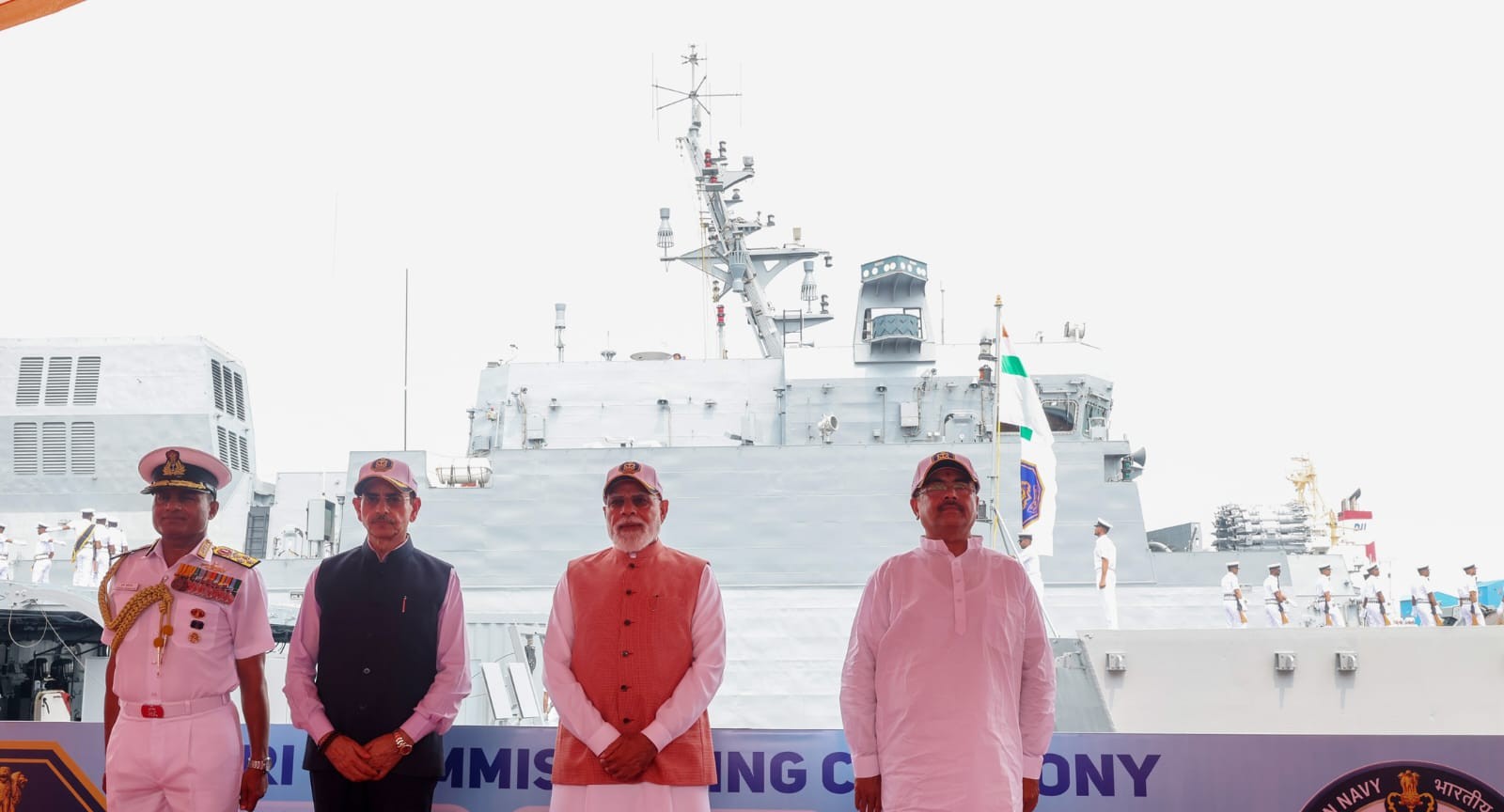
Prime Minister Shri Narendra Modi commissioned three frontline naval platforms—INS Dunagiri, an advanced stealth frigate; INS Sanshodhak, a Survey Vessel (Large); and INS Agray, an Anti-Submarine Warfare Shallow Water Craft—into the Indian Navy at a ceremonial event in Kolkata today.
The induction of the three indigenously designed and constructed warships marks a significant milestone in India’s maritime modernisation drive and strengthens the Navy’s capabilities in surface warfare, hydrographic operations, anti-submarine warfare, and maritime domain awareness.
Addressing the gathering, the Prime Minister described the commissioning as “an important milestone in the journey towards an Aatmanirbhar Bharat, a secure India and a developed India.”
Highlighting the strategic importance of maritime power, Shri Narendra Modi stated, “No nation can emerge as a major power without strong maritime capabilities. Development, security and prosperity are closely linked to the oceans.”
He noted that the commissioning of INS Sanshodhak coincided with World Hydrography Day and underscored the growing role of oceans in global trade, data connectivity, energy security and access to critical resources.
Emphasising self-reliance in defence manufacturing, the Prime Minister said, “All three vessels symbolise India’s commitment to indigenous design, manufacturing and innovation. Designed and built in India, the vessels showcase the talent of Indian industries, the expertise of Indian engineers and the hard work of Indian workers.”
He further asserted that India seeks to become a producer and manufacturer of advanced defence systems rather than remain dependent on imports. Referring to the Navy’s modernisation efforts, he noted that over 40 indigenously built warships and submarines have been inducted in recent years, while 45 major naval platforms are currently under construction.
Highlighting the economic impact of the maritime sector, Shri Modi said more than 200 MSMEs contributed to the construction of the three vessels, generating employment and strengthening India’s industrial ecosystem. He also referred to the Government’s ₹70,000 crore incentive package for the shipping sector and initiatives such as Sagarmala aimed at enhancing maritime infrastructure and logistics.
Reflecting on India’s defence manufacturing progress, the Prime Minister said defence production has increased from around ₹40,000 crore in 2014 to nearly ₹1.8 lakh crore today, driven by policy reforms and a focus on self-reliance.
Concluding his address, Shri Modi said, “Security is indispensable for protecting prosperity, while self-reliance is necessary for building the future. INS Agray, INS Dunagiri and INS Sanshodhak embody these very ideals and symbolize a nation that is increasingly aware of its capabilities, confident in its strengths and determined to move forward with renewed energy and purpose in the twenty-first century.”
In a post on X, Defence Minister Shri Rajnath Singh described the tri-commissioning as a defining moment in India’s maritime capability development. “These state-of-the-art platforms are a testament to our robust defence manufacturing ecosystem and our unwavering resolve towards Aatmanirbhar Bharat. They now stand ready to safeguard our national interests and ensure a secure Indian Ocean,” he said.
Chief of the Naval Staff Admiral Krishna Swaminathan said the tri-commissioning, coming just 17 months after Independent India’s first such event in Mumbai, demonstrated the growing momentum of India’s warship-building capability. He stated that the vessels would significantly enhance the Navy’s operational effectiveness in safeguarding national maritime interests.
Designed by the Indian Navy’s Warship Design Bureau and Garden Reach Shipbuilders & Engineers (GRSE), and built by GRSE with participation from more than 200 MSMEs, the three platforms have an indigenous content exceeding 75 per cent, underscoring India’s commitment to Aatmanirbharta in defence production.
