



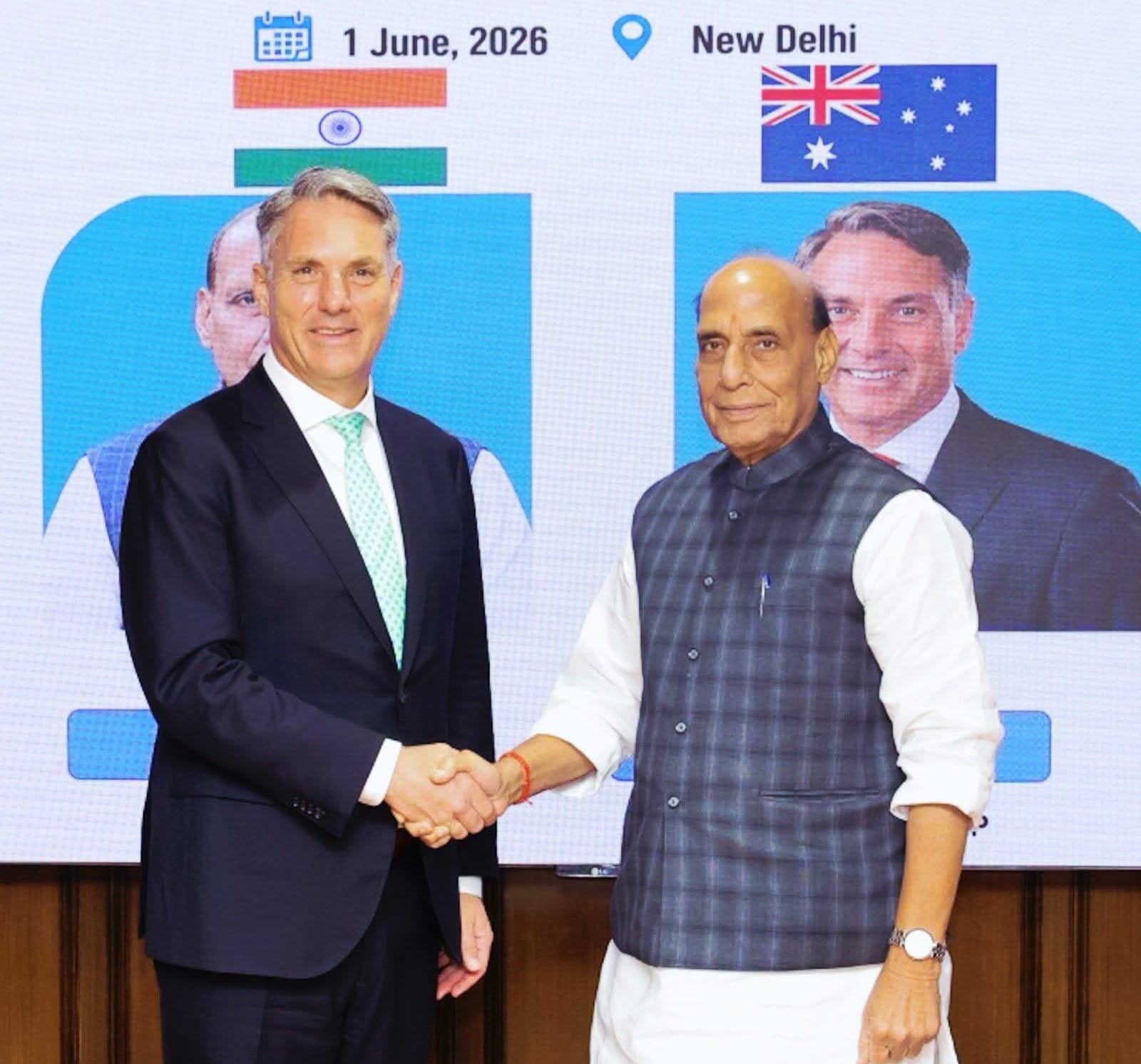
India and Australia have reaffirmed their commitment to strengthening defence and security cooperation across the Indo-Pacific, with a strong emphasis on maritime security, defence industrial collaboration, and emerging technology research. The developments emerged during the second India–Australia Defence Ministers’ Dialogue co-chaired by Defence Minister Rajnath Singh and Australian Deputy Prime Minister and Defence Minister Richard Marles at the Manekshaw Centre in New Delhi.
The high-level dialogue reviewed the significant progress achieved since the inaugural ministerial meeting in October 2025 and advanced the long-term strategic vision outlined by the two Prime Ministers. Both sides welcomed efforts to renew and strengthen the Joint Declaration on Defence and Security Cooperation, reflecting the growing maturity of the bilateral strategic partnership.
Maritime Security Takes Centre Stage:
A key focus of the discussions was maritime security cooperation. The ministers reviewed progress toward finalising the Joint Maritime Security Collaboration Roadmap and agreed to expand collaborative maritime domain awareness activities, including maritime patrol aircraft operations and cooperation in undersea domain awareness.
India and Australia also pledged to strengthen cooperation between the Indian Coast Guard and Australia’s Maritime Border Command. Reaffirming their shared vision for a free, open, peaceful, and prosperous Indo-Pacific, the ministers underscored the importance of freedom of navigation, overflight rights, and adherence to international law, particularly the United Nations Convention on the Law of the Sea (UNCLOS).
As co-leads of the Indian Ocean Rim Association (IORA) Working Group on Maritime Safety and Security, the two nations will jointly host a Search and Rescue Exercise and tabletop exercise at the Maritime Rescue Coordination Centre in Chennai in June 2026. The initiative aims to enhance regional maritime safety and operational coordination.
Expanding Operational Interoperability:
Building on the 2020 Mutual Logistics Support Arrangement, both countries agreed to explore mechanisms to improve procedural interoperability during joint exercises and operations. Continued deployment of aircraft from each other’s territories was identified as an important measure to deepen operational familiarity and readiness.
The ministers also welcomed increased information-sharing between operational headquarters and announced plans for the inaugural Joint Staff Talks later this year. Efforts to establish secure bilateral communications at strategic, operational, and tactical levels will be advanced through dedicated subject-matter exchanges.
Defence Industry Collaboration Moves Forward:
In a major step toward strengthening defence industrial ties, India and Australia announced plans to begin negotiations on a Memorandum of Understanding covering the Provision of Defence Articles and Defence Services.
The ministers highlighted the strategic value of defence industry cooperation and welcomed Australia’s first Defence Trade Mission to India and the Australia–India Defence Industry Roundtable held in October 2025. Future collaboration will be pursued through the Joint Working Group on Defence Industry, Research, and Materiel.
Both sides also expressed interest in expanding defence science and technology cooperation, particularly in emerging fields such as advanced sensor technologies. Australia invited India to participate in the 2026 Australian Defence Science, Technology, and Research Summit.
Growing Military-to-Military Engagement:
The dialogue highlighted the expanding scope of military engagement between the two armed forces. Australia welcomed India’s enhanced participation in Exercise Talisman Sabre 2027, while both sides acknowledged successful participation in recent multinational exercises, including Exercise Milan 2026, Exercise Kakadu 2026, and preparations for operationalising the bilateral Air-to-Air Refuelling Implementing Arrangement during Exercise Pitch Black.
Army Exercise Austrahind has evolved to include amphibious combat and littoral manoeuvre operations, reflecting growing operational sophistication. Australia also welcomed India’s first participation in Operation Render Safe 2026, while India accepted Australia’s invitation to participate in the submarine rescue exercise Black Carillon.
Quad Cooperation and Maritime Domain Awareness:
The ministers welcomed growing strategic convergence among Australia, India, Japan, and the United States through the Quad framework. Both countries reaffirmed support for the Quad Indo-Pacific Maritime Surveillance Collaboration initiative, initially focused on the Indian Ocean Region.
Australia welcomed India’s operationalisation of the Indian Ocean Region programme under the Quad Indo-Pacific Partnership for Maritime Domain Awareness through the Information Fusion Centre–Indian Ocean Region (IFC-IOR) in Gurugram. Both sides agreed to work towards developing a Common Operational Picture across the Indo-Pacific by leveraging existing maritime domain awareness mechanisms.
Strategic Outlook:
The second India–Australia Defence Ministers’ Dialogue underscored the rapid evolution of bilateral defence ties from traditional military engagement to a comprehensive strategic partnership encompassing maritime security, defence industry cooperation, advanced technology research, interoperability, and regional security coordination. As both nations navigate an increasingly complex Indo-Pacific security environment, the dialogue demonstrated a shared commitment to enhancing collective capabilities and contributing to regional stability.
