



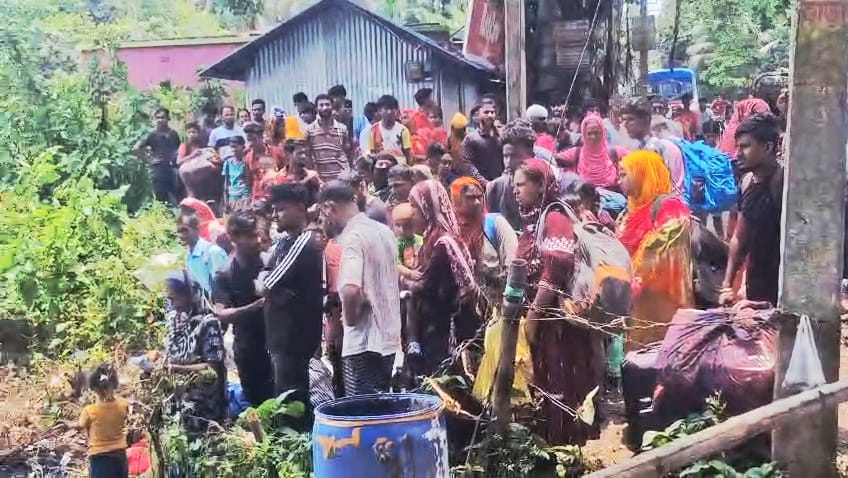
Hundreds of individuals suspected of lacking valid Indian citizenship documents have reportedly gathered at the Hakimpur international border checkpost in North 24 Parganas district in recent days, seeking to cross into Bangladesh amid intensified citizenship verification measures launched by the West Bengal government.
The “Detect, Delete, Deport” Policy:
Earlier West Bengal Chief Minister Suvendu Adhikari has announced the launch of deportation proceedings against illegal Bangladeshi infiltrators under the Citizenship (Amendment) Act (CAA). The government has adopted a “Detect, Detain and Deport” policy, directing authorities to activate detention centres in border districts. Reports indicate heightened activity at the Hakimpur border check post in North 24 Parganas, where many suspected infiltrators have gathered amid fears of detention. The BSF and local police remain on high alert as deportation efforts intensify.Following the May 2026 West Bengal Assembly elections, Chief Minister Suvendu Adhikari intensified efforts to identify and remove illegal immigrants. The state government set up temporary holding centres and began a Special Intensive Revision (SIR) of voter lists, prompting local police and authorities to crack down on undocumented settlers.
The development follows the implementation of a state-wide campaign aimed at identifying undocumented residents and updating official records. Authorities have begun extensive verification exercises, including revisions of voter rolls and scrutiny of citizenship-related documents, as part of broader efforts to strengthen border management and administrative oversight.
Crowds Reported at Hakimpur Border:
According to local sources, large groups of people carrying personal belongings have been arriving at the Hakimpur border crossing in the Basirhat subdivision since early morning hours. The number of individuals gathering at the checkpost has reportedly ranged from several dozen to a few hundred on different days.
Many of those attempting to cross the border are believed to have been employed as daily wage labourers, construction workers, domestic helpers, and other informal-sector workers in various Indian cities, including Kolkata, Howrah, and Pune.
Personal Stories Emerge:
Officials and local residents report that several individuals cited uncertainty surrounding documentation checks as a reason for leaving. Some claimed they had lost employment or accommodation, while others who had earlier entered India for medical treatment reportedly chose to return voluntarily rather than face possible legal proceedings.
Verification and Repatriation Process:
Security personnel at the border checkpost are conducting identity verification procedures, including the examination of available documents and biometric records where applicable. Individuals able to establish Indian citizenship are permitted to remain in the country.Those found without valid documentation are referred to the relevant authorities for further processing. Following completion of formal procedures by Indian officials, cases involving foreign nationals are coordinated with border authorities on the Bangladeshi side in accordance with existing protocols.
Political Reactions:
The citizenship verification campaign has generated political debate within the state. Supporters of the initiative argue that maintaining accurate voter rolls and identifying undocumented migrants are essential for national security, Border management, and electoral integrity.Observers note that the developments have placed renewed focus on migration, citizenship documentation, and Border security issues in eastern India, particularly in districts located along the India-Bangladesh frontier.
Authorities have urged residents to cooperate with verification procedures and have emphasized that all cases will be handled in accordance with legal and administrative guidelines.
