



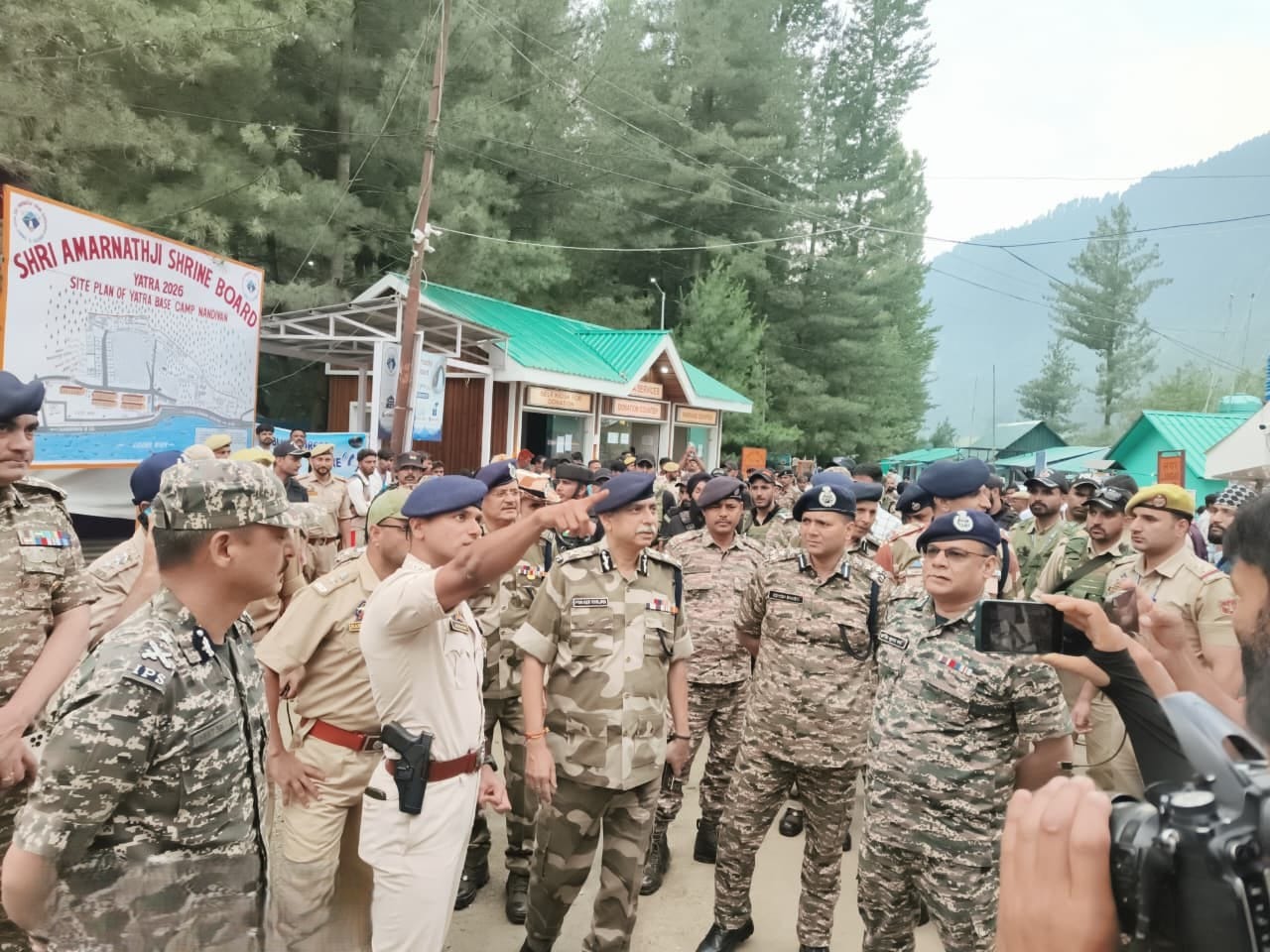
As the annual Amarnath Yatra-2026 continues with thousands of pilgrims undertaking the sacred pilgrimage through the twin routes of Pahalgam and Baltal, Director General of the Central Industrial Security Force (CISF), Shri Praveer Ranjan, carried out an extensive review of the security architecture at key operational locations to assess preparedness and strengthen coordination among security agencies.
Accompanied by Additional Director General (North) Shri Sudhir Kumar and DIG/NZ-II Shri M. K. Yadav, the DG first visited the Nunwan Base Camp in Pahalgam, where he reviewed the overall deployment strategy and the operational framework established to ensure the safe movement of pilgrims.
The inspection focused on multiple aspects of the security ecosystem, including personnel deployment, access control mechanisms, surveillance infrastructure, communication networks, medical response systems, logistics support and inter-agency coordination. The review was aimed at evaluating operational efficiency and ensuring that all arrangements remain responsive to the evolving security environment during the Yatra.
During the visit, the DG inspected several critical operational installations, including security check posts, communication centres, Quick Reaction Teams (QRTs), Quick Action Teams (QATs), the CCTV Control Room and other strategic security facilities. He also interacted with CISF personnel deployed on duty, healthcare workers and women personnel engaged in various operational roles.
Appreciating the commitment and professionalism displayed by the deployed teams, Shri Praveer Ranjan stressed the importance of maintaining the highest levels of operational readiness throughout the pilgrimage. He called for unwavering vigilance, strict adherence to Standard Operating Procedures (SOPs) and seamless coordination among all agencies involved in safeguarding the Yatra.
A high-level security review meeting was subsequently held at Nunwan, bringing together senior officers from the CISF, Central Reserve Police Force (CRPF), Indo-Tibetan Border Police (ITBP), Jammu and Kashmir Police and the civil administration. The meeting provided an opportunity to assess the overall security architecture, review contingency plans and strengthen coordination mechanisms to address any emerging challenges during the pilgrimage.
The DG commended the collaborative approach adopted by all participating agencies and expressed confidence that their coordinated efforts would continue to ensure the smooth, secure and incident-free conduct of the Yatra.
Baltal Base Camp and Holy Cave Security Reviewed:
Continuing the comprehensive assessment, the DG later visited the Baltal Base Camp and the Amarnath Holy Cave, where he conducted another detailed review of the security arrangements along the northern axis of the pilgrimage.
The inspection covered key operational areas, including perimeter security, medical emergency response teams, fire safety preparedness, logistical support systems and inter-agency coordination. Given the challenging terrain and the high volume of pilgrims using the Baltal route, the review focused on ensuring rapid response capability and uninterrupted operational readiness.
During the Baltal visit, Shri Praveer Ranjan chaired another high-level security review meeting attended by senior officers of the Central Armed Police Forces (CAPFs), the Indian Army, Jammu and Kashmir Police and other stakeholder agencies. Discussions centred on maintaining robust coordination, intelligence sharing and emergency response protocols to ensure comprehensive security coverage.
The DG also inspected the Joint Police Control Room (JPCR), the newly established CISF camp, camps of other security forces and several critical operational facilities at Baltal Base Camp. The inspection was aimed at evaluating command-and-control arrangements, communication systems and field-level preparedness across all participating agencies.
Expressing satisfaction over the preparedness demonstrated by the security forces, Shri Praveer Ranjan praised the dedication, discipline and professionalism of personnel deployed across the Yatra route. He highlighted the importance of sustained cooperation among the Army, CAPFs, Jammu and Kashmir Police and civil administration in ensuring the safety of pilgrims throughout the pilgrimage.
Multi-Layered Security Framework:
The DG’s twin inspections at Pahalgam and Baltal underscore the emphasis being placed on maintaining a robust, technology-enabled and multi-layered security framework for Amarnath Yatra-2026. The integrated deployment of surveillance systems, specialised response teams, medical infrastructure and coordinated command-and-control mechanisms reflects the collective efforts of multiple security and civil agencies to provide a secure environment for devotees.
With security forces maintaining heightened vigilance across both pilgrimage routes, authorities remain focused on ensuring that the annual Yatra proceeds safely, smoothly and without incident, reaffirming their commitment to protecting one of the country’s most significant religious pilgrimages.
