



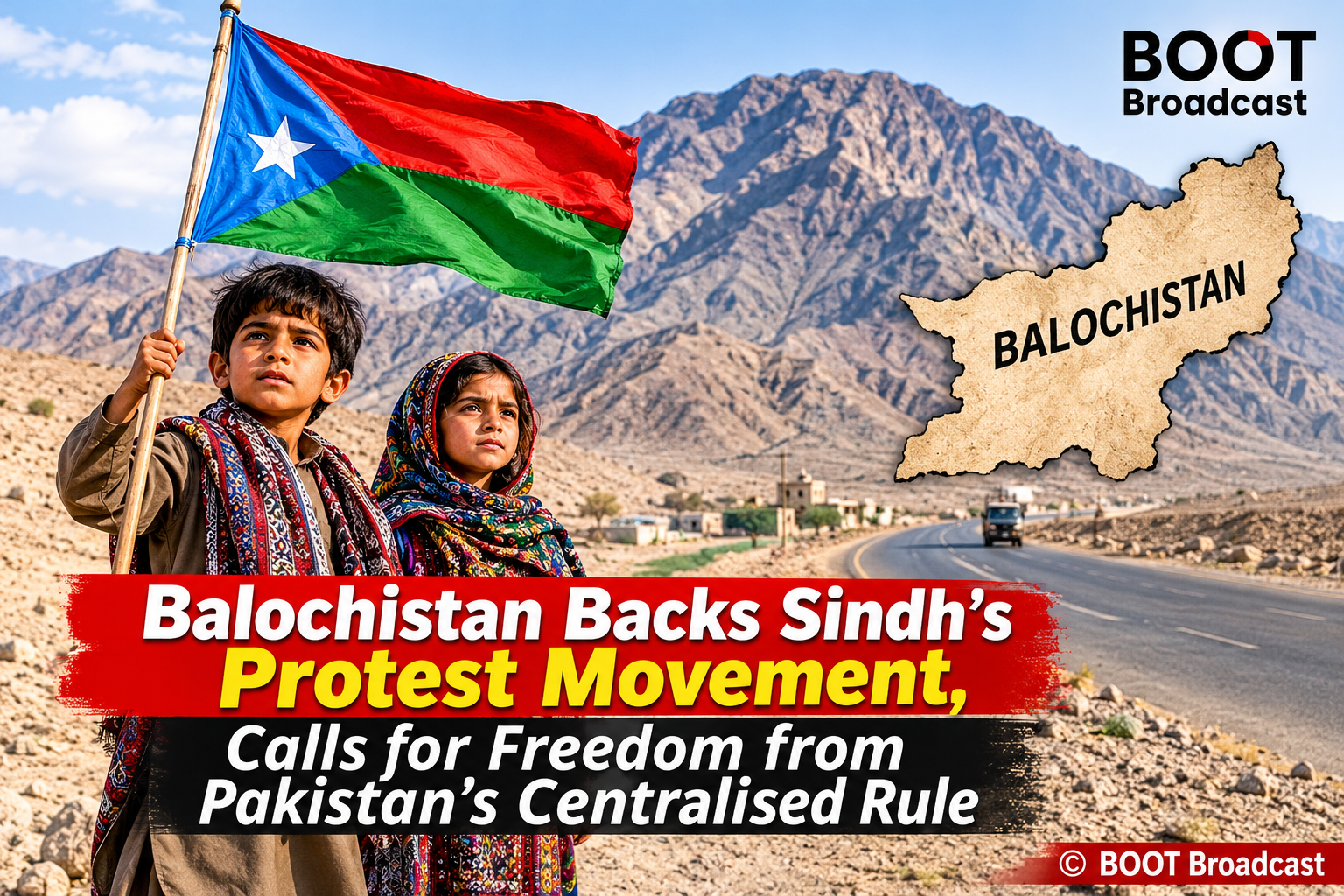
The self declared Republic of Balochistan has voiced strong support for the growing protest movement in Sindh, describing the demonstrations as a significant expression of political awakening and a demand for greater control over the region’s resources, identity and future.
In a strongly worded statement issued recently, prominent Baloch leader Mir Yar Baloch expressed solidarity with the people of Sindh, alleging decades of political marginalisation, economic exploitation and domination by Pakistan’s federal and military establishment.
Referring to reported demonstrations and sit-ins across Sindh, including Hyderabad, Karachi, Jacobabad and Badin, the statement described the protests as more than a reaction to immediate political or economic grievances, calling them an assertion of Sindhi identity and self-determination.
“From the Baloch nation to our Sindhi brothers and sisters: we hear you, we stand with you, and we salute you,” the statement declared.
Drawing parallels between the political experiences of Sindh and Balochistan, they alleged that both regions had faced prolonged marginalisation under Pakistan’s centralised political structure. It accused the country’s military establishment of exercising disproportionate influence over provincial affairs and decision-making.
Water dispute emerges as central flashpoint:
A major focus of the statement was Sindh’s longstanding concerns over water distribution, proposed canal projects and the development of corporate agricultural schemes.
The Balochistan alleged that large-scale water diversion projects and canal development plans threatened Sindh’s agricultural economy, the Indus River system and the ecological sustainability of the Indus Delta.
It also questioned the implementation of the 1991 Water Apportionment Accord, arguing that the underlying problem was not limited to individual infrastructure projects but concerned Sindh’s lack of control over decisions affecting its natural resources.
According to the statement, control over water, land, ports and economic resources remains central to the region’s political grievances.
Raises Bhutto legacy and political accountability:
The statement also invoked the political history of the Bhutto family, referring to the execution of former Prime Minister Zulfikar Ali Bhutto and the violent deaths of his children, Shahnawaz, Murtaza and Benazir Bhutto.
It questioned the accountability surrounding these events and alleged that successive political leaders from Sindh had faced pressure from Pakistan’s powerful military establishment.
The Baloch leader further criticised sections of Sindh’s political leadership, accusing them of benefiting from political arrangements with Islamabad while failing to adequately address the concerns of ordinary citizens.
Calls for international attention to self-determination
Moving beyond provincial grievances, the statement framed the Sindhi and Baloch political struggles as questions of national identity and the right to self-determination.
It urged the international community to pay attention to the demands emerging from both regions, warning that silence over alleged political and economic injustices would only deepen existing grievances.
Concluding its message with a declaration of solidarity, the organisation said Sindh was not alone in its struggle and expressed support for what it described as the people’s aspiration for control over their land, resources and political future.
The statement ended with the slogans “Jeay Sindh” and “Zindabad Balochistan”, underscoring its call for solidarity between the two communities.
The latest declaration adds another dimension to the political debate surrounding Sindh’s water resources, provincial autonomy and relations with Pakistan’s federal establishment. However, the organisation’s allegations and characterisation of the protests have not been independently established by the statement itself.
