



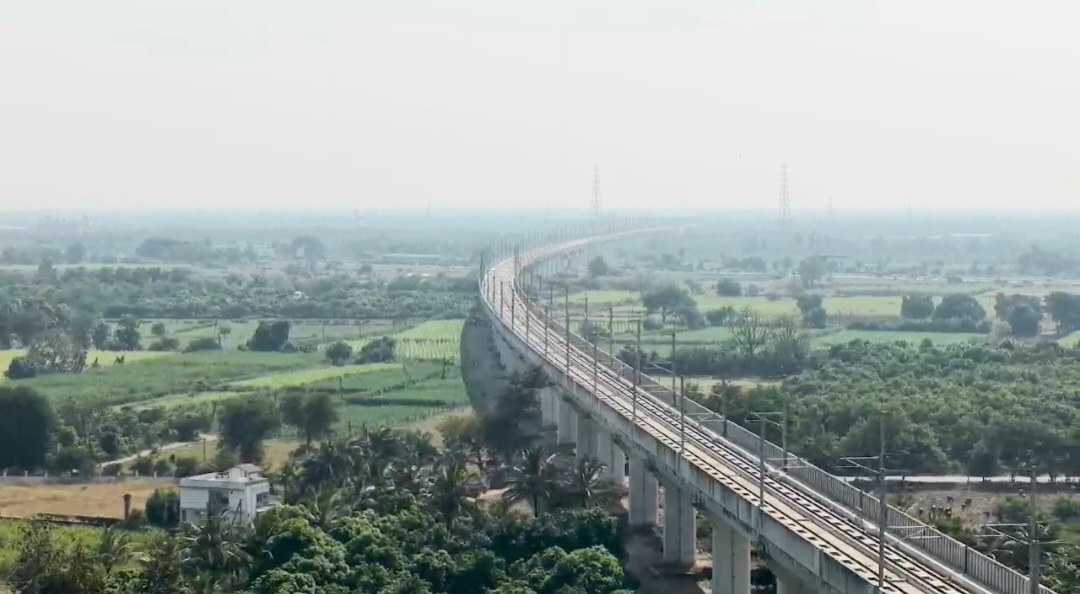
India’s first high-speed rail project has achieved another major engineering milestone with the successful energisation of the Overhead Equipment (OHE) system along the Surat–Bilimora section of the Mumbai–Ahmedabad Bullet Train corridor on November 20.
The development marks a significant step towards the testing and commissioning phase of the ambitious high-speed rail project, bringing India closer to introducing a new generation of rail transportation.
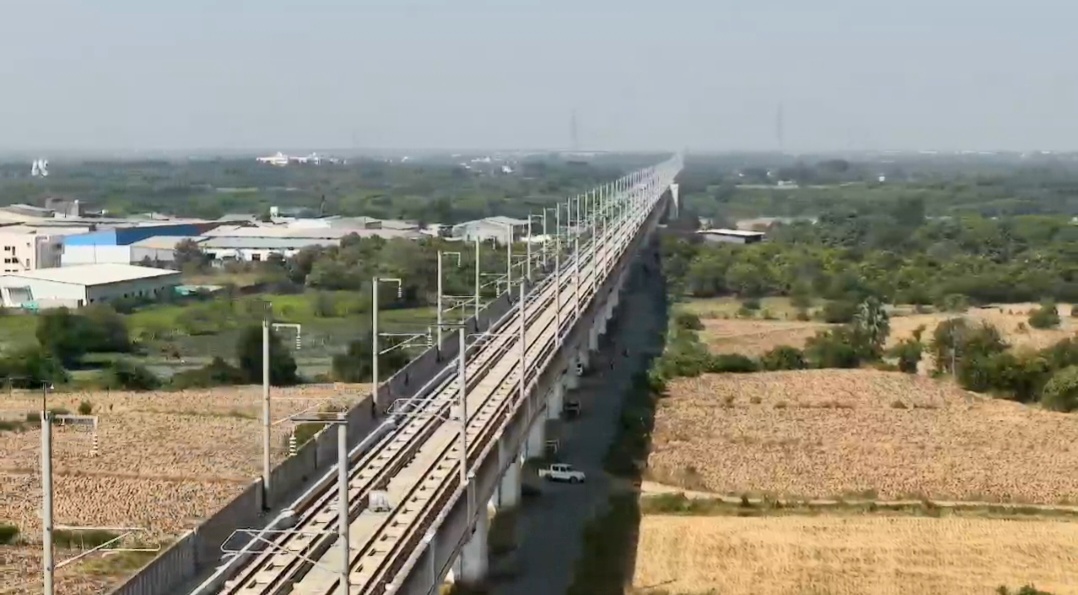
The energised section covers approximately 50 km of elevated railway alignment, comprising both Up and Down lines between Surat and Bilimora in Gujarat. The energisation process will be undertaken progressively in smaller sections under the close supervision of specialised technical teams, following prescribed safety and operational procedures.
Advanced 2 × 25 kV traction technology:
A key technological feature of the Mumbai–Ahmedabad High-Speed Rail corridor is its advanced 2 × 25 kV overhead traction system, a sophisticated electrification technology designed to meet the demanding power requirements of high-speed trains.
The 508-km corridor will be supported by 14 strategically located Traction Substations (TSS), which will draw electricity from the national grid and supply power to the overhead traction network.
The first traction substation at Bilimora, located in Gujarat’s Navsari district, has completed installation work across its Control Panel, Changeover Switch, Transformer and Circuit Breaker buildings.
The Bilimora TSS will receive electricity from the 220 kV Ambetha Grid Substation operated by Gujarat Energy Transmission Corporation Limited (GETCO).
The entire electrical network will be monitored through a centralised control centre, enabling coordinated supervision and supporting safe and reliable power supply for high-speed railway operations.
Engineering infrastructure along the corridor:
The Surat–Bilimora stretch also highlights the scale of engineering involved in constructing India’s first Bullet Train corridor.
The approximately 50-km elevated alignment includes bridges across four rivers and a steel bridge over National Highway 53. The viaduct is additionally equipped with approximately 94,000 noise barriers designed to reduce the impact of railway operations on surrounding communities.
These infrastructure components reflect the complex engineering requirements of developing a high-speed railway network through populated areas and varied geographical conditions.
Safety becomes critical after energisation:
With the overhead electrical system now energised, the National High Speed Rail Corporation Limited (NHSRCL) has issued a public safety advisory for residents, commuters, construction workers and others living or working near the alignment.
People have been strictly advised not to approach or touch overhead electrical installations or undertake any unauthorised activity near the railway infrastructure.
The warning is particularly important because energised overhead equipment carries high-voltage electricity and can pose a serious risk even without direct physical contact.
A major step towards India’s high-speed rail future:
The successful energisation of the Surat–Bilimora section represents more than an electrical infrastructure achievement. It signals the transition of a major part of the Mumbai–Ahmedabad corridor towards the next stage of high-speed rail development.
As work progresses across the corridor, electrification, traction power integration, system testing and safety validation will remain essential before passenger services can begin.
For India, the Bullet Train project represents a major technological shift in railway transportation, with the potential to transform intercity connectivity, travel experience and the country’s high-speed rail capabilities.
The latest milestone brings that ambition another step closer to reality.
