



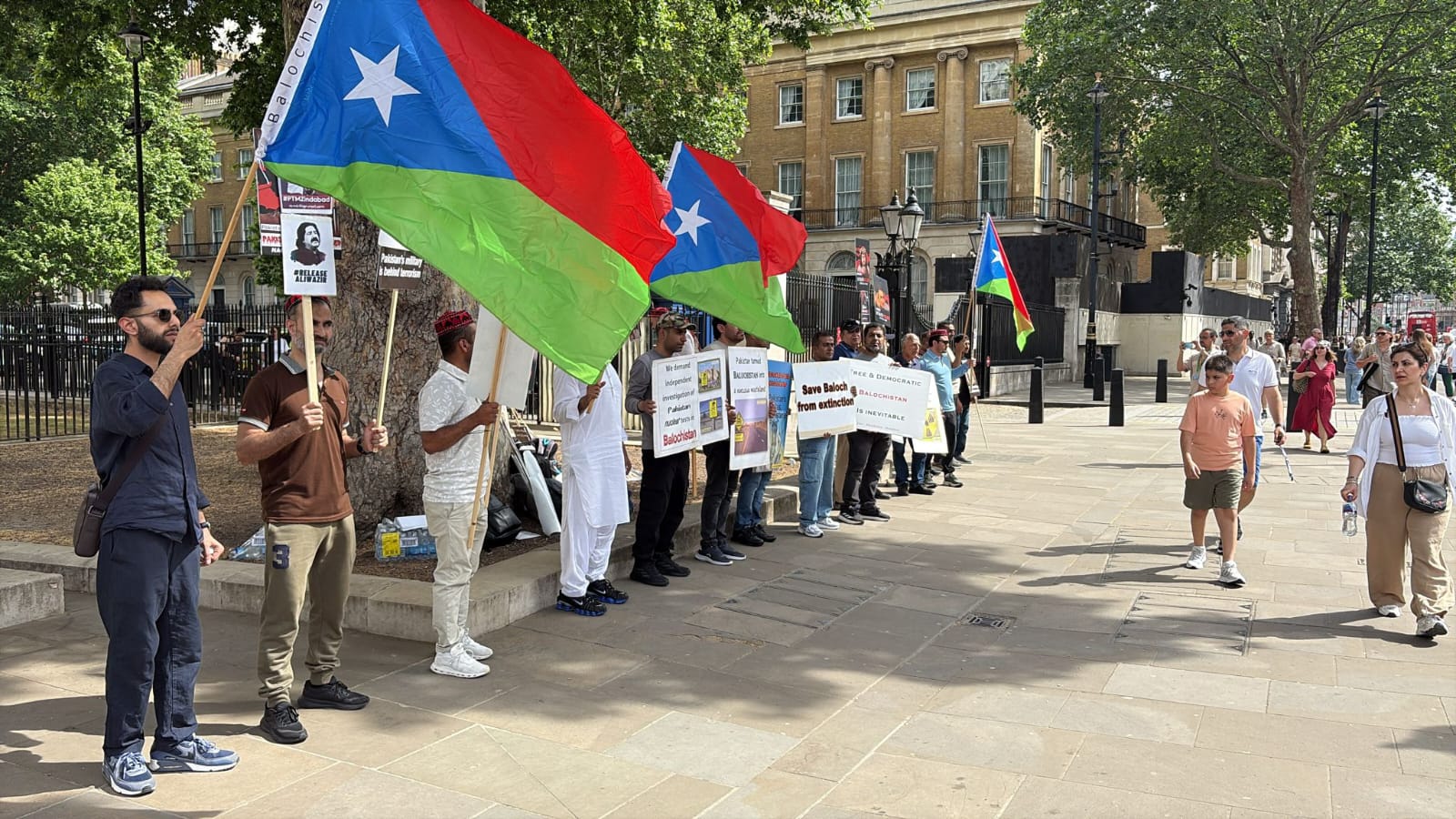
London, May 28, 2026: Activists affiliated with the Free Balochistan Movement (FBM) staged a protest outside 10 Downing Street in London on Wednesday, observing the anniversary of Pakistan’s 1998 nuclear tests in Balochistan as a “Black Day.”
The demonstrators gathered to mark May 28 — the day Pakistan conducted nuclear tests in the Chagai region of Balochistan — and raised slogans drawing attention to alleged human rights concerns and political issues in the region. Protesters carried banners demanding international awareness of the situation in Balochistan and described the nuclear tests as a tragic chapter in the region’s history.
According to organisers, the protest aimed to highlight what they described as the long-term environmental, political and economic impact of the nuclear tests and subsequent militarisation on local communities in Balochistan.
The demonstration was organised under the banner of the Free Balochistan Movement, which advocates for the rights and self-determination of the Baloch people.
During the gathering, Kurdish activists also held a separate protest nearby, demanding greater political rights for Kurds and calling for the release of imprisoned Kurdish leader Abdullah Öcalan. Demonstrators displayed placards carrying messages including “Free Kurdistan” and “Free Öcalan.”
Participants said members of the Pashtun Tahafuz Movement (PTM) also expressed solidarity with the protest. Activists from different groups highlighted shared concerns related to human rights, political representation and freedom of expression.
The protests remained peaceful and were monitored by local authorities in central London.
Pakistan carried out its first nuclear tests on May 28, 1998, in the Chagai district of Balochistan, shortly after India conducted the Pokhran-II nuclear tests earlier that month. While Pakistan officially commemorates the occasion as “Youm-e-Takbeer,” some Baloch nationalist groups observe the day as one of mourning and protest, alleging that local communities faced long-term hardships without corresponding benefits.
The demonstrations in London reflected how regional political and human rights issues in South Asia continue to resonate among diaspora communities and activists abroad.
(Courtesy: IBG)
