



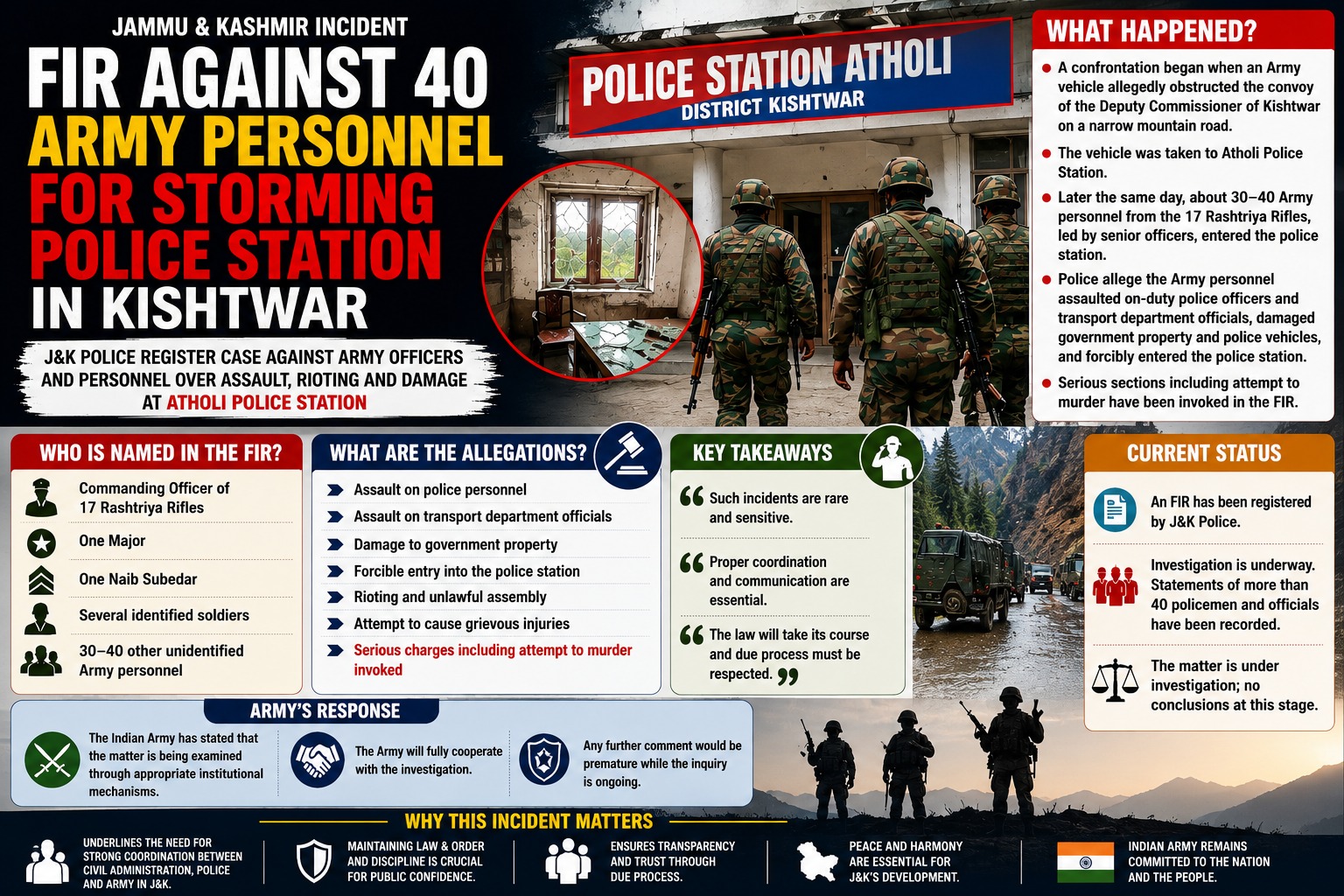
The incident in Kishtwar is far more than a local administrative dispute. It is a warning that institutional friction, if left unchecked, can erode the very foundations of India’s internal security architecture.
For over three decades, the Indian Army and the Jammu & Kashmir Police have fought shoulder to shoulder against terrorism. They have buried their dead together, shared intelligence, executed countless joint operations and stood as the first line of defence against Pakistan-sponsored terrorism. That relationship was built not through paperwork but through sacrifice, trust and mutual respect.
Any confrontation between these institutions is therefore not merely unfortunate—it is strategically damaging.
The facts surrounding the Kishtwar episode are still under investigation, and no responsible observer should rush to assign blame. Accountability must rest on evidence, not emotion or competing narratives. But one reality is already evident: such confrontations should never have been allowed to reach the public domain.
Security institutions operating in conflict zones cannot afford public displays of discord. Every visible fracture is closely watched—not only by citizens but also by terrorist organisations and hostile intelligence agencies seeking to exploit perceptions of disunity.
The Indian Army enjoys extraordinary public trust because it has earned that trust through decades of sacrifice, professionalism and operational restraint. Its credibility has been forged in the mountains of Kargil, the forests of Kashmir and the valleys of the Northeast—not through public relations, but through service.That trust carries responsibility.The Indian Army operates under one of the world’s most rigorous systems of discipline and command responsibility. Its officers are trained to exercise restraint under extreme pressure, and its institutional credibility has been earned through decades of service in the nation’s most difficult operational theatres. If allegations arise against military personnel, they must be investigated fairly and transparently.
The same principle must apply to every civilian authority and every police official. Accountability cannot be selective.
What should concern policymakers is not who possesses greater authority on paper. The real question is whether India’s security institutions are functioning as partners or drifting towards rivalry.
Civil administration, police and the Army perform distinct but complementary roles. The law grants each institution defined responsibilities, but effective counter-insurgency depends on coordination, not competition. Turf battles have no place in areas where operational success depends upon seamless cooperation.
Leadership is tested not during routine administration but during moments of tension. Senior officials—civilian and military alike—must possess the maturity to defuse disagreements before they escalate into institutional confrontations. Professionalism is demonstrated through restraint, not public confrontation.
The Kishtwar incident must therefore become a catalyst for reform. Clearer protocols for civil-military coordination, stronger mechanisms for dispute resolution and regular joint leadership engagement are no longer desirable—they are essential. Every operational theatre requires unity of purpose, because terrorists thrive wherever institutions appear divided.
India’s adversaries will undoubtedly study this episode. They will search for signs of mistrust, fragmentation and weakened coordination. The strongest response is not rhetoric but visible institutional cohesion backed by transparent investigation and professional accountability.
The nation does not benefit when one institution seeks moral victory over another. It benefits when every institution remembers that its ultimate loyalty is not to bureaucratic hierarchy or organisational prestige, but to the Constitution and to India’s security.
The people of Jammu and Kashmir deserve confidence in every arm of the state. They deserve institutions that work together, resolve differences internally and remain united in the face of common threats.
The lesson from Kishtwar is simple: institutions must co-operate, not compete. When they stand together, India is stronger. When they stand against one another, only the nation’s enemies gain.
(The views are author’s personal)
Image credit: Suman Munshi
