



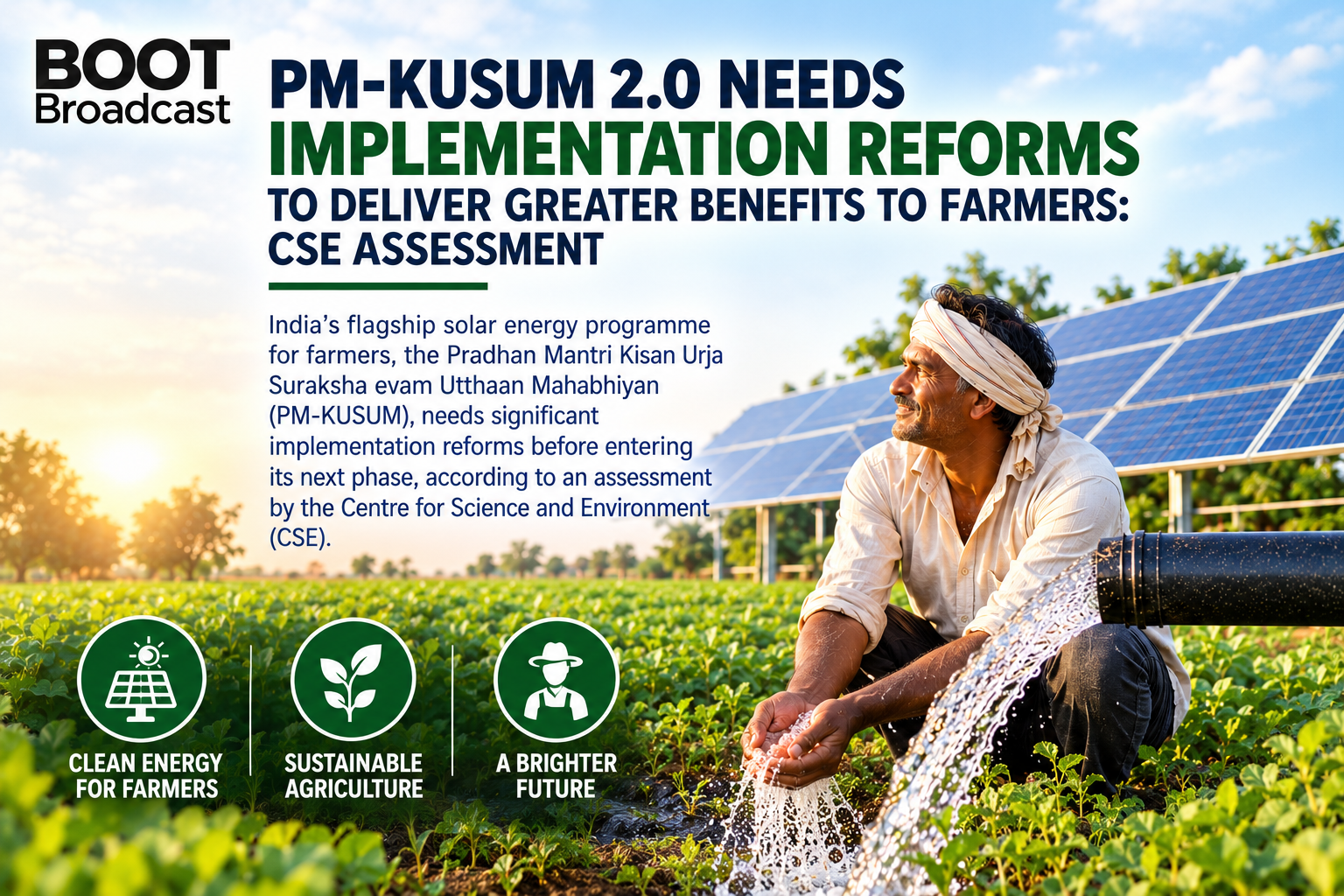
India’s flagship solar energy programme for farmers, the Pradhan Mantri Kisan Urja Suraksha evam Utthaan Mahabhiyan (PM-KUSUM), needs significant implementation reforms before entering its next phase, according to an assessment by the Centre for Science and Environment (CSE).
With Phase I concluding in March 2026, CSE has called for a redesigned approach to PM-KUSUM 2.0 that addresses implementation bottlenecks, strengthens project financing and grid readiness, and ensures that solar energy deployment delivers reliable agricultural power and tangible benefits to farmers.
The assessment was presented during a national webinar titled ‘Redesigning PM-KUSUM 2.0’, organised by CSE on October 27, 2026. The discussion examined ways to improve project preparation, financing mechanisms and farmer participation in the scheme’s next phase.
Participants included Binit Das, Programme Manager, Renewable Energy, CSE; Hemanga Deka, Scientific Officer, Assam Energy Development Agency; Himanshu Tyagi, Senior Research Specialist–Energy, WRI India; and Priyami Dutta, Policy Advisor, International Institute for Sustainable Development (IISD).
Uneven Progress Across Scheme Components:
According to CSE, Phase I recorded varying levels of progress across the programme’s three components.
Component B, which supports standalone solar agricultural pumps, has installed approximately 11.9 lakh pumps, achieving close to 90 per cent of its sanctioned target. In contrast, Component A, which promotes decentralised, grid-connected solar power plants, has installed around 2,400 MW against a target of 10,000 MW.
Progress under Component C, which supports solarisation of existing grid-connected agricultural pumps and feeders, has also varied across states and implementation models. CSE identified feeder-level solarisation as a potentially scalable option where electricity demand and grid conditions are suitable.
Explaining the implementation challenges, Binit Das said: “Phase I of PM-KUSUM concluded in March 2026 with uneven progress across its components. Component B, which supports stand-alone solar pumps, has installed about 11.9 lakh pumps, close to 90 per cent of the sanctioned target. Component A, which supports decentralised grid-connected solar power plants, has installed around 2,400 MW against the programme target of 10,000 MW. Progress under Component C has also varied by state and implementation model, with feeder-level solarisation offering a scalable route where demand and grid conditions are suitable.”
The assessment highlights that relatively straightforward, farmer-facing delivery models have achieved greater scale, while decentralised generation projects require coordination among state agencies, electricity distribution companies (DISCOMs), regulators, developers, lenders and landowners.
Significant differences in implementation across states further underline the need for a framework that accounts for local conditions and institutional capacity.
PM-KUSUM 2.0: Proposed Expansion and Agrivoltaics:
The government is preparing the next phase of PM-KUSUM, with a dedicated agrivoltaics component reportedly under consideration. Agrivoltaics involves combining solar electricity generation with agricultural activities on the same land.
Public reporting has also referred to a proposed financial requirement of up to ₹51,000 crore, including existing liabilities. However, the final financial outlay, eligibility criteria and implementation guidelines remain subject to formal government approval.
CSE argues that the success of the next phase should be measured by implementation quality and outcomes for farmers rather than the scale of announced targets alone.
Das said: “PM-KUSUM 2.0 should address the complete delivery chain — from site selection and project preparation to financing, grid readiness, maintenance and farmer outcomes. Capacity should be allocated only when the conditions for implementation are in place, and performance should be measured through functioning projects and reliable agricultural energy.”
Three Priorities for a More Effective Roll-out:
CSE has identified three major areas requiring attention in the redesign of PM-KUSUM.
1. Ensure project readiness before allocation:
Project preparation should include verification of land access, grid capacity, statutory clearances, procurement plans and financing arrangements before projects receive allocations. This would help minimise delays between project approval and commissioning.
2. Strengthen financial viability and payment security:
Project economics should account for land costs, infrastructure, grid connectivity, financing, insurance, operations and maintenance. Competitive procurement must use realistic cost benchmarks, while tariffs should support project viability and financial closure.
Delayed payments by DISCOMs can increase borrowing costs and undermine developers’ ability to service debt. CSE therefore recommends clear billing and payment timelines, credible payment-security mechanisms and procedures to resolve overdue invoices.
3. Design agrivoltaics around farming needs and farmer rights:
Agrivoltaic projects should be designed according to crop requirements, local agro-climatic conditions and day-to-day farming operations. Implementation models must accommodate different farm sizes and local circumstances, while financing and eligibility arrangements should address barriers faced by smallholders and tenant farmers.
The assessment also stresses the importance of linking solar irrigation with water management safeguards. Lower pumping costs could encourage excessive groundwater extraction if appropriate measures are not introduced.
Emphasising the importance of farmer-centric outcomes, Priyami Dutta of IISD said: “The measure of success of PM KUSUM 2.0 will not be limited to how much solar capacity we installed on agricultural land, but how much tangible benefits we will be able to create for farmers who depend on their land.”
Shift from Targets to Measurable Outcomes:
CSE has called for a unified performance dashboard to monitor the scheme throughout its implementation cycle, from sanction and tendering to commissioning and operation.
The proposed monitoring framework would track financing and subsidy disbursement, electricity generation and utilisation, grid availability, equipment downtime, maintenance and measurable outcomes for farmers. These outcomes could include realised savings, additional income, crop yields and water consumption.
Das said: “PM-KUSUM 2.0 should move from allocation-led implementation to a readiness-driven, outcome-linked approach. A unified performance dashboard should track project status from sanction and tender through commissioning and operation; financing and subsidy disbursement; generation, utilisation and grid availability; equipment downtime and maintenance; and farmer outcomes such as realised savings, additional income, crop yields and water use.”
He added: “The framework should assign clear responsibilities to the Ministry of New and Renewable Energy and other concerned agencies. Independent assessment should help verify whether projects are operating reliably and whether they deliver the intended agricultural and environmental benefits.”
As India prepares to expand its agricultural solar programme, CSE’s assessment underlines the importance of improving coordination, ensuring financial sustainability and placing farmers at the centre of implementation. The effectiveness of PM-KUSUM 2.0 will ultimately depend on whether it can translate solar infrastructure into dependable energy access, sustainable farming practices and measurable economic gains for the agricultural community.
Source: Centre for Science and Environment (CSE) assessment and webinar.
