



– by Pratyusha Mukherjee
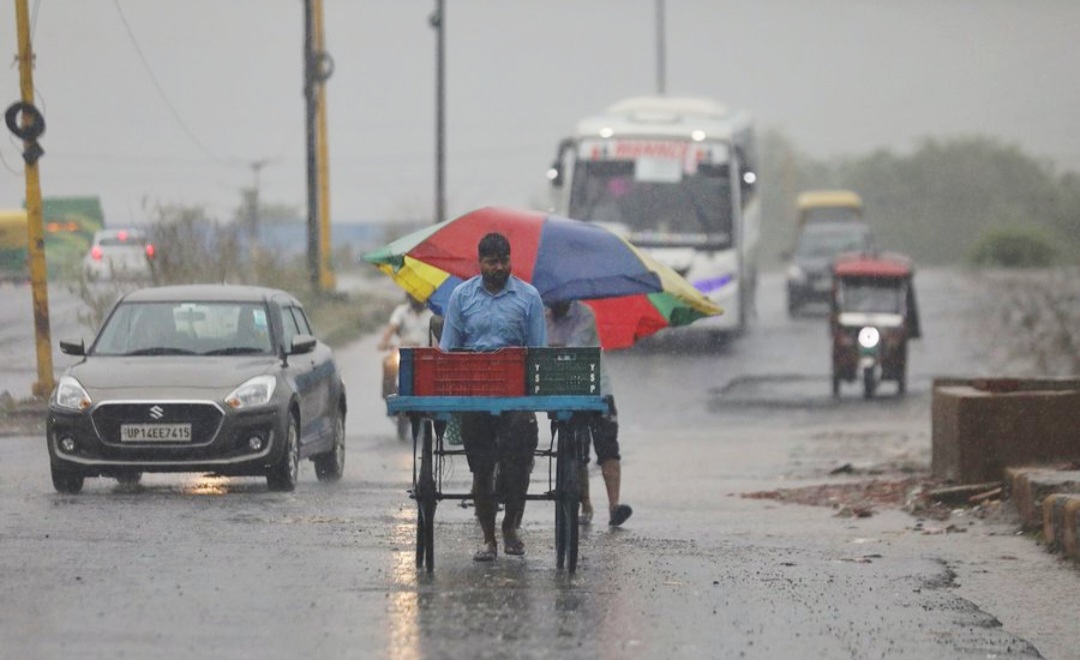
Delhi recorded just one day of ‘Good’ air quality during the 92-day monsoon season despite receiving nearly 577 mm of rainfall, according to a new analysis by the Centre for Science and Environment (CSE).
The assessment found that the relief provided by rainfall was short-lived. PM2.5 levels rose by 10.7 per cent within 24 hours after rainfall stopped and surged 37.9 per cent within 48 hours, pointing to a rapid return of pollution once the atmosphere dried.
CSE said the findings highlight the limits of relying on seasonal rainfall or temporary winter restrictions to manage Delhi-NCR’s air pollution. It called for sustained, year-round emission reductions across the entire National Capital Region (NCR) airshed.
The study analysed air quality during summer, defined as April 1-May 31, and the monsoon period from June 1-August 31, 2026.
During the monsoon, ‘Moderate’ air quality remained the dominant category, accounting for 53 of 92 days, or 57.6 per cent. There were 35 ‘Satisfactory’ days, three ‘Poor’ days and only one ‘Good’ day.
The only ‘Good’ air day was recorded on July 9, when average rainfall measured at Delhi’s Safdarjung and Palam stations was 67.75 mm.
Even the season’s highest daily rainfall, 101.05 mm on August 8, resulted only in a ‘Satisfactory’ AQI.
“While monsoon rains bring temporary relief, they only mask the underlying crisis,” said Anumita Roychowdhury, executive director, research and advocacy, CSE. She said the failure of even heavy rainfall to consistently produce ‘Good’ air quality, coupled with the rapid rebound in pollution during dry spells, indicated persistently high baseline emissions.
The analysis found that average PM2.5 concentrations declined from 60.2 micrograms per cubic metre during summer to 40.2 micrograms per cubic metre during the monsoon, a seasonal reduction of about 33.2 per cent.
However, the improvement did not last once rainfall stopped.
Across six isolated monsoon rainfall events analysed by CSE, the average PM2.5 concentration fell from a pre-rain baseline of 40.6 micrograms per cubic metre to 32.7 micrograms per cubic metre during rainfall — a decline of about 19.5 per cent.
Twenty-four hours after the rain stopped, PM2.5 had climbed to 36.2 micrograms per cubic metre, up 10.7 per cent from the washout level. After 48 hours, it reached 45.1 micrograms per cubic metre, a 37.9 per cent increase from the rainfall phase and 11.1 per cent above the pre-rain baseline.
CSE described this as a “washout and quick rebound” pattern, arguing that rainfall removes particulate matter from the atmosphere temporarily but does not address the emissions that continue to enter it.
The analysis also found that rainfall changed the mix of pollutants driving Delhi’s daily AQI. As wet deposition reduced particulate pollution, gaseous pollutants became more prominent.
Ground-level ozone was the leading pollutant on 20 monsoon days, or about one in five days. Nitrogen dioxide was prominent on 10 per cent of monsoon days, while carbon monoxide was prominent on 7 per cent.
During summer, ozone was prominent on 49 per cent of days.
CSE said emissions of nitrogen oxides, carbon monoxide and volatile organic compounds from sources such as vehicles, diesel generators and industrial facilities continue during rainfall. Under suitable sunlight and atmospheric conditions, these pollutants can contribute to the formation of ground-level ozone.
“This multi-pollutant complexity proves that addressing particulates alone is insufficient for regional air quality management,” said Sharanjeet Kaur, deputy programme manager, Urban Lab, CSE.
The study also compared summer and monsoon air quality. During the 61 summer days analysed, 38 days were classified as ‘Moderate’, 17 as ‘Poor’ and six as ‘Satisfactory’. There were no ‘Good’ days.
During the monsoon, the number of ‘Poor’ days fell sharply to three, while ‘Satisfactory’ days increased to 35. However, ‘Moderate’ air quality remained the largest category.
CSE noted that an AQI in the ‘Moderate’ range corresponds to PM2.5 concentrations that remain above the national 24-hour ambient air quality standard cited in the assessment.
The organisation said the findings are particularly significant as Delhi enters the post-monsoon period. The India Meteorological Department recorded the southwest monsoon as having withdrawn from Delhi on September 23, two days ahead of the normal withdrawal date of September 25 based on the 1971-2019 climatology.
With the end of regular monsoon rainfall and the onset of winter conditions characterised by shallower atmospheric mixing and more stagnant air, CSE said emissions that remain elevated through the year could contribute to a deterioration in air quality.
The organisation called for a shift from short-term emergency responses to permanent measures covering the entire NCR airshed.
Its recommendations include faster adoption of electric vehicles, zero-emission freight corridors, expanded public transport and better last-mile connectivity; cleaner fuels and electrification in industrial processes; stronger controls on industrial emissions and waste burning; 100 per cent segregated municipal waste collection and processing; construction-waste recycling; reliable grid electricity and battery storage to reduce dependence on diesel generators; and cleaner cooking.
CSE also called for a coordinated airshed-level governance framework covering all NCR districts and sectors.
“Only sustained, year-round airshed-wide emission reductions can secure clean, safe air for Delhi and the broader National Capital Region,” Roychowdhury said.
(Inputs from CSE)
