



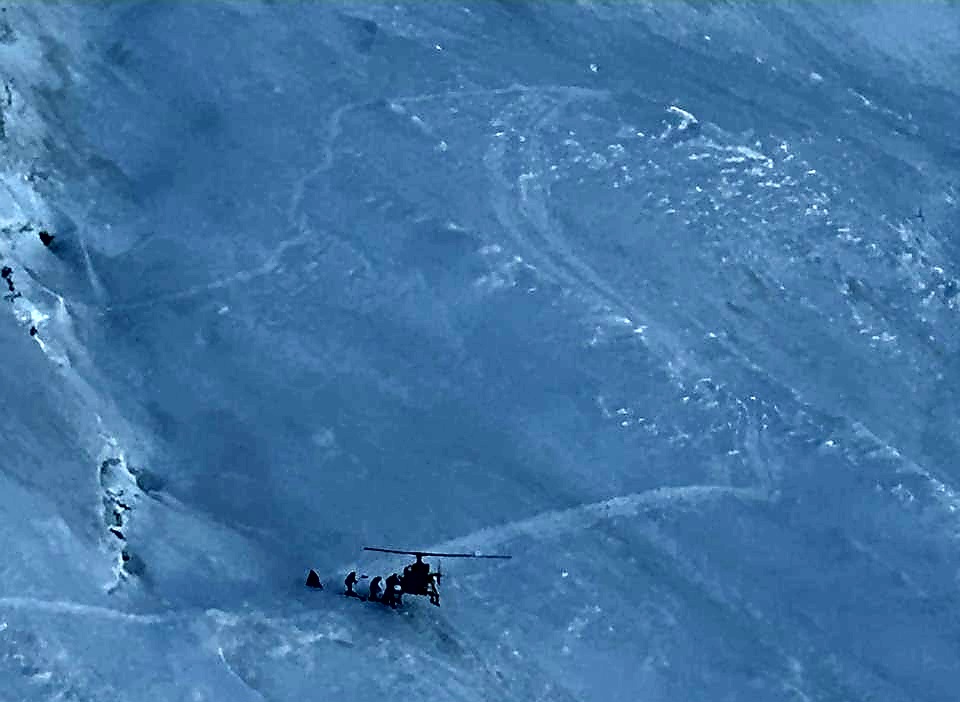
At an altitude where thin air, unpredictable winds and unforgiving terrain can turn even a routine helicopter operation into a high-risk mission, Indian Army Aviation pilots carried out a demanding casualty evacuation near Nun Kun, operating at approximately 18,600 feet.
The mission involved evacuating a casualty from an extremely steep and difficult slope where conventional helicopter landing options were effectively unavailable. With no suitable landing area and strong winds adding to the challenge, the evacuation demanded precise flying, careful weight management and split-second decision-making by the crew.
For the aviators involved, there was little margin for error.
A mission against the terrain:
High-altitude helicopter operations present a unique combination of challenges. At extreme elevations, reduced air density affects helicopter performance, while mountainous terrain can produce sudden and unpredictable wind conditions. Steep slopes further restrict the options available to a pilot attempting to position an aircraft close enough for a casualty to be brought aboard.
The evacuation near Nun Kun presented precisely such conditions.
The casualty was located on a slope without adequate space for a conventional landing. The surrounding terrain left little room for manoeuvre, while strong winds increased the difficulty of maintaining a stable aircraft position.
The crew therefore had to balance two competing priorities: getting close enough to evacuate the casualty while maintaining sufficient control and performance margins to safely recover the aircraft.
Every kilogram mattered:
One of the critical measures taken before the evacuation was to reduce the helicopter’s weight.
Non-essential equipment was removed and the aircraft was operated with limited fuel, reducing the load and improving its performance in the demanding high-altitude environment.
Such weight-saving measures can be crucial during operations at extreme elevations. With thinner air reducing rotor and engine performance, a lighter aircraft has greater operating margins and improved responsiveness compared with a fully loaded helicopter.
But reducing weight alone could not solve the problem posed by the terrain.
The crew still had to bring the aircraft close to a slope where there was no conventional landing area.
A landing with one skid:
The most demanding phase of the operation came when the pilots executed a critical landing manoeuvre with one skid touching the slope.
Rather than landing on a level surface, the aircraft had to be positioned against the uneven terrain in a manner that allowed the casualty to be evacuated while the crew maintained control of the helicopter.
The manoeuvre required exceptional precision. A small deviation in aircraft position, combined with the strong winds and steep gradient, could have significantly increased the risk to both the crew and the casualty.
The successful execution demonstrated the ability of Army Aviation crews to operate helicopters in terrain where conventional landing techniques are not feasible.
Racing the mountain weather:
The evacuation was further complicated by the timing of the mission.
It was undertaken during the last available landing window of the day, adding another layer of urgency to an already difficult operation.
In high-altitude mountainous areas, daylight, weather and wind conditions can rapidly narrow the window available for aviation operations. Missing the final opportunity could have meant delaying the evacuation until conditions permitted another attempt.
The crew therefore had to combine speed with caution—moving decisively without compromising the safety margins required for an operation in extreme terrain.
Precision under pressure:
The successful evacuation was ultimately the product of several factors working together: careful preparation, aircraft weight reduction, assessment of the terrain, accurate positioning and the pilots’ ability to adapt their flying to rapidly changing conditions.
The operation also highlights an important aspect of military aviation that extends beyond combat missions.
Army Aviation helicopters routinely provide critical support in some of the most inaccessible areas of the country, including casualty evacuation, logistics, troop movement and disaster-response missions. In high-altitude sectors, these tasks can become particularly demanding because the same terrain that makes ground evacuation difficult also restricts aviation options.
The Nun Kun mission illustrates that role in stark terms.
At approximately 18,600 feet, the aircraft was operating in an environment where performance margins were limited and the terrain offered virtually no room for conventional recovery. Yet the crew was able to position the helicopter on the slope, using a one-skid landing technique to facilitate the evacuation.
More than a flying skill:
The mission is significant not simply because a helicopter reached an altitude of 18,600 feet or because of the technical difficulty of the landing.
Its importance lies in what the operation demonstrates about military aviation in high-altitude environments: the ability to transform a seemingly inaccessible location into a reachable point of evacuation when a life depends on it.
For the casualty, the operation provided a vital route out of terrain where conventional evacuation would have been exceptionally difficult.
For the pilots and crew, it was an exercise in precision, judgement and controlled risk.
And for Indian Army Aviation, the mission underscores the service’s role in supporting personnel operating in some of the most demanding mountain environments in the world.
The image of a helicopter holding position on a steep mountainside, with one skid resting on the slope, captures the extraordinary nature of the operation. But behind that moment was a chain of decisions—reducing weight, carrying limited fuel, exploiting the final landing window and executing a highly precise approach—that made the evacuation possible.
In an environment where altitude and terrain leave little room for error, the mission near Nun Kun stands as a compelling example of military aviation being used not only to project capability, but to save a life.
It is, ultimately, a story of technical skill guided by courage and compassion: an evacuation carried out at the edge of the operational envelope because, in that moment, reaching the casualty mattered more than the difficulty of getting there.
