



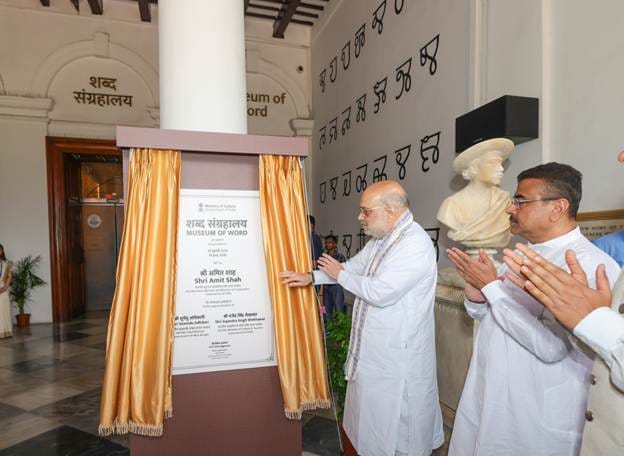
Union Home Minister and Minister of Cooperation Amit Shah inaugurated the first phase of the Museum of Word in Kolkata on Saturday, describing it as a landmark initiative to preserve India’s linguistic heritage and promote the country’s cultural renaissance.
The event was attended by West Bengal Chief Minister Suvendu Adhikari, Finance Minister Swapan Dasgupta, the Union Home Secretary, the Union Culture Secretary, the Director of the Intelligence Bureau, and several other dignitaries.
Addressing the gathering, Shah said the museum gives tangible expression to Prime Minister Narendra Modi’s vision of cultural renaissance by showcasing the evolution of language and its role in shaping India’s civilizational identity. He emphasized that language is built upon words, words emerge from human emotions, and culture is expressed through language. According to him, understanding this interconnected journey is essential for preserving and strengthening India’s cultural heritage.
Shah said the Museum of Word would serve as an educational resource for future generations by documenting the development of language from the concept of Omkar and Panini’s grammar to the traditions of Shruti and Smriti, manuscripts, inscriptions, the printing press, and the age of Artificial Intelligence. He urged that the museum continue expanding its digital and AI capabilities to ensure Indian languages remain relevant in emerging technologies.
Highlighting India’s intellectual traditions, the Home Minister said Indian civilization has historically welcomed innovation while preserving its cultural values. He noted that despite centuries of challenges, India’s cultural foundations have remained resilient because of their openness and adaptability.
The museum, he said, transforms the abstract concept of words into an immersive experience through visual, auditory, and interactive exhibits. It also preserves India’s multilingual traditions, manuscripts, inscriptions, copper plates, handwritten texts, printed books, and regional dialects, offering visitors a comprehensive view of the country’s linguistic evolution.
Shah described linguistics as a naturally evolving science that has developed alongside human civilization. He stressed the importance of preserving mother tongues, encouraging original thinking in educational institutions, and strengthening libraries as centres of intellectual development. According to him, the future of a nation depends not merely on the number of colleges and universities it has, but on how deeply its young people engage with libraries and knowledge.
Speaking about West Bengal’s historical contribution to Indian thought, Shah said the state has long served as a centre of India’s intellectual and cultural life. He referred to the contributions of figures such as Maharshi Aurobindo, Swami Vivekananda, Ramakrishna Paramahansa, Chaitanya Mahaprabhu, Rabindranath Tagore, Netaji Subhas Chandra Bose, and Dr. Syama Prasad Mookerjee, expressing confidence that Bengal would continue to play an important role in India’s cultural future.
He also highlighted the significance of the 150th anniversary of Vande Mataram, stating that the inauguration of the Museum of Word during this commemorative year carried symbolic importance. Shah noted that the complete rendition of Vande Mataram is now being sung in schools across the country, describing it as an important step in preserving India’s cultural traditions.
Outlining a vision for the future of Indian languages, Shah proposed five guiding principles: making the family the first school for language learning, beginning education in the mother tongue, promoting original research and thinking in universities, equipping every Indian language with digital and AI capabilities, and expanding the reach of libraries and museums beyond physical spaces through outreach initiatives. He also encouraged young people to learn at least one additional Indian language alongside their mother tongue to strengthen national linguistic diversity.
Concluding his address, Shah called upon citizens to strengthen India’s cultural identity through the power of language and words. He said that a confident cultural foundation would contribute to the goal of building a developed India by 2047 and advancing the country’s long-term aspirations through knowledge, language, and innovation.
