



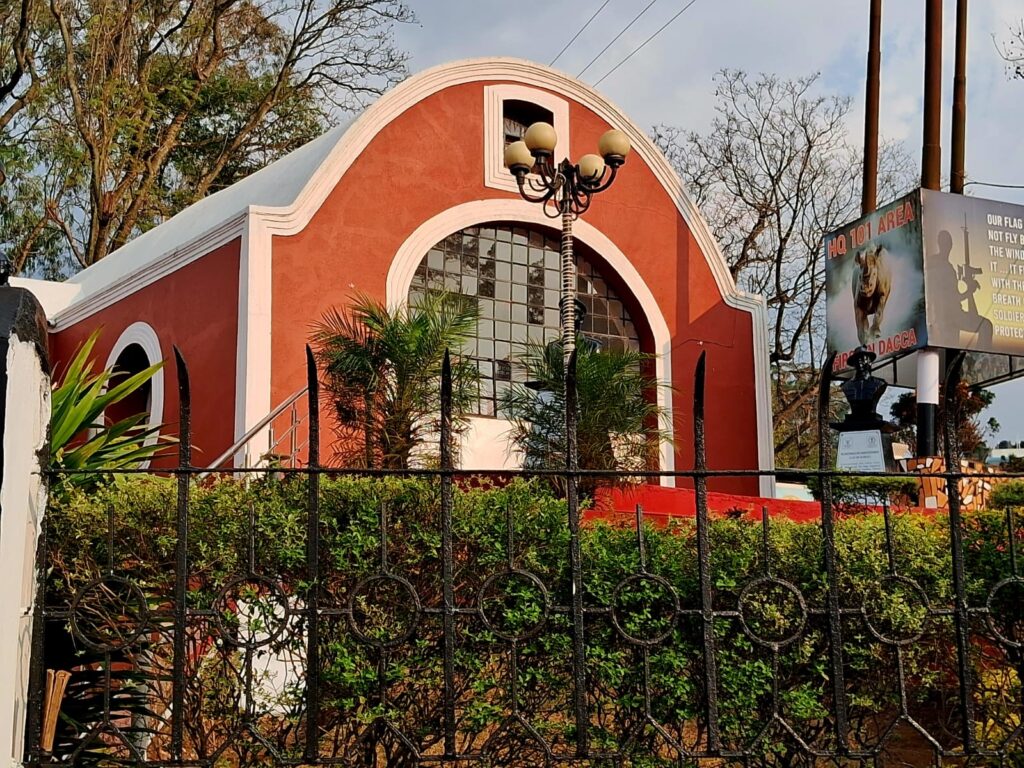
In today’s story I will try to highlight a more detailed look at the Rhino Heritage Museum , its connection to the Indian Army and the Civil – Military co-ordination in the North Eastern States of India.
Purpose and Focus:
The museum’s primary goal is to honour the valiant contributions of the Indian Army, especially the Assam Regiment and 101 Area, during various military campaigns.
Martyrs and Memorials:
The museum includes a bust of (Late) Major David Manlun, KC, and pays homage to (Late) Captain Clifford Nongrum, MVC, who were local Indian Army officers and martyrs. Nearly two decades after he sacrificed his life in Kargil leading his Kashmiri troops into battle, the bust of Captain Keishing Clifford Nongrum, MVC, at the Rhino Heritage Museum, surveys the Rilbong crossroads in the town where he grew up. The bust of Major David Manlun, KC, who was educated in Shillong and killed in combat in Nagaland in 2017 is also there, and the two join the life – sized statue of Field Marshal SHFJ Manekshaw, who spearheaded India’s victory in the Indo-Pak War of 1971.
1971 Indo-Pak War:
The museum highlights the history of 101 Area, the first army formation to reach Dhaka during the 1971 Indo-Pak War.
India’s civil-military co-ordination, particularly in the Northeast, involves integrated efforts combining security, development, and disaster response. The Indian Army plays a multi-dimensional role in this sensitive region.
Security & Counter-Insurgency:
The Army remains central to counter-insurgency operations in states like Manipur, Nagaland, and Assam, often co-ordinating with paramilitary forces (Assam Rifles, CRPF) under unified command structures. Recent reforms like the Chief of Defence Staff (CDS) and Department of Military Affairs (DMA) aim to enhance inter-service and civil-military synergy.
Disaster Response:
The Army is the primary responder during floods, landslides, and earthquakes. Its credibility in relief operations (evidenced in Bihar flood responses) extends to the Northeast, where its rapid deployment capabilities save lives during monsoons.
Development Initiatives:
Programs like Operation Sadbhavana (successfully used in Kashmir) have counterparts in the Northeast, focusing on:
Infrastructure projects (bridges, roads) National Integration Tour (NIT),Medical camps and education initiatives,Veteran integration through schemes like Rashtra Nirman.
Institutional Reforms:
Share resources between civil administration and military,Strengthen disaster preparedness,Leverage veterans for community development.
The Defence Industrial Base (DIB) reforms aim to involve local industries in defense manufacturing, potentially boosting Northeast’s economic growth.
Historical Evolution:
Post-Kargil reforms (1999) and the 2016 surgical strikes demonstrated improved civil-military coordination. However, challenges persist in bureaucratic harmonization and inter-service jointness, which recent CDS reforms seek to address.
The Army’s dual role as security provider and development partner remains critical in the Northeast’s stability, though greater civilian-military bureaucratic integration is needed for long-term synergy.
(All articles are original works of Ms.Pratyusha Mukherjee, and some news media also shared the same. Any modification or usage needs to be approved by her only)
