



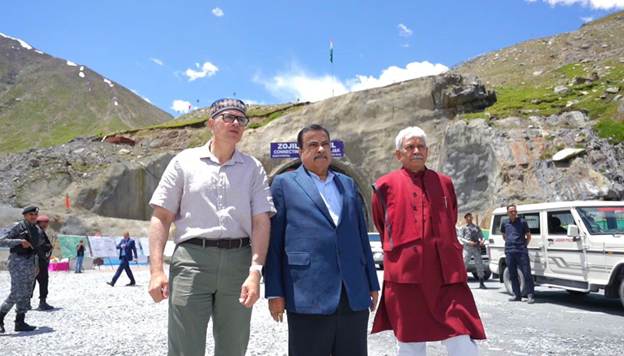
Minamarg (Ladakh): India marked a major milestone in its Himalayan infrastructure journey as the main tunnel of the ambitious Zojila Tunnel Project achieved a breakthrough at the eastern portal near Minamarg in Kargil district. The development is expected to transform connectivity between Jammu & Kashmir and Ladakh by providing reliable all-weather access through one of the country’s most challenging mountain corridors.
Union Minister for Road Transport and Highways Nitin Gadkari witnessed the breakthrough ceremony, accompanied by Jammu & Kashmir Lieutenant Governor Manoj Sinha, Chief Minister Omar Abdullah, Members of Parliament and senior government officials. Lieutenant Governor of Ladakh Vinai Kumar Saxena joined the event virtually.
Engineering a Lifeline Through the Himalayas:
Constructed between Baltal and Minamarg along National Highway-1, the nearly 14-kilometre bi-directional tunnel is being built at an estimated cost of ₹6,800 crore. Located at elevations ranging from 2,900 to 3,310 metres, the project is regarded as one of India’s most complex and strategically significant mountain infrastructure undertakings.
The breakthrough represents a major engineering achievement, considering the region’s extreme weather conditions, heavy snowfall, avalanche-prone terrain and challenging geological formations. The project is being executed under the supervision of the National Highways & Infrastructure Development Corporation Limited (NHIDCL) with support from engineers, contractors, consultants and thousands of workers.
Advanced Safety and Modern Infrastructure:
Upon completion, the tunnel will be equipped with state-of-the-art safety and operational systems, including advanced ventilation networks, automatic fire detection and suppression systems, CCTV-based surveillance and emergency pedestrian cross-passages.
The larger project also includes eight cut-and-cover sections, four bridges, 40 culverts, snow galleries, avalanche protection structures, catch dams and upgraded approach roads designed to ensure uninterrupted connectivity even during severe winter conditions.
Travel Time to Shrink Dramatically:
The Zojila Tunnel is expected to revolutionise transportation in the region by reducing travel time between Sonamarg and Minamarg from nearly two hours to approximately 30 minutes. The tunnel will eliminate frequent disruptions caused by snowfall, avalanches and adverse weather, ensuring year-round movement of people, goods and essential services.
Beyond improved transportation, the project is expected to generate substantial economic benefits through enhanced tourism, expanded trade opportunities and improved access to remote communities in both Jammu & Kashmir and Ladakh.
Strategic Importance for National Security:
The tunnel also carries significant strategic value. Once operational, it will provide uninterrupted connectivity to Ladakh throughout the year, enabling faster movement of military personnel, equipment and logistical supplies to forward areas. Defence planners view the project as a crucial component of India’s long-term border infrastructure strategy.
₹18,000-Crore Connectivity Push in Ladakh:
Highlighting the broader development agenda for the region, Gadkari stated that road and tunnel projects worth nearly ₹18,000 crore are currently under implementation across Ladakh.
Among the major projects is the Kargil–Zanskar–Padum highway, aimed at improving access to the remote Zanskar region while enhancing strategic mobility. Additional initiatives include the North and South Bypass projects in Leh, designed to streamline traffic movement towards Srinagar, Manali and Khardung La.
The government is also advancing plans for the Fatu-La Twin-Tube Tunnel and the Kela Pass Tunnel, which are expected to improve all-weather connectivity and facilitate access to key tourist destinations, including Pangong Lake.
Major Tunnel Projects Planned on Manali-Leh Axis:
To further strengthen connectivity to Ladakh, tunnel projects are being planned at Baralacha La, Lachulung La and Tanglang La along the Manali-Leh highway. These projects are expected to improve travel reliability, reduce transit times and ensure uninterrupted access during winter months.
Jammu & Kashmir Witnessing Massive Infrastructure Expansion:
Gadkari said that road and highway projects worth approximately ₹1.35 lakh crore—covering completed, ongoing and proposed works—are currently being implemented across Jammu & Kashmir.
Several high-speed corridors are under development, including the Jammu–Udhampur–Srinagar corridor, which is nearing completion and is expected to significantly reduce travel times. Other key projects include the Jammu–Chenani–Anantnag corridor, Srinagar–Baramulla–Uri corridor and the Jammu–Akhnoor–Poonch corridor, all aimed at improving connectivity, logistics and regional development.
Border Roads and Strategic Corridors:
The government is also prioritising projects of strategic significance, including the Katra–Srinagar High-Speed Corridor, the Rafiabad–Kupwara–Chowkibal–Tangdhar road project and the Srinagar–Sonamarg–Gumri corridor. These projects are expected to improve access to border regions, support economic activity and strengthen national security infrastructure.
Plans are also underway for a new corridor connecting Surankote, Bufliaz, Supen, Doodhpathri and Magam, providing enhanced connectivity between the Pir Panjal region and the Kashmir Valley.
Ring Roads and Expressways to Transform Mobility:
Urban mobility improvements are being pursued through the Srinagar Ring Road and Jammu Ring Road projects, which aim to reduce congestion and facilitate smoother movement of traffic. Dedicated links are also being developed to improve access to Srinagar Airport and the railway network.
Meanwhile, the Delhi–Amritsar–Katra Greenfield Expressway is expected to strengthen connectivity between northern India and Jammu & Kashmir through a modern access-controlled corridor, reducing travel times and boosting economic integration.
A Symbol of India’s Infrastructure Transformation:
Describing the breakthrough as a defining moment in India’s infrastructure journey, Gadkari said the Zojila Tunnel exemplifies how modern engineering and strategic planning are overcoming geographical barriers to drive economic growth, regional integration and national security.
Once completed, the tunnel will stand as one of India’s most significant mountain infrastructure achievements, permanently altering the connectivity landscape of Jammu & Kashmir and Ladakh while reinforcing the country’s commitment to developing resilient infrastructure in frontier regions.
