



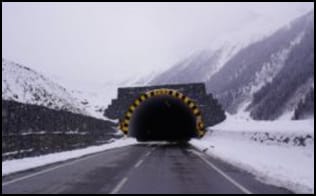
The final breakthrough of the strategically vital Zojila Tunnel on June 9 marks a significant milestone in India’s long-term effort to strengthen connectivity and military mobility across the sensitive Himalayan frontier. While the tunnel remains several years away from commissioning, the completion of excavation through the mountain barrier represents a major step toward establishing uninterrupted road access between Kashmir and Ladakh.
Union Minister for Road Transport and Highways Nitin Gadkari is expected to attend the breakthrough ceremony, underscoring the national importance of a project that has emerged as one of India’s most consequential border infrastructure initiatives.
At 13.15 kilometres, the tunnel beneath the Zojila Pass will become India’s longest road tunnel and Asia’s longest bi-directional road tunnel upon completion. Linking Baltal in Jammu and Kashmir’s Ganderbal district with Minamarg in Ladakh’s Kargil district, the project is designed to overcome one of the most persistent logistical vulnerabilities in the country’s northern sector.
A Strategic Lifeline to Ladakh:
For decades, the Zojila Pass has served as the sole road gateway connecting the Kashmir Valley to Ladakh through the Srinagar-Kargil-Leh Highway. However, extreme winter conditions routinely force the closure of the pass for up to six months each year, isolating Ladakh and severely constraining both civilian and military movement.The tunnel is expected to fundamentally alter that equation.
By providing all-weather connectivity at an altitude of nearly 11,600 feet, the project will enable year-round movement of troops, military equipment, fuel, ammunition and essential supplies to forward areas. This assumes greater significance in the aftermath of heightened military deployments along both the Line of Actual Control (LAC) with China and the Line of Control (LoC) with Pakistan.
Reliable road connectivity has become a central pillar of India’s border infrastructure strategy following lessons learned from past conflicts and recent military stand-offs in eastern Ladakh. The Zojila Tunnel is expected to reduce transit time across the pass from several hours to approximately 15 minutes, allowing military convoys to move rapidly regardless of weather conditions.
Defence planners have long viewed winter closures of the Zojila Pass as a logistical challenge. The tunnel will substantially reduce dependence on seasonal weather windows and improve operational flexibility for forces deployed in Ladakh.
Transforming Civilian Connectivity:
Beyond its military significance, the project is poised to reshape life in Ladakh, particularly in Kargil district, where residents have historically faced prolonged periods of winter isolation.
Year-round connectivity will facilitate uninterrupted transportation of food supplies, fuel, medicines and other essential commodities. Access to healthcare, education and emergency services is also expected to improve significantly for remote communities that have traditionally remained cut off during heavy snowfall.
The tunnel is expected to reduce transportation costs and improve supply chain reliability, potentially lowering prices of essential goods while stimulating regional economic activity.
Tourism Set for Major Expansion:
The strategic tunnel is also expected to unlock significant tourism potential across Kashmir and Ladakh.
Together with the recently operational Z-Morh Tunnel, the project will provide seamless access to destinations such as Sonamarg, Drass, Kargil and Leh throughout the year. Tourism stakeholders anticipate a longer visitor season, greater investment in hospitality infrastructure and increased tourist arrivals during winter months.
Ladakh’s tourism industry has historically been constrained by seasonal accessibility. With road connectivity no longer dependent on weather conditions, local businesses, transport operators, hotels and restaurants are expected to benefit from sustained visitor flows.
The tunnel will also improve access to Baltal, the gateway to the Amarnath Yatra, enhancing pilgrimage-related infrastructure and logistics.
Engineering Through Extreme Conditions:
Constructing the Zojila Tunnel has been one of India’s most challenging engineering undertakings.
Engineers have contended with unstable geological formations, continuous water ingress, avalanche threats and sub-zero temperatures that can plunge below minus 40 degrees Celsius during winter. The eastern portal near Minamarg posed particular challenges due to difficult rock conditions and severe weather.
The tunnel is being built using the New Austrian Tunnelling Method (NATM), an advanced excavation technique widely employed in complex mountain environments. Modern safety systems include SCADA-based tunnel management, CCTV surveillance, communication networks, emergency response infrastructure and a semi-transverse ventilation system.
The broader project extends over 30 kilometres and includes approach roads, bridges, snow galleries and multiple ventilation shafts, including India’s longest vertical shaft measuring over 474 metres.
A Cornerstone of Border Infrastructure:
The Zojila Tunnel forms part of India’s broader push to modernise strategic infrastructure across Jammu and Kashmir and Ladakh. Alongside a network of new tunnels, roads and bridges being developed in the region, the project reflects New Delhi’s emphasis on improving connectivity in border areas that have traditionally faced severe geographical constraints.
Although substantial work remains—including tunnel lining, road surfacing, ventilation installation and safety systems—the June 9 breakthrough represents the successful completion of the most critical phase of construction.
When operational in 2028, the Zojila Tunnel will not merely shorten travel times. It will strengthen India’s strategic posture in Ladakh, enhance civilian resilience, support economic growth and establish a permanent all-weather corridor through one of the most challenging terrains in the Himalayas.
For both national security planners and local communities, the breakthrough signals the approaching realization of a decades-old objective: reliable, year-round access to Ladakh.
