



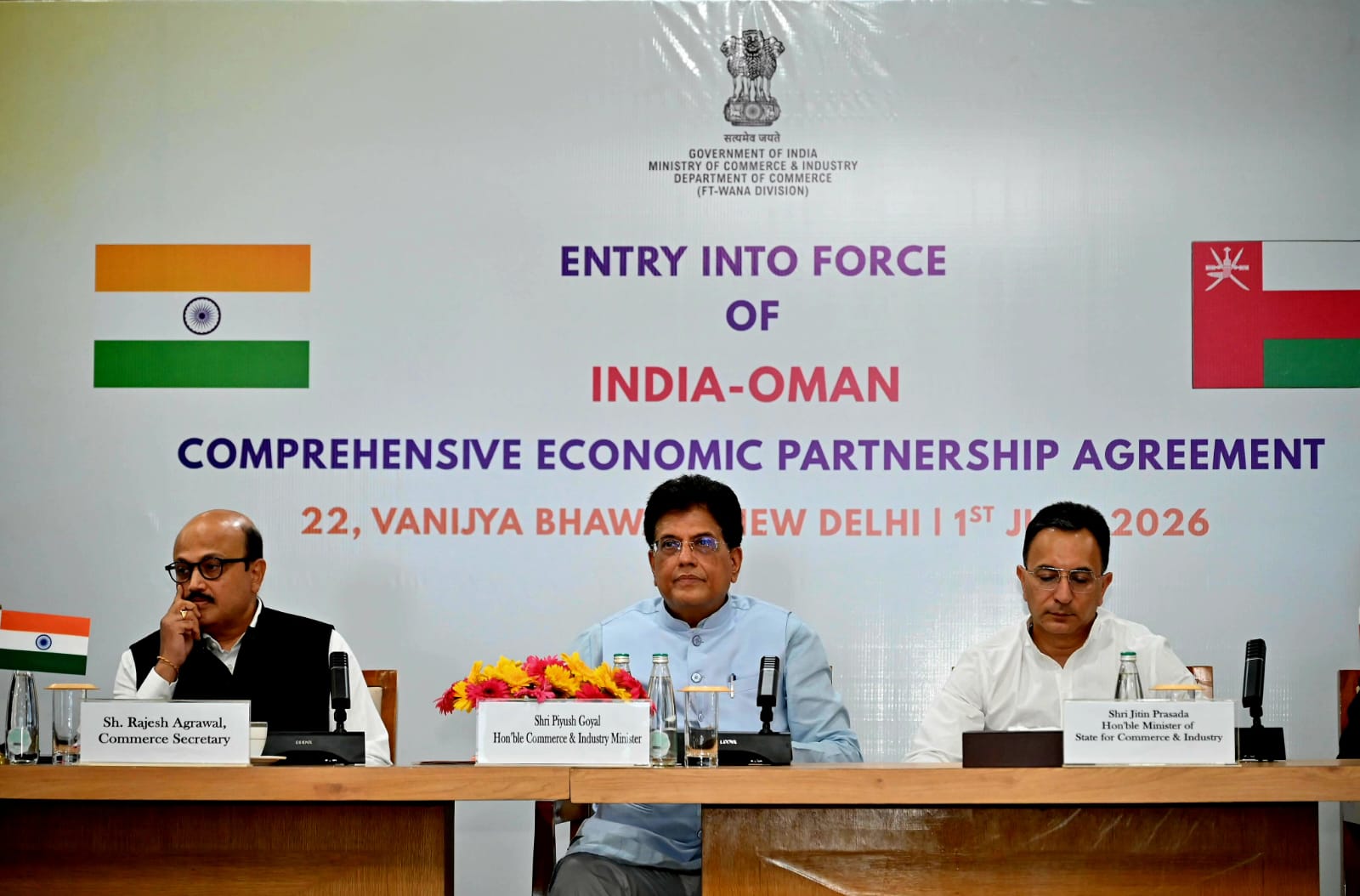
India and Oman on Monday operationalized the Comprehensive Economic Partnership Agreement (CEPA), marking a major milestone in bilateral economic relations and paving the way for deeper trade, investment and strategic cooperation.
The agreement, signed in Muscat on December 18, 2025, in the presence of Prime Minister Narendra Modi and Sultan Haitham bin Tarik Al Said, officially entered into force after the completion of domestic procedures by both countries.
The launch was marked by the flagging off of the first consignments availing preferential tariff benefits under the agreement, including agricultural products and gems and jewellery exports from Mumbai, Kolkata and Chennai. The event was attended by Union Commerce and Industry Minister Piyush Goyal and Oman’s Ambassador to India, Issa Saleh Al Shibani.
Under the CEPA, 99.38 per cent of India’s exports by value will receive duty-free access to Oman, covering 98.08 per cent of Oman’s tariff lines. India becomes only the second country after the United States to secure a comprehensive bilateral trade pact with Oman.
Bilateral trade between the two countries reached USD 11.18 billion in FY 2025-26, up from USD 10.61 billion in the previous fiscal year. Oman, India’s second-largest trading partner in the Gulf region, serves as a key gateway to GCC and East African markets.
The agreement is expected to significantly boost exports in labour-intensive sectors such as marine products, gems and jewellery, agriculture, processed foods, pharmaceuticals, textiles, leather and engineering goods. It also provides expanded market access for Indian service providers across 127 sectors, including IT, healthcare, education, engineering and financial services.
Speaking on the occasion, Commerce and Industry Minister Piyush Goyal described the CEPA as a “defining milestone” in India-Oman relations, stating that it would unlock new opportunities for exporters, professionals, farmers, fishermen, women entrepreneurs and MSMEs while strengthening India’s integration into regional and global value chains.
Commerce Secretary Rajesh Agrawal said the agreement would create more resilient value chains, enhance economic competitiveness and strengthen the strategic partnership between the two countries through closer cooperation in trade, services, investment and logistics.
The CEPA also includes provisions for investment facilitation, regulatory cooperation, faster customs clearances, recognition of Indian certification systems and enhanced professional mobility. It is expected to strengthen economic integration between South Asia, the Gulf and East Africa while supporting India’s vision of becoming a globally competitive economy under Viksit Bharat @2047.
