



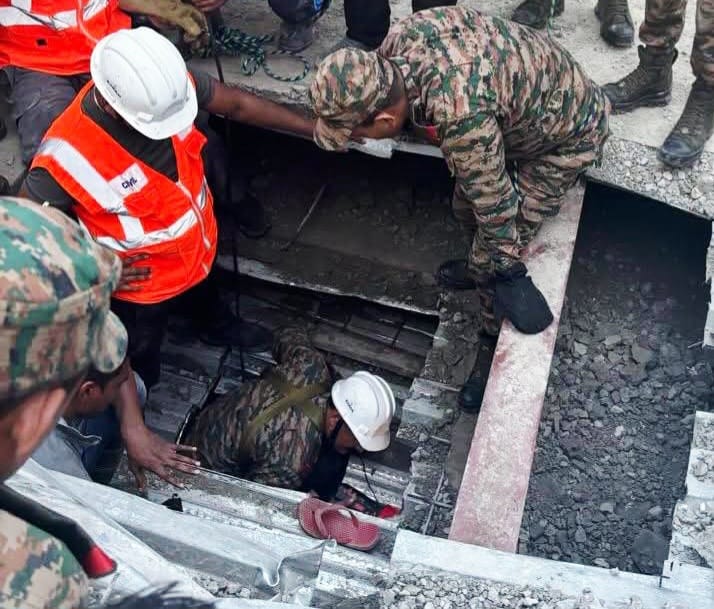
In a mission that underscores the Indian Army’s unwavering commitment beyond the battlefield, troops of Eastern Command continue to wage a relentless fight against time, concrete, and uncertainty at the Taratala godown collapse site in Kolkata.
What began as a catastrophic structural failure has evolved into a complex urban rescue operation demanding military precision, engineering expertise, and extraordinary endurance. As hopes of finding survivors diminish with every passing hour, the soldiers on the ground remain undeterred, demonstrating the same resolve that defines them in combat.
Seven specialised Indian Army rescue teams, operating in close coordination with the National Disaster Response Force (NDRF), State Disaster Response Force (SDRF), and Kolkata Police, have maintained round-the-clock operations amid hazardous conditions. Supported by advanced engineering equipment, cutting machinery, heavy rescue tools, and high-intensity illumination systems, the troops continue their painstaking search through mountains of twisted steel and shattered concrete.
The scale of the deployment reflects the gravity of the crisis. Military ambulances, medical personnel, and a fully equipped 10-bedded emergency medical facility staffed by medical and surgical specialists have been established on-site, ensuring immediate life-saving intervention for rescued victims.
The operation has already yielded significant results, with 31 citizens rescued alive from the debris. Yet the mission remains far from over.
For the soldiers of Eastern Command, this is not merely a rescue operation—it is a battle against the clock. Every slab lifted, every void searched, and every cry detected beneath the rubble carries the possibility of saving another life. The complexity of the collapsed structure demands meticulous execution, where a single miscalculation could endanger both survivors and rescuers.
Military engineers, trained to operate under extreme conditions, have become the spearhead of the effort. Working through darkness, fatigue, and unstable debris fields, they continue to carve pathways into the wreckage with remarkable professionalism and discipline.
The operation also highlights the Indian Army’s critical role in supporting civil authorities during national emergencies. While the Army’s primary mandate remains national defence, its rapid mobilisation capability, engineering prowess, and medical infrastructure often make it the nation’s first and most trusted responder during disasters.
At Taratala, that trust is once again being justified.
As rescue teams press deeper into the collapsed structure, the message from the ground is unequivocal: the mission will continue for as long as there remains even the slightest chance of finding survivors.
In the face of tragedy, Eastern Command has transformed military capability into humanitarian action—proving that the Army’s strength is measured not only in its ability to defend borders, but also in its determination to protect lives when disaster strikes at home.
Amid the dust, darkness, and danger of Taratala, India’s soldiers remain steadfast—silent warriors fighting a different kind of battle, one life at a time.
