



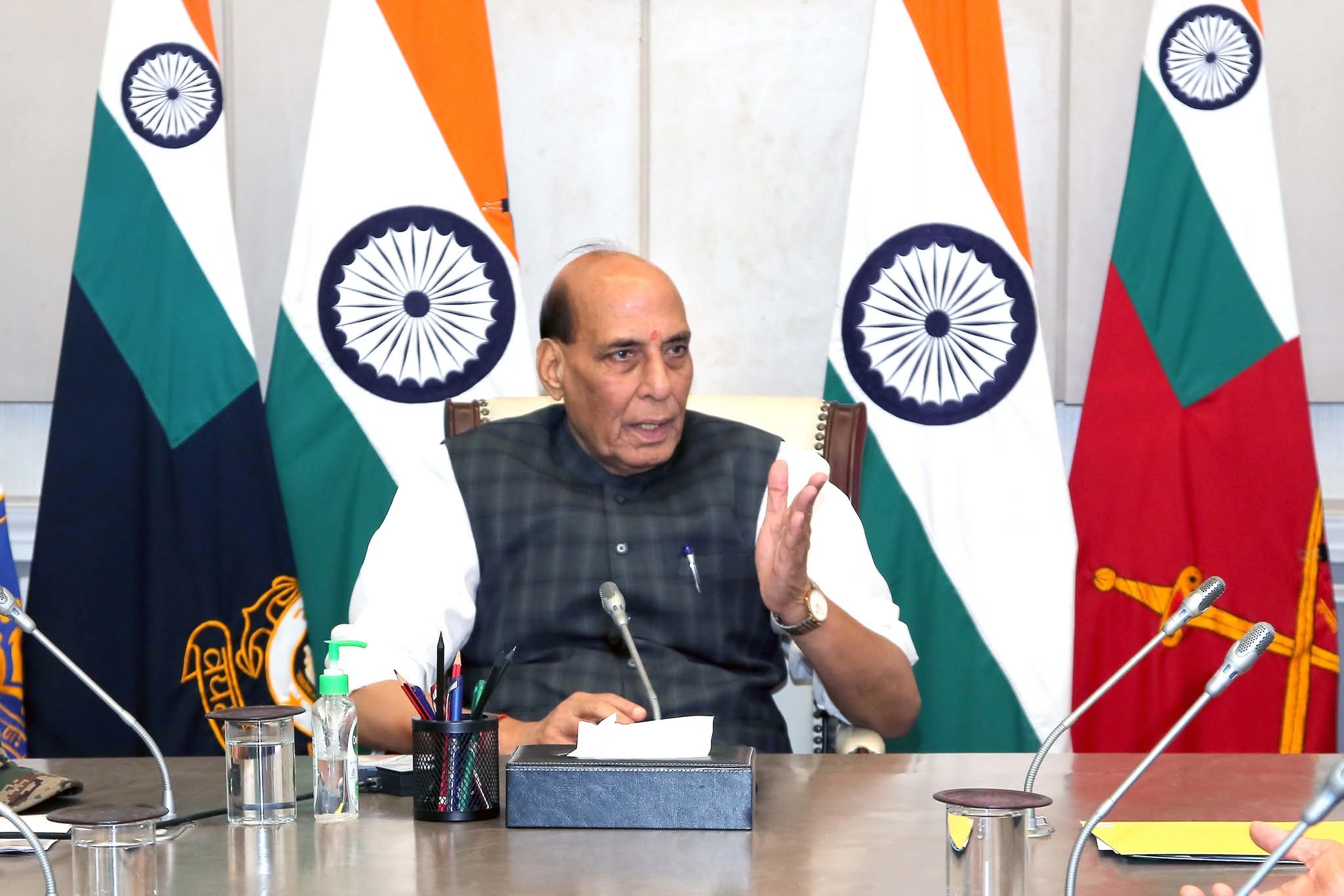
India does not seek to occupy the territory of any country but will take necessary measures to protect its security and strategic autonomy when threatened, Defence Minister Rajnath Singh said on Saturday, underlining New Delhi’s approach of pursuing peace without compromising national security.
Addressing a Defence Conclave in New Delhi, Singh said India believes in peace and global stability but warned that its commitment to peace should not be interpreted as weakness.
“India believes in peace and does not seek to occupy the territory of any country. However, peace should not be mistaken for weakness,” Singh said.
The Defence Minister said India remains committed to safeguarding its security and strategic autonomy in the face of threats. He also ruled out the possibility of dialogue with countries that promote terrorism against India.
Singh said nations that use terrorism as an instrument of state policy or provide shelter and support to terrorists must be made to understand that terrorism cannot be treated as a strategic instrument. Referring to Prime Minister Narendra Modi’s recent remarks at the Shanghai Cooperation Organisation meeting, he said India remains entitled to take necessary measures against terrorism as long as a neighbouring country continues to support it.
National Unity Linked to National Security:
Singh identified national unity as a critical component of India’s national security, stressing that the responsibility for protecting the country extends beyond the armed forces.
He called upon citizens to rise above divisions based on religion, caste, creed, language and region, and place national interests above narrower considerations.
Describing India as a “civilizational power,” Singh said the country’s rise is based on inclusive development rather than confrontation or disruption. He outlined three broad foundations of India’s approach: India’s democratic and civilizational traditions, the principles of Vasudhaiva Kutumbakam and Sabka Saath, Sabka Vikas, and five strategic pillars—respect, dialogue, prosperity, security and culture.
India’s Expanding Role in the Global South:
The Defence Minister also highlighted India’s growing engagement with developing countries and its efforts to position itself as a reliable partner for the Global South.
He cited India’s Vaccine Maitri initiative, under which more than 30 crore COVID-19 vaccine doses were supplied to over 100 countries. India has also supported developing nations through medicines, digital payment solutions, technical expertise and other resources.
Singh pointed to initiatives such as the Voice of Global South Summits as part of India’s efforts to advance the interests of developing countries and promote greater participation in global development.
He stressed that responsible use of national power requires cooperation even in an increasingly competitive international environment.
Defence Exports Surge:
A major focus of Singh’s address was India’s transformation from a major defence importer into an increasingly important defence producer and exporter.
According to the Defence Minister, India’s defence exports have increased from ₹686 crore in 2013-14 to a record ₹38,424 crore in 2025-26. Indian defence products are now being exported to more than 100 countries.
After achieving the ₹30,000-crore defence export target in the previous year, the government has now set an export target of ₹50,000 crore by 2029.
Singh said the growing international demand for Indian missiles, radars, ammunition and other defence platforms reflected increasing confidence in Indian defence technology, quality and delivery capabilities.
He said the “Made in India” label was increasingly becoming a symbol of confidence in Indian defence capabilities.
₹7.85 Lakh Crore Defence Allocation:
India’s defence allocation has risen significantly, reaching ₹7.85 lakh crore for 2026-27, compared with around ₹2.53 lakh crore in 2013-14, Singh said.
Around 75% of the capital acquisition budget, amounting to ₹1.39 lakh crore, has been earmarked for procurement from the domestic defence industry.
The government expects the increased domestic procurement to strengthen India’s indigenous defence manufacturing base and expand opportunities for small and medium-sized enterprises across the defence supply chain.
Focus on Future Warfare:
Singh said the character of warfare is undergoing rapid transformation, with military competition increasingly extending beyond traditional domains.
Cyber warfare, space operations, electronic warfare and information warfare are becoming integral to modern conflicts, while technologies such as artificial intelligence, drones, autonomous systems, quantum technology and hypersonic systems are reshaping military capabilities.
He stressed the need for India to develop future-ready capabilities across these emerging domains.
The Defence Minister also identified technology, energy, data and supply chains as areas of strategic vulnerability. Efforts are consequently being undertaken to strengthen domestic capabilities in semiconductors and critical minerals, diversify energy sources and improve energy security.
509 Defence Systems Under Indigenisation:
India’s drive towards defence self-reliance is also being pursued through a series of indigenisation measures.
According to Singh, 509 defence equipment, weapon systems and platforms have been included in five positive indigenisation lists issued by the Armed Forces.
Defence Public Sector Undertakings have separately released six indigenisation lists covering 5,417 items, including strategically important line-replaceable units, subsystems, spares and components. Around 3,300 of these items have already been indigenised.
The Defence Minister said the objective is to develop indigenous capabilities across the defence spectrum, from individual components to complete weapon systems.
Private Sector and MSMEs Expanding Defence Base:
India’s defence industrial ecosystem is increasingly being supported by private companies, startups, MSMEs, universities and research institutions.
The ecosystem now includes Defence Public Sector Undertakings, private industry, more than 16,000 MSMEs, startups and research institutions, with defence manufacturing capabilities expanding across multiple regions.
Investment proposals worth around ₹70,000 crore have been received in the Uttar Pradesh and Tamil Nadu Defence Industrial Corridors, with approximately ₹10,000 crore already invested.
Singh also highlighted the SRIJAN and SRIJAN DEEP portals, which are intended to strengthen indigenous defence supply chains.
Around 33,000 imported items have been identified for import substitution through SRIJAN, of which approximately 15,700 have been indigenised. SRIJAN DEEP, meanwhile, has created a national digital database covering more than 40,000 manufacturers and sellers and lakhs of products.
DPSUs and Ordnance Factories Undergoing Transformation:
Singh said the corporatisation of the former Ordnance Factory Board’s production units has helped improve their technology orientation, output and accountability.
He stated that all 16 DPSUs are currently operating without losses and are increasing their focus on research and development as well as exports.
The government is also seeking to expand the role of startups and innovators in defence technology through programmes such as iDEX, iDEX-Prime and ADITI.
As of March 2026, 676 startups and innovators had been engaged through iDEX, with 551 contracts signed. The Ministry of Defence has approved procurement worth more than ₹2,400 crore from startups and MSMEs, along with development projects exceeding ₹1,500 crore.
DRDO Technologies to Move to Industry:
In a significant step towards expanding private-sector participation in defence production, the Defence Minister announced that technologies developed by the Defence Research and Development Organisation for conventional missile systems would be transferred to eligible Indian industries.
Qualifying private companies will be able to undertake production of these systems, subject to the applicable requirements.
Singh said the move would help strengthen the preparedness of the Armed Forces and enable faster delivery of missile systems.
The initiative also reflects a broader division of responsibilities in which DRDO is expected to place greater emphasis on research and development, while industry assumes a larger role in production and manufacturing.
Building Strategic Autonomy:
Concluding his address, Singh said India’s long-term objective is to build indigenous capabilities across the entire defence spectrum and reduce dependence on foreign sources.
The strategy encompasses everything from critical components and subsystems to complete weapons and platforms, with an emphasis on developing key technologies within the country.
The Defence Minister said strengthening indigenous capabilities would contribute to India’s strategic autonomy, defence preparedness and the resilience of its domestic defence-industrial ecosystem.
