



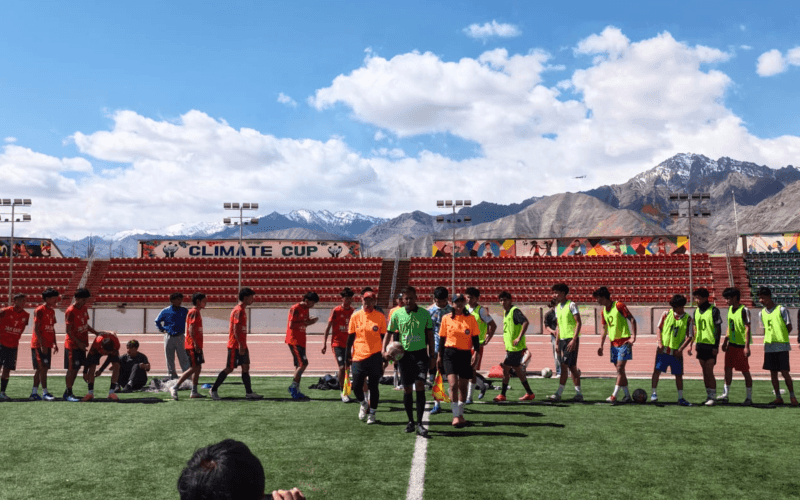
Ladakh is renowned for its dramatic mountains, stark landscapes and breathtaking natural beauty. For millions of Indians, a journey to Leh and the wider Ladakh region remains a dream. Yet beyond tourism and its spectacular terrain, the Union Territory is witnessing another remarkable transformation — the steady rise of football.
Over the past five years, the sport has evolved from a passionate grassroots pursuit into an increasingly organised football ecosystem. The breakthrough moment came in 2025, when made history by competing in the Durand Cup, India’s oldest football tournament.
Making their debut in a major professional competition, 1 Ladakh FC secured a point and earned praise for their attractive, attacking style of play. More importantly, their participation placed Ladakh’s football culture on a national platform and demonstrated that the region possesses players capable of competing at a higher level.
But the story goes far beyond one club or one tournament.
Football at 11,000 Feet:
In a region with a relatively small population, football enjoys a remarkable following. However, the conditions in which players pursue the sport are among the most demanding in India.
For almost six months of the year, heavy snowfall, freezing temperatures, strong winds and extreme weather make regular training and competition difficult. Playing at an altitude of around 11,000 feet presents an additional physical challenge, while limited financial resources and infrastructure have historically restricted opportunities for aspiring players.
Yet the passion for the game has remained undiminished.
Tsering Angmo, founder and General Secretary of the Ladakh Football Association, believes talent exists across the region and that the next phase of Ladakh football must focus on developing players locally.
“There is football talent hidden in every part of Ladakh. Our aim is to see future football stars emerge from Ladakh itself. We do not want to depend on players from outside. Our priority is to identify and develop local talent.”
For Angmo, the Durand Cup was not simply a tournament appearance. It was the beginning of a broader strategy to create sustainable pathways for local players.
The footballers who represented 1 Ladakh FC in the tournament are now contributing to the development of the sport in different capacities. Some have moved into coaching, while others are becoming referees — helping to build the foundations of a football ecosystem from within the community.
“We want to bring a professional structure to football in Ladakh so that the next generation can grow up in the right environment, go on to play in the ISL and the IFL, and eventually represent the country,” Angmo said.
From One Club to a Football Ecosystem:
The impact of 1 Ladakh FC’s Durand Cup campaign extended well beyond the pitch. For the first time, football supporters across India were able to see Ladakh not only as a destination of extraordinary natural beauty, but also as a region with a deep-rooted football culture and a growing pool of talented players.
The club has since sought to build on that momentum through its grassroots programme, ‘Football For All’. The initiative provides children from across Ladakh with the opportunity to train at least three days a week, giving young players a more consistent and structured environment in which to develop.
Infrastructure is also beginning to improve.
Leh and Kargil already have two FIFA-recognised professional football pitches, while the Ladakh Football Association is working towards expanding the number of playing fields and improving facilities across the region.The objective is clear: create an environment in which talented children can progress from local football to the professional game without having to leave Ladakh at the earliest stage of their development.
A Grassroots Revolution:
Perhaps the most significant evidence of football’s growth can be seen at the grassroots level.Five local leagues have been established across Ladakh, providing players with more regular competitive opportunities. The women’s game has also taken an important step forward.
In August 2026, Ladakh hosted its first professional women’s football tournament, featuring eight teams — with every participating player a resident of the Union Territory.
For a region where climatic conditions can severely restrict sporting activity for much of the year, the development represents a significant milestone.
“You would not believe how much has changed recently. Five local leagues have started in Ladakh. In August 2026, Ladakh hosted its first professional women’s football tournament, with eight teams taking part, and every player was a resident of Ladakh,”- Angmo added.
The progress has been supported by both government initiatives and the All India Football Federation (AIFF). According to Angmo, the introduction of a new sports policy and the announcement of employment opportunities through the sports quota have provided additional encouragement to young athletes.
Building for the Future:
Ladakh’s football journey is still in its early stages. The region faces obvious geographical and climatic disadvantages, and creating a professional football structure at high altitude will require sustained investment, planning and patience.But those involved in the development of the game are looking at the long term.
“We have taken the experience of the Durand Cup and decided that we want to build a complete football ecosystem in Ladakh,” Angmo said. “We know it will take time. Even if it takes three or four years, we are ready to invest that time in our own boys and girls.”-he added with confidence.
That long-term approach could prove crucial. Rather than relying primarily on outside players, Ladakh is seeking to create a system in which local children can enter the sport at an early age, receive professional coaching, compete regularly and gradually progress towards the national stage.
The ambition is not merely to produce one successful club. It is to establish an entire football culture capable of sustaining itself.
Passion That Survives the Winter:
Ladakh’s football story is ultimately one of perseverance.
In a place where winter can bring organised football to a halt for almost half the year, players, coaches, administrators and supporters continue to push the sport forward. From local leagues and women’s competitions to professional pitches and structured youth development, the foundations of a new football era are gradually taking shape.The road from Ladakh’s high-altitude football grounds to India’s biggest professional stages will not be easy. But the region has already demonstrated that geography and weather cannot extinguish its ambition.
For Ladakh, the beautiful game is no longer simply a pastime. It is becoming a pathway — one that could, in time, carry a new generation of footballers from the mountains of the Himalayas to the biggest stages in India and beyond.
(Inputs from AIFF)
