



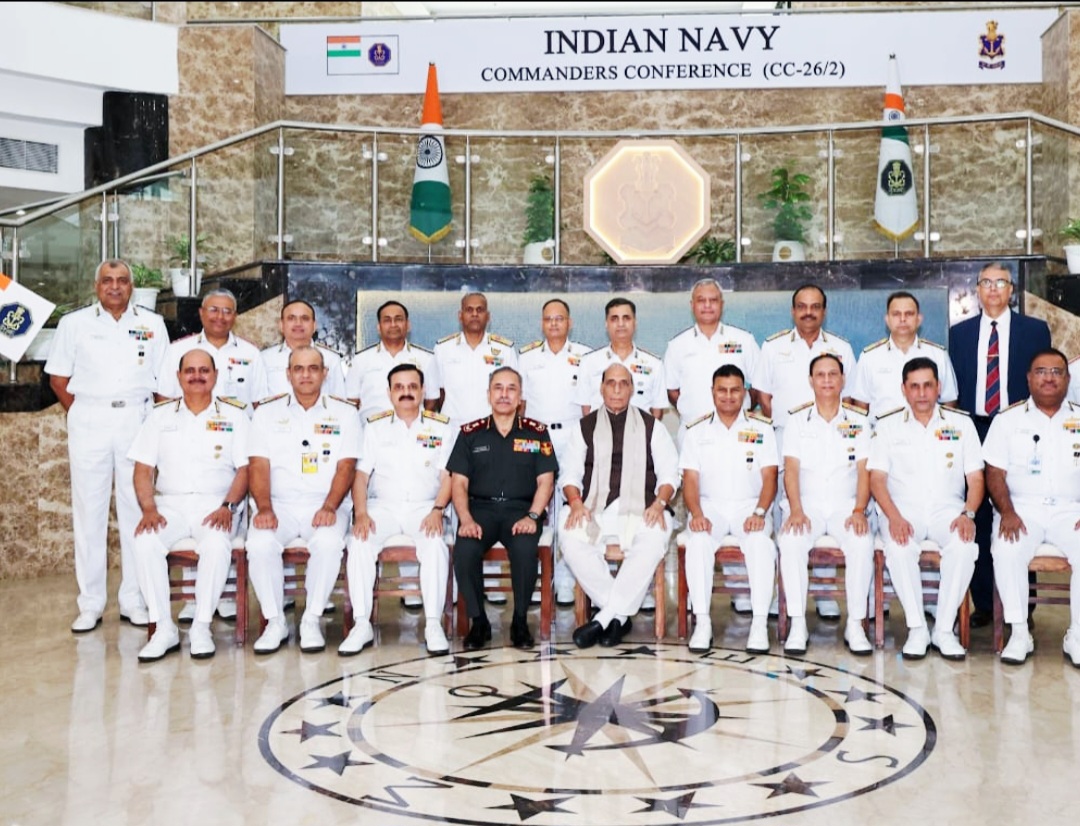
Defence Minister Rajnath Singh on Tuesday described India as a “First Responder” and “Preferred Security Partner” in the Indian Ocean Region, asserting that the country’s growing maritime responsibilities require stronger surveillance and response mechanisms.
Addressing the second edition of the Indian Navy’s biannual Commanders’ Conference at Nausena Bhawan in New Delhi, Singh said India’s strategic position and responsibilities in the region were expanding amid increasingly complex maritime challenges, including congestion, deception and grey-zone activities.
He highlighted the Indian Navy’s expanding operational reach, noting that Indian warships are deployed across the South China Sea, Mediterranean and Atlantic, demonstrating the country’s blue-water naval capability.
“The Indian Navy serves as a strategic anchor in the vision of Viksit Bharat 2047,” Singh said, adding that the service’s role extends beyond safeguarding maritime boundaries to protecting economic interests, supporting regional stability and enabling power projection.
The Defence Minister also highlighted the Navy’s role in ensuring the safe movement of Indian-flagged merchant vessels during the West Asia crisis. Under Operation Urja Suraksha, Indian naval assets helped facilitate the safe transit of merchant vessels, including LPG tankers, through the Strait of Hormuz.
Singh noted that India imports around 85–90 per cent of its crude oil and nearly half of its natural gas through maritime routes, making the security of sea lanes closely linked to the country’s economy, energy security and defence preparedness.
Push for stronger maritime surveillance
Singh called for a significant upgrade to India’s maritime surveillance architecture, saying the increasing volume and complexity of maritime traffic required greater analytical and monitoring capabilities.
He also highlighted progress in domestic naval shipbuilding, saying recently commissioned Indian warships have more than 75 per cent indigenous content. He urged the Navy and the wider defence industry to move beyond meeting domestic requirements and work towards exporting Indian-built warships to friendly countries.
The year 2026, he said, would be historic for the Indian Navy, with 18 warships scheduled for induction or commissioning — described as the largest single-year addition to the Navy’s fleet.
Focus on women and international cooperation
Singh also praised the Navy’s efforts under the “All Ranks, All Roles” approach, including the deployment of women officers aboard frontline warships and aircraft and their participation in long-distance naval expeditions such as Navika Sagar Parikrama.
He congratulated the Navy on assuming command of Combined Task Force-154 under the Combined Maritime Forces, calling it an important contribution to regional maritime security.
He also highlighted Operation Southern Readiness, conducted in Kochi during India’s tenure as CTF-154 commander. The exercise brought together 276 personnel from 27 countries, 76 facilitators and subject-matter experts, and representatives from four international organisations.
Singh further referred to the deployment of INS Sudarshini for Lokayan-26, saying the voyage strengthened India’s maritime engagement across the United States, Atlantic and Mediterranean regions while showcasing the country’s maritime heritage.
Concluding his address, Singh commended the Indian Navy for maintaining a high level of combat readiness and meeting its operational commitments despite an evolving maritime security environment.
“If the seas are secure, India will be secure; and if India is secure, the resolve for a Viksit Bharat will be further strengthened,” he said.
- The three-day Commanders’ Conference, being held from September 29 to October 1, brings together the Indian Navy’s senior leadership to review operational preparedness, maritime security and future capability development. Singh also interacted with the Chief of Defence Staff and the Chief of the Army Staff during the conference.
