



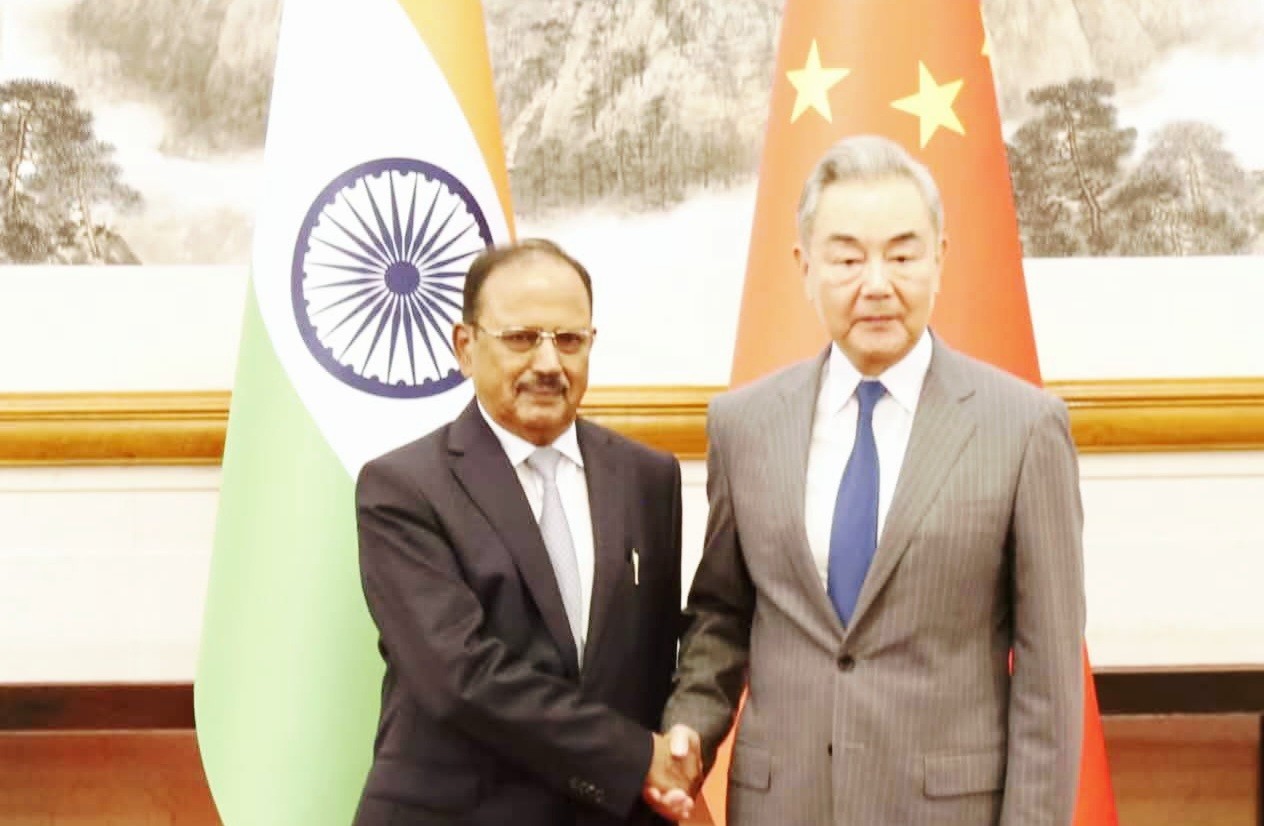
India and China have agreed to continue efforts towards finding a political settlement of the long-standing boundary question, with both sides emphasising the importance of protecting their broader and long-term interests.
The understanding emerged during the 25th round of the Special Representatives’ Talks on the India-China Boundary Question, co-chaired by National Security Advisor Ajit Doval and Chinese Foreign Affairs Minister Wang Yi in Beijing.
The talks assume significance as India and China seek to consolidate the recent improvement in bilateral engagement following a period of heightened tensions along the Line of Actual Control (LAC).
According to the Ministry of External Affairs, the two Special Representatives held a candid and in-depth exchange of views on the boundary question. Both sides agreed that efforts towards a political settlement should continue in accordance with their overall and long-term interests.
Peace and Tranquillity Along the Border:
India reiterated that maintaining peace and tranquillity in the border areas remains essential for the continued development of the broader bilateral relationship.
New Delhi has consistently maintained that peace along the border is fundamental to creating conditions for the normalisation and sustained expansion of India-China ties.
The latest talks indicate that while the boundary dispute remains unresolved, both countries continue to use the Special Representatives’ mechanism as an important channel for addressing the complex issue at the political and strategic level.
Building on Previous Leaders’ Understandings:
The two sides also reviewed progress in implementing the important understandings reached by their leaders at Kazan in October 2024 and Tianjin in August 2025.
The reference to these agreements is significant as both countries work towards maintaining momentum in the process of stabilising bilateral relations.
The discussions suggest an effort to consolidate progress already achieved while keeping the broader boundary settlement process alive.
Resumption of Cross-Border Exchanges:
India and China also expressed satisfaction over the steady resumption of people-to-people and cross-border exchanges.
Among the developments highlighted were the ongoing Kailash Manasarovar Yatra and the resumption of border trade through the three designated border trading passes.
The gradual restoration of such exchanges represents an important confidence-building element in the relationship, particularly after years of disruptions caused by border tensions and the COVID-19 pandemic.
Wider Bilateral and Regional Issues:
Beyond the boundary question, Doval and Wang also discussed bilateral, regional and international issues of mutual interest, reflecting the broader strategic dimensions of India-China relations.
During his two-day visit to China, NSA Doval also called on Chinese Vice-President Han Zheng, adding another high-level engagement to the visit.
A Cautious Step Towards Stabilisation:
The latest round of talks does not signal an immediate resolution of the India-China boundary dispute, which remains a complex and sensitive issue. However, the agreement to continue working towards a political settlement, alongside progress in restoring exchanges, indicates a continued willingness on both sides to manage differences through dialogue.
For India, the central priority remains clear: peace and stability along the border must underpin any sustainable improvement in bilateral relations.
The continuation of the Special Representatives’ dialogue therefore remains important not only for managing the boundary question but also for creating a stable framework for India-China relations in the years ahead.
The latest engagement reflects a cautious but significant effort to move from a period of prolonged border tensions towards structured dialogue, confidence-building and long-term political engagement, while keeping the larger objective of a peaceful and mutually acceptable settlement of the boundary question on the agenda.
