



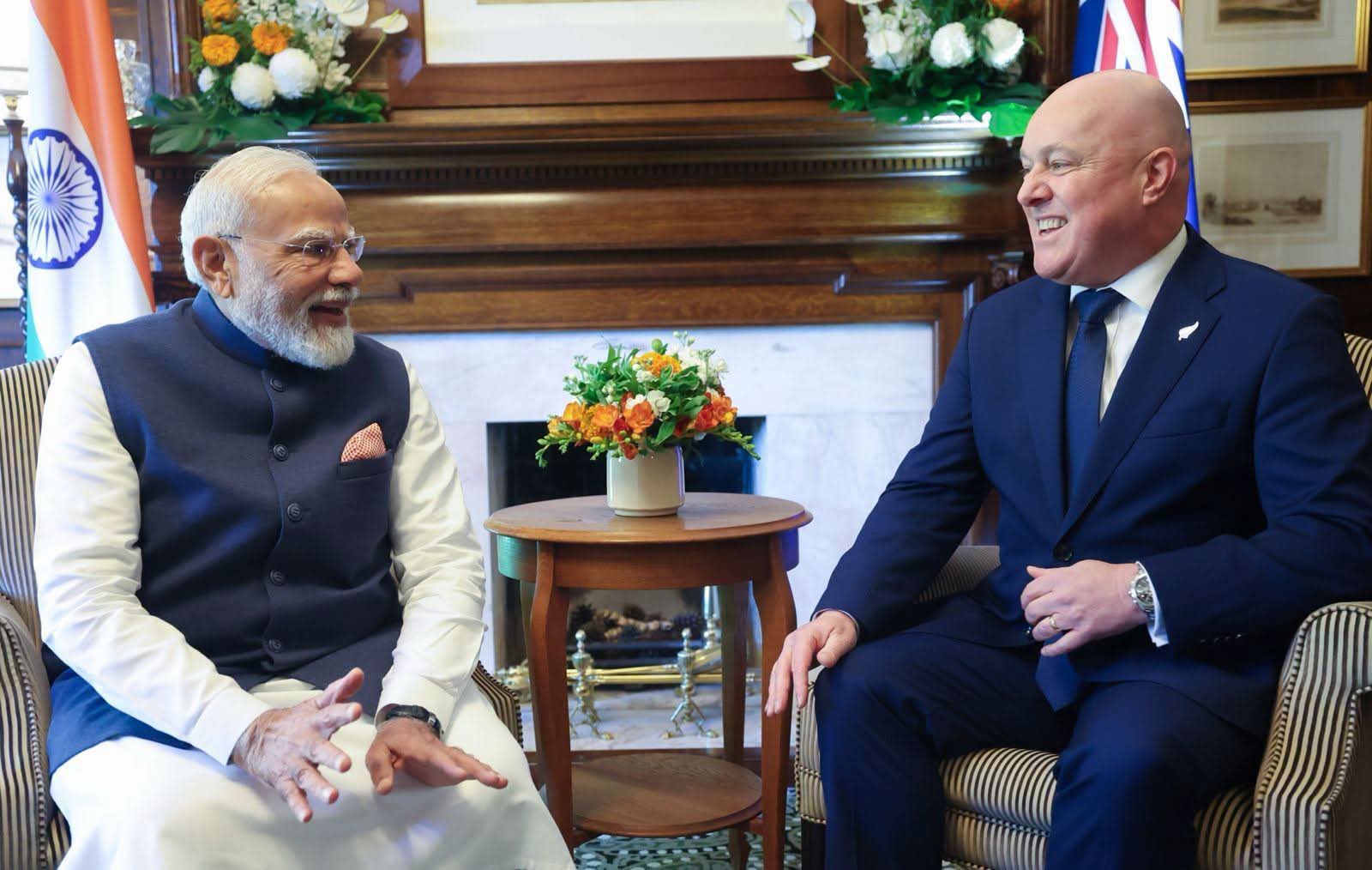
India and New Zealand on Saturday elevated their bilateral ties to a Strategic Partnership, with Prime Minister Shri Narendra Modi and New Zealand Prime Minister Christopher Luxon unveiling the India–New Zealand Strategic Partnership: Roadmap to 2030, a comprehensive framework aimed at expanding cooperation across defence, trade, security, education, science and people-to-people exchanges over the next four years.
The roadmap outlines six key pillars of cooperation and provides a structured framework to deepen engagement through regular high-level political dialogue, enhanced defence collaboration, stronger economic ties and closer coordination on regional and global issues.
Enhanced Political and Defence Engagement:
Under the roadmap, both countries agreed to institutionalise regular meetings between their Prime Ministers, Foreign Ministers and senior government officials while expanding parliamentary exchanges and ministerial visits.
In the defence and security domain, India and New Zealand committed to strengthening military cooperation through bilateral exercises, maritime engagements, personnel exchanges, high-level defence dialogues and implementation of the 2025 Memorandum of Understanding on Defence Cooperation.
The two sides will also operationalise recently concluded agreements on maritime cooperation, hydrography and nautical cartography, along with a Mutual Logistics Support Arrangement focused on the maritime domain. Regular bilateral naval exercises and an annual Maritime Security Dialogue will further reinforce cooperation in the Indo-Pacific.
The roadmap also envisages enhanced collaboration in counter-terrorism, cyber security, law enforcement, anti-narcotics operations and disaster resilience, including operationalisation of a Joint Working Group on Counter-Terrorism and closer cooperation between India’s National Investigation Agency and the New Zealand Police.
Target to Double Bilateral Trade by 2030:
Recognising the growing economic relationship, both countries have set an ambitious target of doubling bilateral trade in goods and services to NZ$7 billion (approximately ₹35,000 crore) by 2030.
The roadmap calls for early implementation of the proposed India–New Zealand Free Trade Agreement, operationalisation of the Authorised Economic Operators Mutual Recognition Arrangement (AEO-MRA) and simplified customs procedures to facilitate trusted trade.
Cooperation will also be expanded in horticulture, forestry, animal husbandry and dairying, while both governments will work towards increasing tourism through industry partnerships and encouraging direct non-stop air connectivity under the updated Air Services Agreement.
Expanding People-to-People Ties:
The Strategic Partnership places significant emphasis on strengthening people-to-people relations through greater engagement with the Indian diaspora, expanded cooperation in sports, cultural exchanges and traditional medicine.
Both countries will also promote collaboration between maritime institutions, encourage local government partnerships and implement cultural cooperation initiatives to deepen mutual understanding.
Focus on Education, Innovation and Climate Action:
India and New Zealand agreed to strengthen collaboration in education, research, science and technology by implementing the 2025 Education Cooperation Arrangement, expanding institutional partnerships and promoting joint research in agriculture, climate resilience, digital transformation and emerging technologies.
The roadmap also envisages closer cooperation on climate action through initiatives such as the International Solar Alliance and the Global Biofuels Alliance, alongside enhanced disaster management cooperation between India’s National Disaster Management Authority and New Zealand’s National Emergency Management Agency.
Stronger Regional and Multilateral Cooperation:
At the regional and multilateral level, both countries reaffirmed their commitment to a free, open, inclusive and rules-based Indo-Pacific, while agreeing to strengthen cooperation under the Indo-Pacific Oceans Initiative and support peaceful resolution of maritime disputes in accordance with international law, particularly the United Nations Convention on the Law of the Sea (UNCLOS).
The two nations also agreed to enhance coordination at the United Nations, support reforms of the UN Security Council, including India’s candidature for permanent membership of a reformed Security Council, and extend mutual support for candidatures in international organisations wherever possible.
The India–New Zealand Strategic Partnership: Roadmap to 2030 serves as a non-binding framework to guide bilateral cooperation and does not create any legal or financial obligations under domestic or international law. It marks a significant step in advancing the comprehensive relationship between the two countries across strategic, economic and regional dimensions.
