



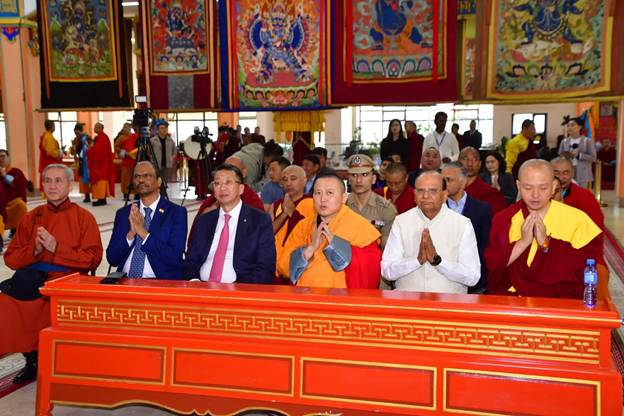
The Holy Relics of Lord Buddha’s two chief disciples, Arhant Sariputra and Arhant Maudgalyayana, returned to India on Tuesday following a highly successful 10-day public exposition at the Gandan Tegchenling Monastery in Ulaanbaatar, Mongolia.
The exposition, held from May 31 to June 9, 2026, was organised by the National Museum of India under the Ministry of Culture in collaboration with the Government of Madhya Pradesh, the Mahabodhi Society of Sri Lanka, and the International Buddhist Confederation (IBC), at the request of the Gandan Tegchenling Monastery. The sacred relics were opened for public viewing on the occasion of Mongolian Buddha Purnima on May 31.
The relics were ceremonially handed over on May 30 by Assam Governor Lakshman Prasad Acharya to Mongolia’s Minister of Education Enkh-Amgalan and His Eminence Ven. Khamba Nomun Khan Geshe Lharampa D. Javzandorj of the Gandan Tegchenling Monastery.
The exposition was announced by Prime Minister Narendra Modi during the State Visit of Mongolian President Khurelsukh Ukhnaa to India in October 2025. Rooted in centuries-old Buddhist traditions, India and Mongolia share deep spiritual and cultural ties, and the event provided Mongolian devotees a rare opportunity to pay homage to the revered relics.
According to organisers, nearly one lakh devotees from across Mongolia visited the monastery during the 10-day exposition. Mongolia has a population of approximately 3.4 million.
These sacred relics have previously been displayed abroad only in Thailand and Mongolia. Earlier, an exposition of the Holy Relics of Lord Buddha held in Mongolia in June 2022 had also received an overwhelming response from devotees.
Alongside the exposition, the National Museum of India and the International Buddhist Confederation organised three special exhibitions highlighting the spread and legacy of Buddhism:
Sariputta and Moggallana – A Journey of Wisdom, Devotion and Relics by the International Buddhist Confederation.
From India to Mongolia: The Transmission of Buddha Dhamma Across Inner Asia by the International Buddhist Confederation.
Vessels of Light: Iconography, Relics and Path of Dhamma (Shakyamuni Buddha’s Journey through Museum Collections of India) by the National Museum of India.
The Holy Relics are accorded the status of a Head of State for protocol and security purposes. They were transported to Mongolia on May 30 aboard a special Indian Air Force aircraft accompanied by an Indian delegation led by Assam Governor Lakshman Prasad Acharya.
Following the conclusion of the exposition, the relics were flown back to India aboard a special Indian Air Force aircraft accompanied by a delegation led by Lieutenant Governor of Ladakh Vinai Kumar Saxena. Ceremonial welcome and farewell events were organised at the Gandan Tegchenling Monastery to mark the occasion.
The Government of Mongolia provided full support for the exposition, while the Gandan Tegchenling Monastery oversaw all religious proceedings in accordance with the sacred status of the relics.
Speaking at the closing ceremony, several dignitaries, including His Eminence Ven. Khamba Nomun Khan Geshe Lharampa D. Javzandorj, Education Minister Enkh-Amgalan, Lieutenant Governor Vinai Kumar Saxena, Mahabodhi Society of Sri Lanka President Ven. Banagala Upatissa Thero, and International Buddhist Confederation Secretary General Shartse Khensur Rinpoche Jangchup Choeden, expressed gratitude to the Government of India and Prime Minister Narendra Modi for facilitating the exposition.
Before the relics departed for India, they were formally handed over by Minister Enkh-Amgalan and His Eminence Ven. Khamba Nomun Khan Geshe Lharampa D. Javzandorj to Lieutenant Governor Vinai Kumar Saxena.
At the airport, India’s Ambassador to Mongolia, Atul Malhari Gotsurve, presented a Mongolian plant sapling to the Lieutenant Governor. The sapling will be planted in Ladakh as a symbol of the enduring friendship and spiritual bond between India and Mongolia.
The organisers and the Gandan Tegchenling Monastery also acknowledged the support of the Embassy of India in Mongolia for its role in ensuring the successful conduct of the exposition.
The event is being viewed as another significant milestone in strengthening the long-standing spiritual, cultural and civilisational ties between India and Mongolia.
