



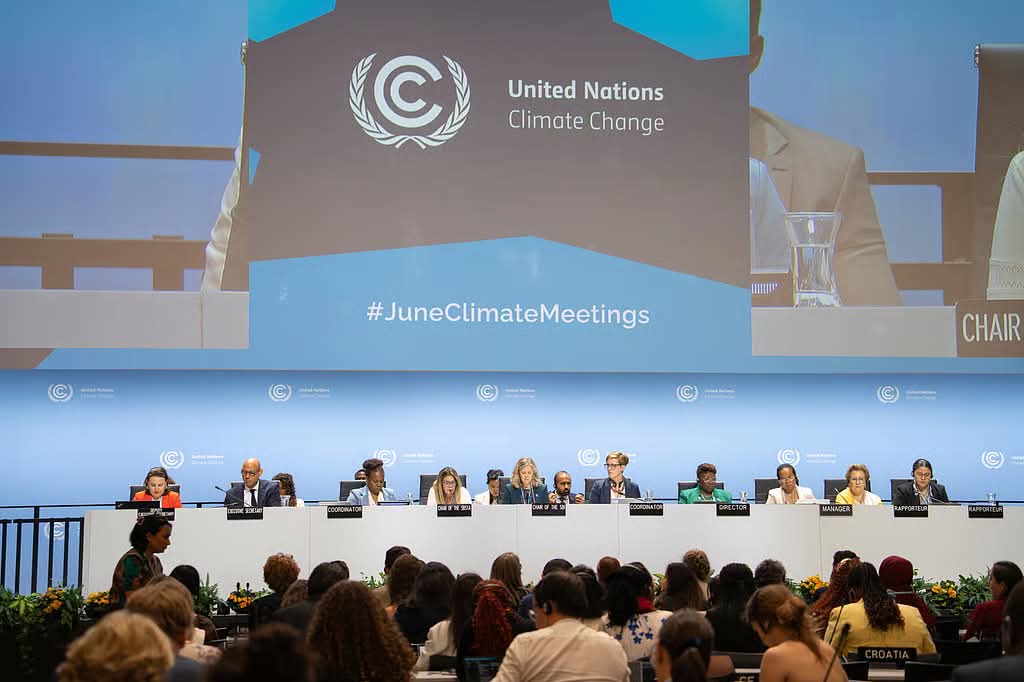
The latest round of UN climate negotiations in Bonn, Germany, concluded amid growing divisions between developed and developing countries, with several key discussions ending without substantive outcomes and major decisions deferred to COP31 in Antalya, Türkiye, according to the Centre for Science and Environment (CSE).
The talks took place against a backdrop of geopolitical conflicts, declining development assistance and escalating trade tensions. Negotiations on adaptation stalled, discussions on the future of the Mitigation Work Programme failed to reach consensus, and debates on trade, finance and science were marked by disagreements over responsibility, equity and support for developing countries.
CSE said that as the Paris Agreement enters the implementation phase, climate negotiations are increasingly confronting political disagreements over finance, historical responsibility and equitable burden-sharing. According to the organisation, developed countries have increasingly shifted discussions towards technical processes and scientific targets while avoiding commitments on finance and equity.
“Developing countries arrived in Bonn united in demanding delivery on existing commitments, including the pledge to triple adaptation finance agreed in Belém just months ago. They have now left having encountered little more than procedural stalling,” said Avantika Goswami, Programme Manager, Climate Change and Green Economy at CSE.
The conference ultimately deferred several contentious issues to COP31 later this year.
Just Transition:
Negotiations under the UAE Just Transition Work Programme focused on implementation, review mechanisms and operationalisation of a just transition mechanism. Discussions highlighted issues such as the right to development and the implications of trade-related measures.
“The discussions on the scope and functions of the just transition mechanism evolved and showed progress,” said Rudrath Avinashi, Programme Officer, Climate Change and Green Economy, CSE. “It was consistently viewed by the developing countries as a tool that would enhance the means of implementation, including finance, technology transfer and capacity building; however, developed countries wanted to limit its scope to a knowledge-sharing platform.”
The conclusions prepared by the co-chairs will form the basis for further negotiations at COP31.
Trade and Climate:
The first UNFCCC Dialogue on Trade and Climate saw developing countries raise concerns over climate-related trade measures such as carbon border adjustment mechanisms, deforestation regulations and reporting requirements. They argued that such measures could hinder industrialisation and development while developed countries continue to fall short on commitments related to finance, technology transfer and capacity building.
Developed countries, led by the European Union, defended the measures as tools to support decarbonisation and emphasised the role of trade in advancing climate action.
Developing countries also called for a more structured dialogue process and formal documentation to ensure that concerns raised during the discussions influence future negotiations and the planned 2028 high-level event.
“The trade and climate dialogues must have concrete discussions assessing how trade measures impact development, and how the Global South can participate meaningfully in low-carbon value chains rather than be locked into extractive roles as raw material suppliers,” says Goswami.
Transition Away from Fossil Fuels:
Discussions on the roadmap for Transitioning Away from Fossil Fuels (TAFF), launched at COP30 in Belém, revealed continuing divisions between developed and developing countries. Developing nations sought a framework grounded in equity and the principle of Common but Differentiated Responsibilities and Respective Capabilities (CBDR-RC), while developed countries emphasised science-based targets and increased ambition.
Small island states questioned the classification of debt instruments as climate finance, while several developing countries stressed the importance of technology transfer and industrial development.
“The process initiated by Brazil shows promise, with focus on national country circumstances and structural barriers to the transition for the Global South. But any framework that is produced, must be applied by the developed world first to produce national transition roadmaps with concrete near-term actions,” said Goswami.
“For the Global South, an equitable transition must account for energy access, upholding low carbon pathways to development, and meeting countries’ aspirations for green industrialisation and structural transformation,” she added.
Global Goal on Adaptation:
Negotiations on the Global Goal on Adaptation (GGA) ended without agreement after countries failed to bridge differences over adaptation finance, implementation support and governance arrangements.
Developing countries argued that adaptation efforts must remain linked to finance, technology transfer and capacity-building commitments, while some developed countries pushed for a narrower focus on technical indicators and methodologies.
A compromise proposal failed to secure consensus and the issue was deferred under Rule 16 of the UNFCCC rules of procedure.
“The GGA discussions have led to a disappointing outcome. The discussion has gravitated more and more towards questions over methodologies, metadata, and expert processes, rather than on public investment, institutional capacity, and support for vulnerable countries. While technical work is important, adaptation is critically dependent upon the means of implementation,” said Trishant Dev, Deputy Programme Manager, Climate Change and Green Economy, CSE.
“Discussions on adaptation finance must move beyond diplomatic applause for commitments to ‘triple’ finance. Developing countries cannot adapt on the basis of ‘welcomed’ commitments alone,” Dev added.
Climate Finance:
Climate finance remained one of the most contentious issues at the Bonn talks. Developing countries expressed frustration over limited progress under the Climate Finance Work Programme (CFWP), which is intended to advance implementation of Article 9.1 of the Paris Agreement requiring developed countries to provide financial resources to developing nations.
“Despite expectations for meaningful outcomes, the Climate Finance Work Programme has yet to secure a clear pathway to substantive discussions or accountability at COP31, raising concerns that the process risks becoming a series of procedural exchanges or a ‘talk shop’ rather than a mechanism for delivering finance commitments”, said Sehr Raheja, Deputy Programme Manager, Climate Change and Green Economy, CSE.
Discussions on the roadmap to mobilise US$1.3 trillion in climate finance also highlighted uncertainty over implementation, monitoring and accountability mechanisms.
The first Veredas Dialogue, which succeeded the Sharm el-Sheikh Dialogue, focused on aligning global financial flows with climate goals under Article 2.1(c) of the Paris Agreement. Participants discussed national approaches to climate finance, adaptation funding and barriers faced by developing countries.
“While the Veredas Dialogue discussions were constructive, civil society emphasised that implementation must not be a substitute for developed countries’ obligations under Article 9. The Dialogue sets the stage for the upcoming Xingu Finance Talks, which will take place alongside the World Bank-IMF Annual meetings later this year in Bangkok,” pointed out Upamanyu Das, Programme Officer, Climate Change and Green Economy, CSE.
Finance-related concerns also featured prominently across negotiations on just transition and adaptation, with developing countries continuing to call for stronger financial support, technology transfer and capacity-building measures.
Mitigation Work Programme:
Negotiations on the future of the Mitigation Work Programme (MWP), whose current mandate ends this year, failed to produce an agreement. Countries remained divided over whether the programme should prioritise raising mitigation ambition or focus on addressing implementation barriers faced by developing nations.
Parties were unable to agree on the programme’s future mandate, scope and modalities, leaving the matter for consultations under the incoming COP31 Presidency.
“The Mitigation Work Programme has forever remained deadlocked between developing countries’ demands to address the financial, technological and capacity constraints that continue to hinder climate action, and developed countries’ push to focus on diagnosing the ambition gap,” says Dev.
(Article based on CSE’s briefing)
Pic: CSE
