



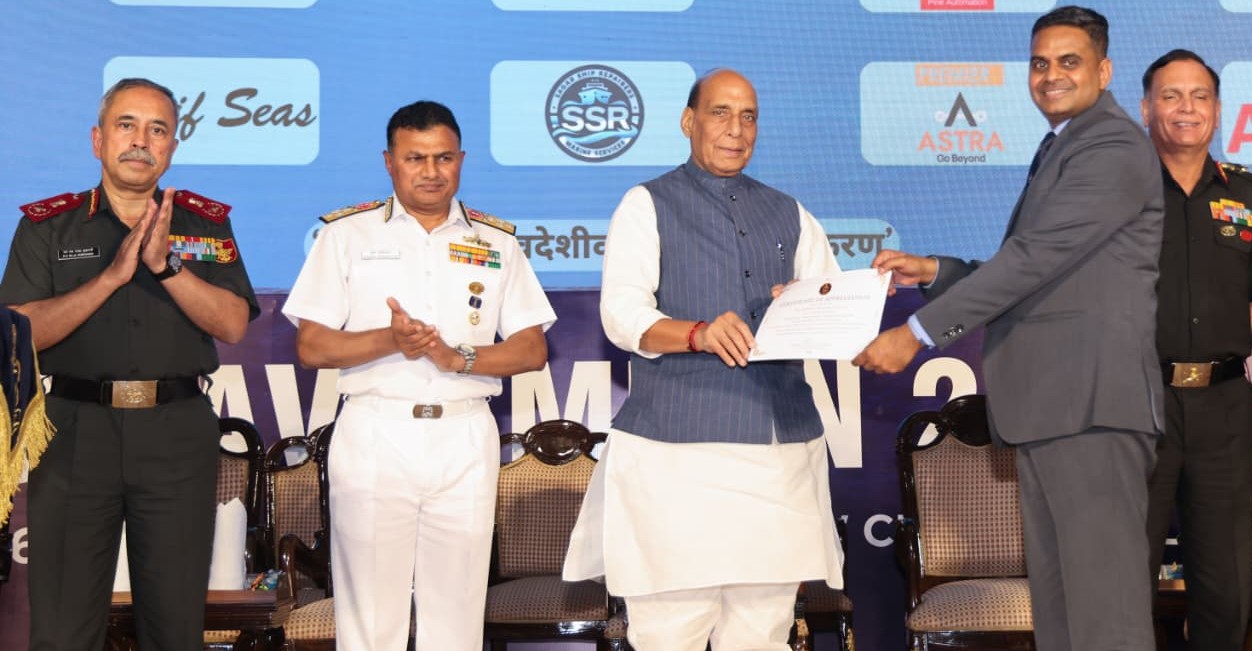
Defence Minister Rajnath Singh has called for a new phase of defence self-reliance, termed ‘Aatmanirbharta 2.0’, with a focus on developing advanced indigenous technologies, strengthening research and development (R&D), and building resilient domestic supply chains to reduce import dependence and enhance India’s technological capabilities.
Addressing the fifth edition of SWAVLAMBAN, the Indian Navy’s Naval Innovation and Indigenisation Seminar, in New Delhi on October 26, the Defence Minister said the next phase must build on the progress achieved in defence indigenisation and pursue more challenging technological objectives in support of the vision of Viksit Bharat@2047.
He stressed that India must develop defence products that are cost-effective, operationally superior and globally competitive, moving beyond the emphasis on the quantity of indigenous equipment to focus equally on quality, efficiency and affordability.
Supply Chain Security a Strategic Priority:
Highlighting the strategic importance of supply chain management, Rajnath Singh said dependence on external sources for critical raw materials and technologies could pose challenges to national security. He called for a time-bound roadmap identifying critical technologies, domestic industries and resources required to achieve self-reliance in key areas.
The Defence Minister emphasised the need to assess potential disruptions to international supply routes in advance and strengthen domestic production capabilities and buffer stocks. He identified critical materials, including rare earth elements, and technologies that remain unavailable domestically as priority areas for indigenisation.
According to him, preparedness must precede a crisis, with a systematic approach to reducing vulnerabilities in essential defence supply chains.
R&D and Private Sector Participation:
The Defence Minister underscored research and development as a central pillar of the next phase of self-reliance. He called for greater private-sector participation, particularly in high-risk, high-reward projects, and encouraged the development of low-cost technologies that enable experimentation and innovation.
Recognising that research inevitably involves failures, he advocated a shift in institutional attitudes towards risk-taking and experimentation. He cited innovation ecosystems in countries such as Israel, South Korea and the United States as examples of how sustained research efforts and a willingness to learn from setbacks can support technological progress.
Rajnath Singh also called for stronger industry-academia collaboration, greater encouragement for research in educational institutions and expanded opportunities for young people to pursue careers in science, engineering and defence technology.
iDEX Boosts Indigenous Innovation:
Highlighting the contribution of the Innovations for Defence Excellence (iDEX) initiative, the Defence Minister said Indian start-ups and micro, small and medium enterprises (MSMEs) were developing solutions in areas previously dependent on imports.
More than 4,000 proposals have been submitted against 229 challenges issued by the Indian Navy, reflecting the participation of entrepreneurs and innovators in addressing operational requirements.
The initiative has supported the development of indigenous solutions in naval systems, sensors, communications and other critical technologies, translating operational challenges into opportunities for domestic innovation.
Rajnath Singh also pointed to the rising demand for naval ships amid the evolving strategic environment in the Indian Ocean Region. Given the capital-intensive nature of shipbuilding, he stressed the need to reduce costs while expanding domestic manufacturing capacity.
He further highlighted the need to address remaining import dependencies, particularly Buyer Nominated Equipment, to advance the Navy’s indigenisation efforts.
Dual-Use Technologies and Jointness:
Calling for a broader approach to defence innovation, the Defence Minister proposed a ‘Dual Technology Roadmap’ to identify technologies that can serve both civilian and military applications.
He also advocated identifying technologies that could be used across the Army, Navy, Air Force and Indian Coast Guard, describing common technological applications as an important dimension of inter-service jointness.
The approach is intended to expand the benefits of indigenous research, reduce duplication and strengthen technological cooperation across the defence ecosystem.
The Defence Minister highlighted emerging fields such as quantum technologies, artificial intelligence in warfighting and uncrewed systems, stressing that their development would require sustained collaboration among the armed forces, industry and academic institutions.
Navy Expands Innovation and Indigenisation:
Chief of the Naval Staff Admiral Krishna Swaminathan highlighted the growth of SWAVLAMBAN since its launch in 2022. Navy-specific iDEX challenges have increased from 20 to 229, accounting for approximately 35 per cent of all iDEX challenges across the defence sector.
He stated that 41 Acceptance of Necessity (AoN) cases, worth more than ₹3,500 crore, had been accorded, while 25 contracts valued at over ₹1,900 crore had been signed.
The Navy Chief emphasised the need to accelerate the transition of promising innovations into operational capabilities, identifying five key areas: ideation, prototyping, testing, contracting and induction, and life-cycle support.
He called for closer collaboration among the Navy, industry, start-ups and MSMEs to accelerate the development and deployment of indigenous technologies.
Secretary (Defence Production) Sanjeev Kumar described SWAVLAMBAN 5.0 as an important platform for bringing together stakeholders to address emerging operational requirements, explore new technologies and expand indigenous manufacturing capacity. He urged stakeholders to move from competition towards collaboration to strengthen national security and defence innovation.
Technology Showcase and Recognition:
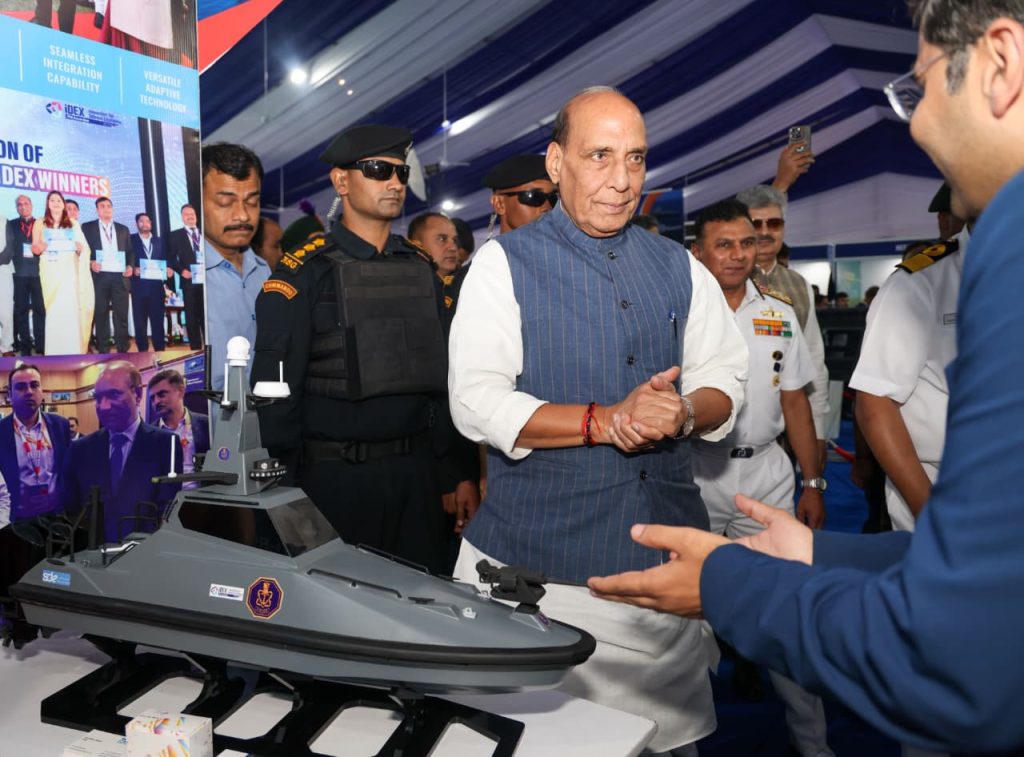
During the event, the Defence Minister visited an exhibition featuring more than 100 stalls by start-ups and MSMEs, showcasing technologies developed to address naval operational challenges.
The exhibits covered autonomous maritime platforms, quantum technologies, artificial intelligence in warfighting, persistent surveillance, resilient navigation, advanced communications and counter-drone systems.
Rajnath Singh also released the Compendium of Technology Imperatives, Problem Statements and Future Concepts and the Swavlamban 5.0 document, outlining naval priorities and opportunities for industry. He felicitated eminent speakers and iDEX innovators for their contributions to indigenous defence capabilities.
SWAVLAMBAN 5.0, organised by the Indian Navy in collaboration with the Defence Innovation Organisation and the Society of Indian Defence Manufacturers (SIDM), is being held at the Manekshaw Centre in New Delhi on October 26–27, 2026. The theme is ‘Strength and Power through Innovation and Indigenisation’.
The seminar features discussions on quantum technologies, artificial intelligence, autonomous systems and hypersonic technologies, alongside sessions on domestic supply chains, academic entrepreneurship, start-up development and investment opportunities.
The emphasis on ‘Aatmanirbharta 2.0’ places advanced technology, industrial resilience and collaborative innovation at the centre of India’s next phase of defence indigenisation.
