



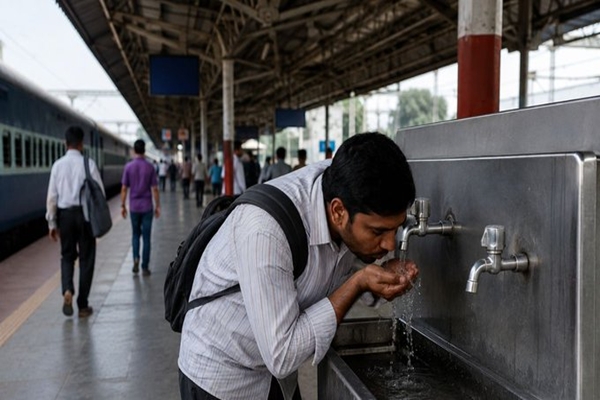
Indian Railways has launched a special cleanliness and disinfection drive across its network to ensure the availability of safe and hygienic drinking water for passengers at railway stations.
As part of the initiative, Zonal Railways have been directed to undertake comprehensive inspections of drinking-water infrastructure and identify deficiencies requiring immediate corrective action. The drive focuses on strengthening preventive maintenance and water-quality monitoring across the entire supply chain.
During the campaign, officials will inspect water sources, treatment and filtration plants, underground and overhead tanks, PVC tanks, water booths, taps and water dispensing points. Drinking-water tanks will be drained, desludged, scrubbed and disinfected. Officials will also ensure that tanks have secure covers and that vents and overflow points are protected from contamination by birds, animals and algae.
Damaged tanks, pipelines and filters will be repaired or replaced wherever necessary. The Railways will also check for cross-connections between potable and non-potable water systems and inspect drinking-water pipelines for leakages to prevent contamination and water wastage.
Special attention will be given to stations and locations where hand pumps and borewells are used as drinking-water sources. Zonal Railways have been instructed to ensure that water from these sources remains free from contamination and is safe for consumption.
Focus on Water Coolers and Purification Systems:
The Railway Board has also directed Zonal Railways to carry out detailed inspections of water coolers and purification systems. Water-cooler tanks will be thoroughly cleaned, while leakages in coolers, pipelines and taps will be repaired promptly.
UV and RO purification systems will be checked for proper functioning and installed wherever required. Scheduled maintenance, servicing and overhauling will be undertaken, along with timely replacement of filter candles and other components.
The same cleaning, purification and quality-monitoring measures will apply to Water Vending Machines to ensure that water dispensed through these facilities meets prescribed safety and hygiene standards.
Officials will conduct physical, chemical and bacteriological tests of water samples at identified locations, including water sources, post-treatment outlets, tanks, coolers, vending machines and representative taps and booths wherever feasible. Daily monitoring of residual chlorine will also be carried out, with immediate re-chlorination or other corrective measures wherever required.
Station-Wise Monitoring of Deficiencies:
The Railway Board has directed Zonal Railways to monitor and expedite sanctioned works for the replacement and construction of new overhead and underground water tanks. Details of sanctioned works will be compiled, while proposals for fresh sanctions will be processed wherever necessary.
The Railways is also working on suitable filtration and purification solutions for different points in the supply chain, including at-source and at-tap filtration, to identify and prevent contamination at various stages.
Zonal Railways will submit station-wise details of deficiencies identified during the drive, along with the corrective action taken. The monitoring mechanism is aimed at ensuring that shortcomings are addressed in a systematic and time-bound manner.
The action plan also extends to drinking-water infrastructure in railway colonies and workplaces, ensuring that railway personnel have access to safe and hygienic drinking water.
Through the special drive, Indian Railways is seeking to strengthen inspection, infrastructure maintenance, cleaning and disinfection, water-quality testing and corrective-action mechanisms across its drinking-water network. The initiative is aimed at ensuring a reliable supply of safe and clean drinking water for passengers and railway personnel.
(Image courtesy :AIR)
