



The Indian Navy today commissioned the indigenous stealth guided missile frigate INS Mahendragiri into the Eastern Fleet in the presence of Defence Minister Rajnath Singh, marking another milestone in India’s indigenous warship construction programme.
Built under Project 17A, INS Mahendragiri is the sixth stealth frigate of the class to join the Navy within the last 18 months. Designed by the Indian Navy’s Warship Design Bureau and constructed by Mazagon Dock Shipbuilders Limited (MDL), Mumbai, the warship has more than 75 per cent indigenous content.
With a displacement of around 6,670 tonnes and a maximum speed of 28 knots, the frigate is capable of undertaking the full spectrum of maritime operations, including fleet air defence, anti-surface warfare, anti-submarine warfare, maritime interdiction, surveillance and humanitarian assistance and disaster relief (HADR) missions.
The warship is equipped with advanced stealth features, network-centric combat systems, modern sensors and an integrated weapons package. It can be armed with BrahMos supersonic surface-to-surface missiles, medium-range surface-to-air missiles, indigenous anti-submarine rocket launchers, torpedo launchers, an Integrated Anti-Submarine Defence System, an electronic warfare suite and a Close-In Weapon System. It is also capable of operating a multi-role helicopter.
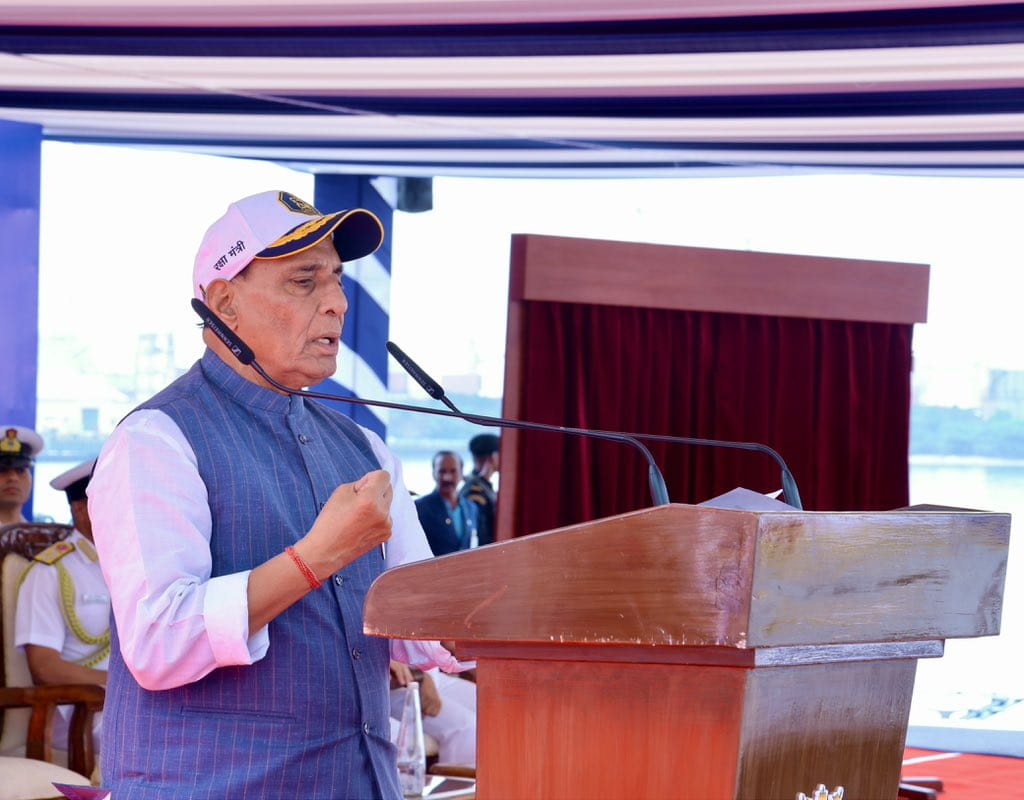
Addressing the commissioning ceremony, Defence Minister Rajnath Singh said INS Mahendragiri reflects India’s growing self-reliance in defence manufacturing and indigenous warship construction. He described the frigate as a technologically advanced frontline combat platform that would strengthen India’s ability to counter aerial, surface and underwater threats while enhancing the Navy’s blue-water operational capability.
The Defence Minister said emerging technologies such as artificial intelligence, drones, cyber warfare, space-based systems and hypersonic weapons are transforming warfare, but stressed that conventional military capabilities continue to remain the foundation of national defence. He said the government remains committed to investing in next-generation technologies while simultaneously strengthening conventional military capabilities.
Referring to Operation Sindoor, Rajnath Singh said the operation demonstrated the effective integration of conventional and advanced capabilities in safeguarding national security.
Highlighting the strategic importance of maritime security, the Defence Minister said secure seas are critical for trade, energy security, supply chains and economic growth. Reaffirming India’s commitment to the SAGAR (Security and Growth for All in the Region) vision, he said the Indian Navy has emerged as a First Responder and Preferred Security Partner in the Indo-Pacific through its timely humanitarian assistance, anti-piracy and evacuation operations.
He also referred to the Navy’s role during the recent West Asia conflict, stating that under Operation Urja Suraksha, it safely escorted 18 merchant vessels carrying cargo valued at over ₹9,000 crore, highlighting the service’s contribution towards protecting India’s economic interests.
Chief of the Naval Staff Admiral Krishna Swaminathan said INS Mahendragiri represents India’s expanding maritime capability and technological self-reliance. He noted that the Project 17A programme has achieved significant efficiencies, with the launch-to-delivery timeline reduced by nearly 50 per cent from 63 months to 31 months, while total construction time has been brought down from 95 months to 75 months.
The Navy Chief also said that all technical analyses for the warship were completed during a single sea trial instead of the conventional five to seven trials, crediting the achievement to the combined efforts of MDL, Indian industry, MSMEs, naval project teams and the ship’s crew.
Named after the Mahendragiri mountain range in the Eastern Ghats, the frigate carries the motto “Mighty, Majestic, Matchless.” Built with contributions from more than 200 Indian industries, including numerous MSMEs, INS Mahendragiri features a Combined Diesel or Gas (CODOG) propulsion system, an Integrated Platform Management System and advanced indigenous combat systems.
With its induction into the Eastern Fleet, INS Mahendragiri is expected to significantly enhance the Indian Navy’s maritime combat capability and operational reach across the Indian Ocean Region.
