



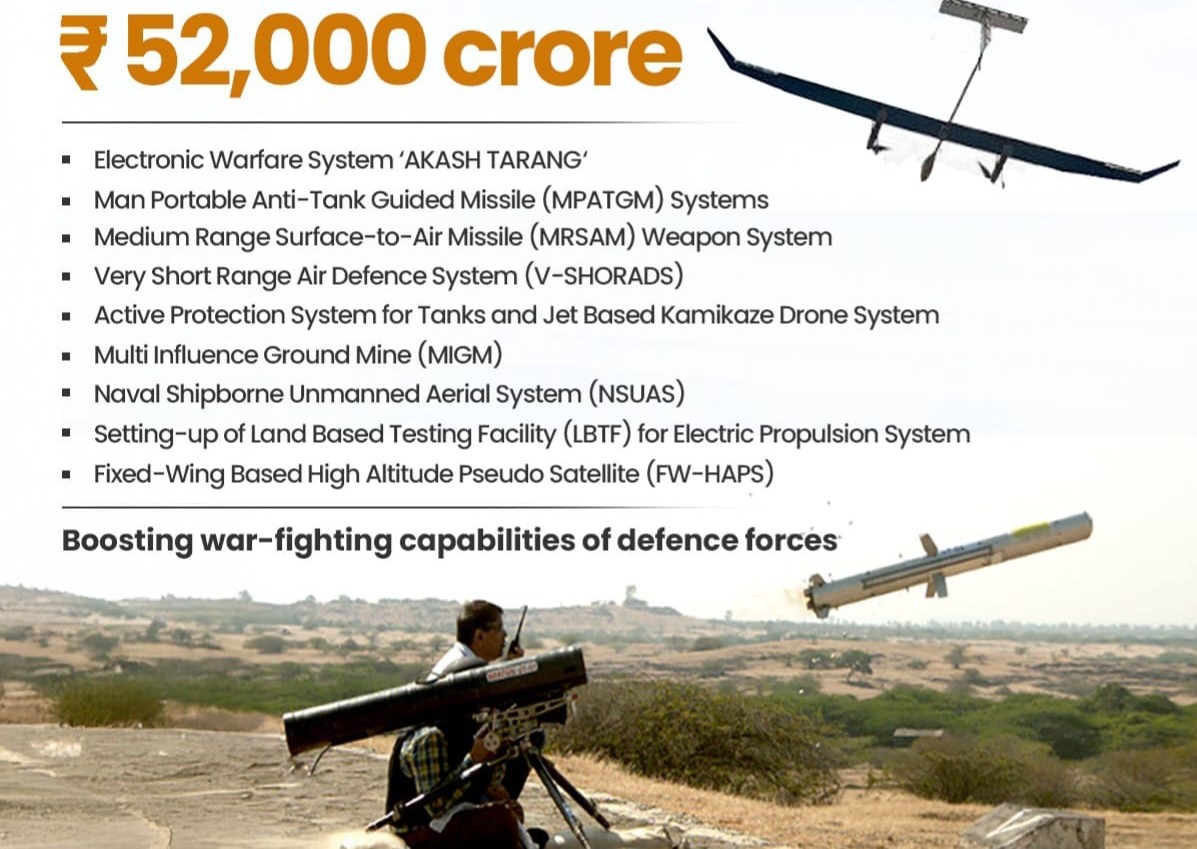
In one of the most significant defence modernisation decisions of the year, the Defence Acquisition Council (DAC), chaired by Defence Minister Rajnath Singh, has approved capital acquisition proposals worth approximately ₹52,000 crore, paving the way for the induction of advanced weapon systems and strategic technologies across the Indian Army, Navy and Air Force.
The Acceptance of Necessity (AoN) marks the first stage of the procurement process and reflects the government’s commitment to rapidly strengthening the operational capabilities of the Armed Forces amid evolving regional security challenges and the growing importance of unmanned and network-centric warfare.
Indian Army to Receive Next-Generation Air Defence and Precision Strike Systems:
The Indian Army emerged as the largest beneficiary of the latest approvals, with clearance granted for the procurement of six critical capability enhancement programmes.
Among the most notable is the AKASH TARANG Anti-Unmanned Aerial Vehicle (UAV) Electronic Warfare System, designed to detect, identify, jam and neutralise hostile drones. As drone warfare becomes increasingly prominent in modern conflicts, the system is expected to provide frontline formations with a robust counter-UAS shield.
The Army will also induct the Man Portable Anti-Tank Guided Missile (MPATGM), an indigenous third-generation fire-and-forget missile that will significantly enhance infantry units’ ability to engage enemy armoured vehicles.
Further strengthening India’s layered air defence architecture, the DAC approved procurement of the Medium Range Surface-to-Air Missile (MRSAM) Weapon System and the Very Short Range Air Defence System (V-SHORADS). Together, these systems will provide comprehensive protection against fighter aircraft, helicopters, cruise missiles and unmanned aerial platforms operating at varying altitudes.
To improve battlefield survivability of armoured formations, the Army will also acquire Active Protection Systems (APS) for tanks. These systems are capable of detecting and intercepting incoming anti-tank missiles and rocket-propelled grenades before impact, dramatically increasing the survivability of main battle tanks in high-intensity combat.
Another notable approval is the induction of Jet-Based Kamikaze Drone Systems, reflecting the Army’s increasing emphasis on precision loitering munitions capable of conducting long-range strikes with enhanced electronic warfare capability while maintaining a relatively low operational cost.
Indian Navy Strengthens Maritime Deterrence:
For the Indian Navy, the DAC approved the acquisition of Multi Influence Ground Mines (MIGM), Naval Shipborne Unmanned Aerial Systems (NSUAS) and the establishment of a Land Based Testing Facility (LBTF) for Electric Propulsion Systems.
The induction of MIGM will strengthen the Navy’s sea-denial capabilities by restricting adversary movement in critical maritime zones and protecting strategic approaches.
The NSUAS will significantly expand the Navy’s intelligence, surveillance and reconnaissance (ISR) capabilities by providing persistent airborne monitoring of the maritime battlespace. Equipped with advanced electro-optical and surveillance sensors, these unmanned systems will improve fleet situational awareness and operational responsiveness.
The planned Land Based Testing Facility will support the testing and validation of indigenous electric propulsion technologies, a critical capability for the next generation of Indian naval warships.
Indian Air Force Moves Towards Persistent Stratospheric Surveillance:
The Indian Air Force received approval for the procurement of Fixed-Wing High Altitude Pseudo Satellite (FW-HAPS) platforms along with other capability enhancement proposals.
Operating at stratospheric altitudes for extended periods, FW-HAPS platforms combine many of the advantages of satellites and unmanned aircraft. They are capable of providing continuous intelligence, surveillance and reconnaissance (ISR), secure communications and remote sensing without the high costs associated with space-based assets.
These systems are expected to play an increasingly important role in border surveillance, disaster response, communication relay and strategic reconnaissance missions.
Modernisation Aligned with Future Warfare:
The latest DAC approvals highlight India’s continued shift towards technology-driven warfare, with particular emphasis on integrated air defence, autonomous systems, electronic warfare, precision strike capability and persistent intelligence gathering.
The procurement package also reflects the Armed Forces’ growing focus on countering emerging threats ranging from drone swarms and precision-guided munitions to electronic warfare and contested maritime environments.
As these programmes move into the procurement and contract negotiation phase, they are expected to significantly enhance India’s military readiness while supporting the government’s long-term objective of expanding indigenous defence manufacturing and reducing dependence on imported military hardware.
