



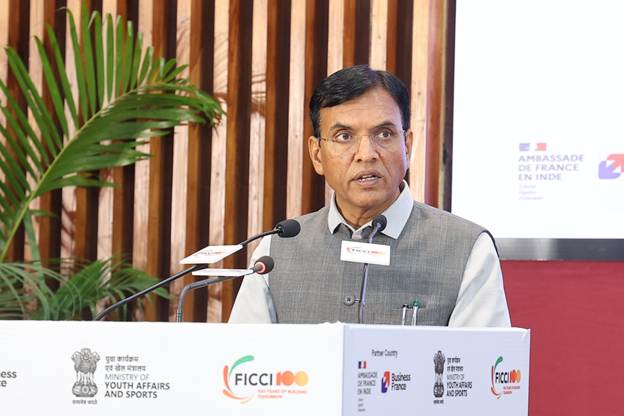
Union Minister for Youth Affairs and Sports Dr. Mansukh Mandaviya has called upon domestic and international sports industry leaders to partner with India in building a globally competitive sports economy, emphasising the role of private investment, innovation, manufacturing and infrastructure in transforming the country’s sporting ecosystem.
Inaugurating the 16th edition of TURF, FICCI’s Global Summit on Business of Sports, in New Delhi on Friday, Dr. Mandaviya said sports had evolved beyond competition to become a powerful driver of youth development, social inclusion, economic opportunity and international cooperation.
Highlighting the government’s vision under Prime Minister Narendra Modi, the Minister said India’s sports development strategy was focused on creating opportunities for aspiring athletes at every level, from grassroots participation to international podium success.
He cited initiatives such as the Khelo India Mission, Fit India Movement and Target Olympic Podium Scheme (TOPS) as key pillars of the country’s efforts to identify talent, strengthen sporting infrastructure and develop high-performance athletes.
The Union Cabinet has recently approved the new Khelo India Scheme with an outlay of ₹36,441 crore over five years to expand sports infrastructure, nurture talent and strengthen sports development nationwide.
Highlighting India’s growing international sporting performance, Dr. Mandaviya noted that the country finished fourth in the medal standings at the Asian Games 2026. India’s para-athletes also achieved a historic milestone at the Asian Para Games 2026, winning a record 114 medals.
Building a globally competitive sports industry:
Emphasising the importance of industry participation, the Minister said the future of sports would depend not only on athletes and sporting institutions but also on a strong, competitive and innovation-driven sports industry.
The government has approved the Khelo India Sports Goods Manufacturing Scheme with an outlay of ₹1,856.67 crore to position India as a global hub for sports goods manufacturing and innovation.
He also highlighted Khelo Bharat Niti 2025 and the National Sports Governance Act as important measures aimed at strengthening sports administration, accountability and transparency.
Dr. Mandaviya identified significant investment opportunities in sports infrastructure, high-performance academies, sports science, technology and athlete-management systems. He said greater private-sector participation could introduce efficiency, innovation and international best practices into India’s sporting ecosystem.
India’s ambitions on the global sporting stage:
The Minister also outlined India’s ambitions to host major international sporting events, including the Commonwealth Games 2030 in Ahmedabad, while pursuing its aspiration to host the 2036 Olympic Games in the city.
He noted that India had successfully hosted 40 international sporting competitions across 18 cities in the preceding 18 months, demonstrating the country’s growing organisational capabilities and sporting infrastructure.
Calling for a long-term partnership between government, industry and international sporting institutions, Dr. Mandaviya said India’s ambition was to evolve from a sporting nation into a global sports economy.
He invited international partners, investors, manufacturers and sporting organisations to contribute to this transformation, concluding with a call to action: “Make in India, Play in India, and Grow with India.”
The summit, themed “Powering India’s Sports Economy: Partnerships, Innovation & Global Leadership”, brought together sports industry leaders, international partners, policymakers, athletes and business representatives to discuss opportunities for strengthening India’s position in the global sports ecosystem.
