



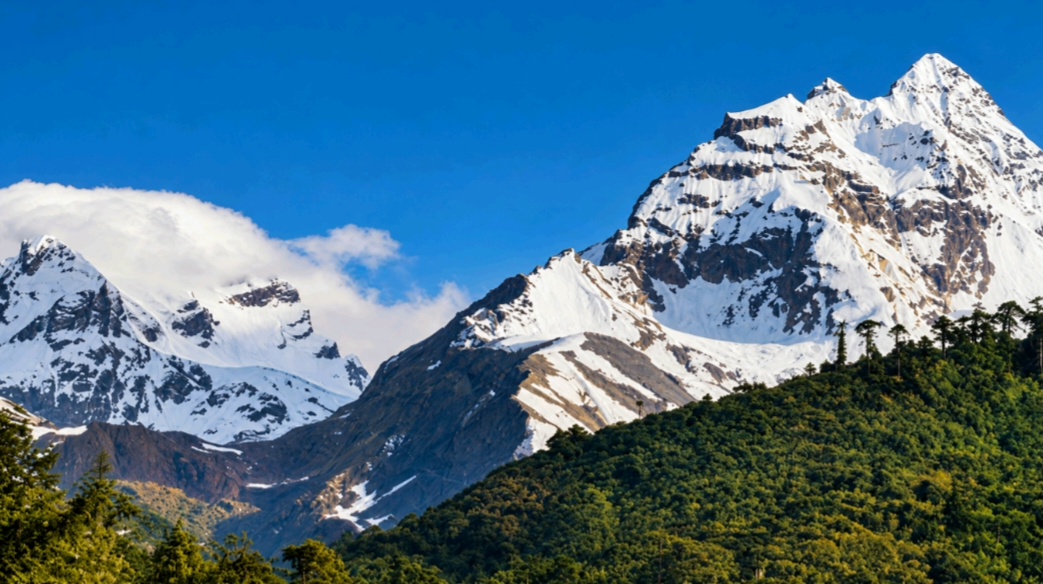
The ancient Tibetan Buddhist pilgrimage of Dakpa Sheri stands as a powerful reminder that political boundaries can divide territories, but they cannot erase centuries of spiritual heritage, cultural memory and indigenous history.
The Himalayas are not merely a geographical frontier. They are a living archive of ancient civilisations, spiritual traditions and cultural connections that existed long before modern nation-states drew lines across their rugged landscapes. Among the sacred peaks of the eastern Himalayas, Dakpa Sheri occupies a distinctive place in Tibetan Buddhist belief—a mountain revered for centuries as a realm of purification, devotion and spiritual liberation.
Known as the Sacred Crystal Mountain, Dakpa Sheri rises to approximately 5,735 metres in present-day Tibet. Its name, rooted in the Tibetan language, evokes purity, crystal and the sacredness of the mountain itself. Also referred to in historical accounts as Tsari and by variant transliterations, it is far more than a geographical landmark. For generations of Tibetan Buddhists, it has represented a sacred landscape in which faith, nature and the pursuit of liberation are inseparably connected.
Today, its significance extends beyond religion. The mountain and its lost pilgrimage route raise important questions about the preservation of historical names, indigenous communities, cross-border cultural heritage and the consequences of political boundaries imposed upon an older Himalayan world.
A MOUNTAIN WHERE FAITH TRANSCENDED GEOGRAPHY:
In Tibetan Buddhist tradition, Dakpa Sheri is not simply a peak to be admired from a distance. Its surrounding valleys, forests, streams, caves and mountain passes form an integrated sacred landscape, where natural features are associated with religious teachings, legends and spiritual experiences.
For centuries, pilgrims travelled through this formidable terrain to undertake the Rongkor Chenmo, also known as the Great Circumambulation or Ringkor. Traditionally associated with the Monkey Year of the Tibetan calendar, this major pilgrimage drew devotees who believed that completing the arduous circuit could bring profound spiritual merit and purification.
The journey demanded extraordinary physical endurance. Pilgrims negotiated dense forests, steep mountain paths, fast-flowing rivers and unpredictable Himalayan weather. In an era without modern roads, permanent bridges or organised emergency medical services, even a short stretch of the route could become life-threatening.
Yet the hardships were integral to the pilgrimage’s spiritual significance. The journey required discipline, humility and unwavering faith. The mountain’s frequently concealed summit, shrouded in clouds and mist, reinforced its mystical character.
Dakpa Sheri thus became a powerful expression of a belief central to Tibetan Buddhist culture: that the natural world is not separate from spiritual life, but can itself become a pathway towards awakening.
DOLMA: THE SACRED LEGEND THAT ENDURES:
At the heart of Dakpa Sheri’s religious identity lies the veneration of Dolma, the Tibetan name for Tara, a revered figure associated with compassion, protection and the liberation of beings from suffering.
According to local religious traditions, the mountain’s remote pastures were associated with Dolma and her sacred yaks. This belief helped establish the spiritual importance of the surrounding landscape, including its lakes, rocks, caves and grazing grounds.
For believers, these places are not simply natural formations. They carry accumulated layers of devotion, inherited stories and collective memory.
Tara is also venerated in Hindu traditions, where the goddess appears in a distinct theological context as one of the ten Mahavidyas. Although the two traditions understand and interpret the deity differently, their respective religious histories illustrate the rich and interconnected spiritual world of the wider Himalayan region.
The traditions surrounding Dakpa Sheri therefore represent more than the history of a single pilgrimage. They reflect a broader cultural landscape in which sacred geography, oral traditions and religious imagination shaped the relationship between communities and their environment.
THE ANCIENT ROUTE THROUGH TODAY’S BORDERLANDS:
One of the most remarkable aspects of the Dakpa Sheri pilgrimage was its geographical reach.
The traditional route began in Tibet, crossed areas now situated in Arunachal Pradesh and returned towards Tibet, following the Tsari Chu river through forests and indigenous territories. The journey connected religious centres, settlements and communities across a landscape that was not organised according to today’s international boundaries.
The region was consequently a corridor of cultural interaction as well as a challenging mountain environment. Pilgrims depended on local knowledge, safe passage and the cooperation of communities living along the route.
Historical accounts refer to some of these communities as “Lopa”, a term used in Tibetan and colonial-era records for indigenous populations of the region. The historical terminology does not correspond neatly to modern ethnic classifications, although some accounts associate these communities with the Tagin and other indigenous peoples of present-day Arunachal Pradesh.
Relations between Tibetan authorities, pilgrims and local communities reportedly involved exchanges of salt, cloth, iron goods and other commodities. Some historical narratives also describe the provision of swords and other goods in connection with arrangements for safe passage.
The precise character of these exchanges requires careful interpretation: they have been described variously as customary payments, religious levies, gifts and reciprocal obligations. Nevertheless, the accounts point towards a longstanding relationship in which the successful passage of pilgrims depended on negotiated arrangements with local inhabitants.
This history challenges the simplistic assumption that the eastern Himalayas were always divided into impermeable political territories. Religious journeys, trade, customary rights and local relationships connected people across the mountains long before the modern border regime emerged.
The communities along the route were not merely spectators to this history. Their cooperation, knowledge and customary practices formed an essential part of the pilgrimage itself.
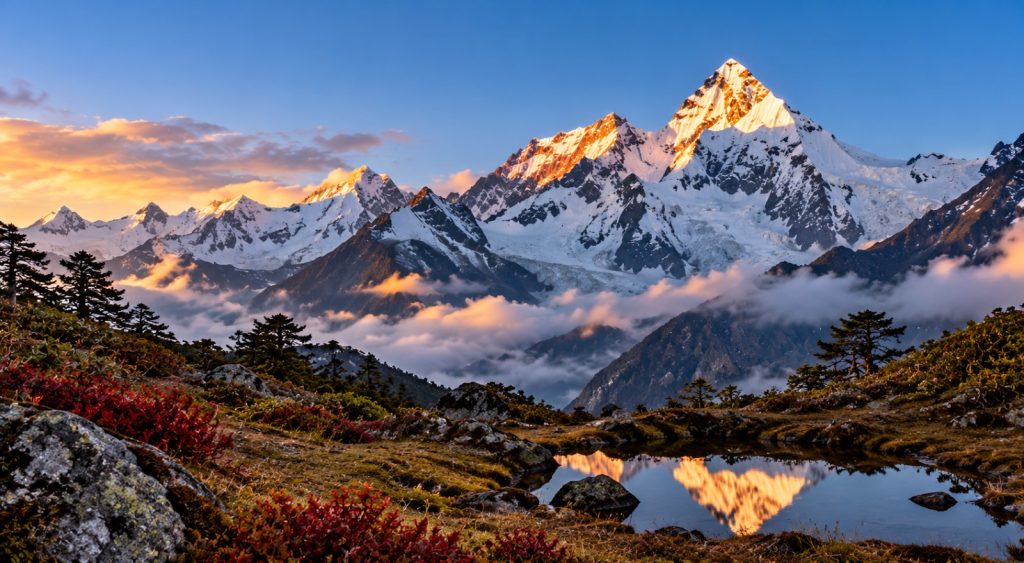
1956: WHEN THE GREAT PILGRIMAGE FELL SILENT:
The last major Rongkor Chenmo is widely reported to have taken place in 1956. The years that followed brought profound political and strategic changes to the eastern Himalayas.
Relations between India and China deteriorated, military tensions intensified, and the frontier increasingly became a zone of security restrictions rather than unrestricted cultural movement. The 1962 India-China war further entrenched the division, making the traditional pilgrimage route inaccessible under the emerging border arrangements.
For Tibetan Buddhist pilgrims, the consequences extended far beyond the cancellation of a religious journey. An important connection between sacred geography and living community tradition was interrupted.
Paths once travelled by devotees became difficult or impossible to access. Communities that had participated in the pilgrimage’s social and economic networks found themselves separated from older patterns of interaction. The mountain remained where it had always stood, but the political conditions that had sustained its pilgrimage had fundamentally changed.
The disappearance of the great procession illustrates a broader reality of Himalayan history: when borders become militarised, the impact is felt not only in territorial administration and security policy, but also in the lives of communities whose cultural practices predate those boundaries.
The closure of the route did not erase the pilgrimage from religious memory. It did, however, transform a living tradition into a heritage increasingly dependent on historical accounts, inherited narratives and the preservation of cultural knowledge.
DAKPA SHERI AND THE POLITICS OF A SACRED NAME:
The struggle surrounding Dakpa Sheri is not only about access to a mountain. It is also about the historical meaning of place names and the cultural identities they preserve.
A name is never merely a label on a map. It can embody a language, a religious tradition, a community’s relationship with its environment and centuries of accumulated historical memory. In culturally significant landscapes, names can preserve knowledge that may otherwise disappear as generations change.
Dakpa Sheri’s Tibetan name is inseparable from its Buddhist heritage. Its historical significance should therefore be acknowledged in geographical records, scholarship, cultural documentation and public discussion, rather than obscured by competing political narratives.
The principle is straightforward: a place’s established historical name and cultural associations should not be erased or misrepresented to serve contemporary political objectives.
This does not require denying the existence of modern territorial disputes or the sovereignty claims made by states. Nor does it mean that every historical name has only one spelling or transliteration. Tibetan names may appear in different forms across historical documents, maps and languages, and these variations should be examined transparently.
What matters is that linguistic variations are not confused with evidence of a separate historical identity, and that administrative or nationalist naming practices do not displace the cultural history that gives a sacred place its meaning.
Dakpa Sheri deserves to be understood first and foremost in the context of its documented Tibetan Buddhist traditions and the communities whose histories are connected with it.
Preserving its name is not inherently an argument against any country. It is an argument for historical accuracy, cultural continuity and respect for the religious heritage of the Himalayas.
THE INDIGENOUS COMMUNITIES MUST REMAIN CENTRAL:
Any serious effort to preserve Dakpa Sheri’s heritage must recognise the role of indigenous communities along the traditional pilgrimage route.
The mountain’s history cannot be reduced to the religious experiences of visiting pilgrims or the policies of governments. Local communities possessed their own relationships with the landscape, including knowledge of mountain paths, forests, rivers, seasonal conditions and customary practices.
Their participation helped make the pilgrimage possible. Their historical experiences also deserve independent documentation rather than being treated as a footnote to Tibetan religious history or modern geopolitical debate.
Oral histories, community traditions, local place names and accounts of historical exchanges could help reconstruct the complex relationships that once connected the region. Such work should be undertaken with the informed participation of local communities, respect for their cultural rights and appropriate recognition of their knowledge.
This is particularly important in a region where strategic narratives can overshadow the everyday lives of borderland populations. Cultural preservation should strengthen the ability of these communities to tell their own histories, rather than impose an outside interpretation upon them.
PRESERVING HERITAGE WITHOUT COMPROMISING SECURITY:
The revival of the Dakpa Sheri pilgrimage would require far more than reopening a mountain path. It would depend on the political relationship between India and China, appropriate cross-border arrangements, security considerations, environmental protection and the consent of the communities concerned.
Any future initiative would need to respect the mountain’s religious character and avoid turning a sacred landscape into an uncontrolled tourism destination. Its fragile Himalayan ecology, local livelihoods and cultural practices would all require careful protection.
However, the preservation of Dakpa Sheri’s heritage need not wait for diplomatic conditions to improve.
Researchers, museums, universities and cultural institutions can begin by documenting historical maps, pilgrimage narratives, archival records, oral traditions and variations in the mountain’s name. Buddhist institutions and scholars could help preserve the religious history of the Rongkor Chenmo, while local communities could contribute their knowledge of the traditional routes and the relationships that sustained them.
Historical claims should be checked against reliable primary and scholarly sources, particularly where accounts differ over dates, routes, terminology or the nature of exchanges between communities. Such documentation would help distinguish established evidence from religious tradition, later interpretation and modern political argument.
If conditions eventually permit a regulated pilgrimage, it should be developed through cooperation rather than unilateral action, with local participation and environmental safeguards at its core.
Heritage preservation and border security need not be treated as mutually exclusive objectives. A careful, evidence-based approach can recognise legitimate security requirements while protecting the historical record and the cultural dignity of the communities connected with the mountain.
A HERITAGE THAT BORDERS CANNOT ERASE:
Dakpa Sheri stands at the intersection of faith, history, geography and contemporary geopolitics. Its story reaches beyond a single mountain or a discontinued pilgrimage. It reveals how political divisions can interrupt ancient cultural networks, isolate communities and place inherited traditions at risk of fading from public consciousness.
Yet the mountain’s significance has not disappeared with the closure of its traditional route. Its place in Tibetan Buddhist belief, the legend of Dolma and the memory of the Rongkor Chenmo continue to give it meaning.
The task now is to preserve that legacy with historical rigour and cultural sensitivity—to document the past without inventing it, to recognise indigenous voices without appropriating them, and to acknowledge modern political realities without allowing them to erase older histories.
Dakpa Sheri should not be reduced to a symbol in a contest between states. It is a sacred landscape with a history that deserves to be understood on its own terms.
The pilgrimage may have fallen silent, but the responsibility to preserve its memory remains.
The borders of the Himalayas may change, harden or divide. The historical record must not be allowed to disappear with them.
