



– by Pratyusha Mukherjee
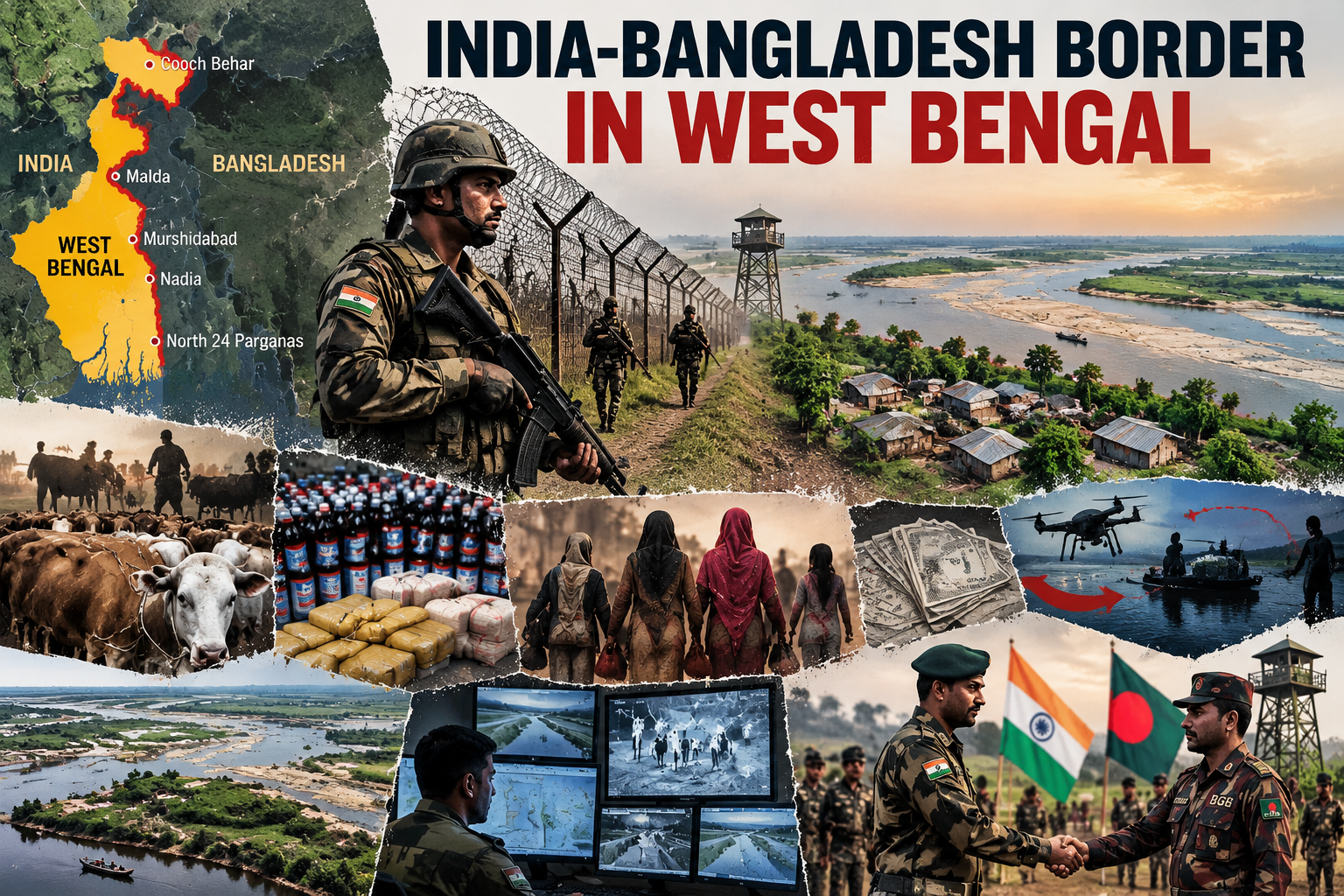
Stretching across 2,216 kilometres, the India-Bangladesh border in West Bengal cuts through paddy fields, riverbeds, densely populated settlements and mangrove creeks. The state accounts for the largest share of India’s international boundary with Bangladesh. In many places, villages lie close to the border fence, while riverine and char areas remain difficult to secure.
For communities living along the frontier, the border is both a dividing line and a lifeline. Families, livelihoods and informal commerce have long been connected across it. At the same time, the same geography has created opportunities for organised smuggling, human trafficking, illegal infiltration and other forms of cross-border crime, posing a continuing challenge to Indian and Bangladeshi authorities.
Security agencies attribute much of the cross-border activity to a combination of economic vulnerability, political instability in Bangladesh and the established networks of organised smugglers operating through vulnerable sections of the frontier. Riverine routes, shifting sandbars and densely inhabited areas near the zero line are particularly difficult to monitor.
Official figures indicate that India recorded 1,104 infiltration attempts through 2025. The figure highlights the continuing pressure on a border where fencing remains incomplete in several stretches. An estimated 850-900 kilometres of the India-Bangladesh boundary remain unfenced or inadequately secured because of difficult terrain, riverine geography, dense habitation and land-acquisition disputes, with West Bengal accounting for a substantial portion of the challenge. Petitions have also reached the Calcutta High Court seeking directions for the acceleration of fencing in vulnerable open stretches.
Smuggling Networks:
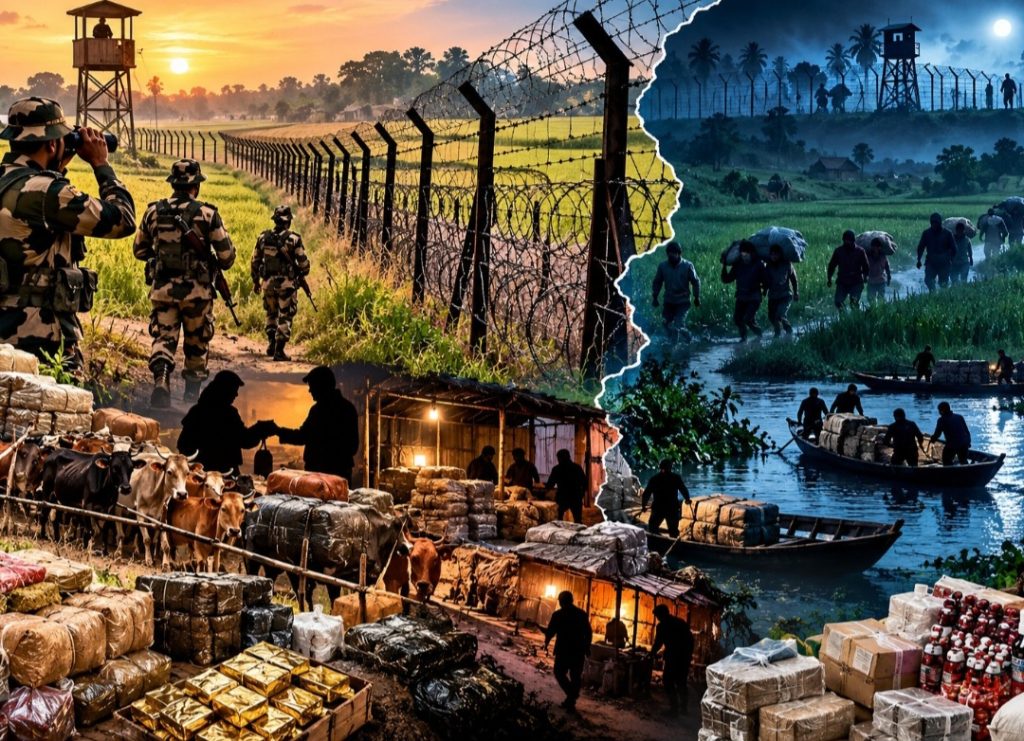
Cattle smuggling remains one of the most persistent forms of organised cross-border crime. Investigations over the years have uncovered networks extending well beyond West Bengal, with cattle allegedly sourced from states such as Rajasthan and transported towards the Bangladesh border. A major 2022 investigation into cattle smuggling implicated individuals associated with the security establishment and political circles, highlighting the extent to which criminal networks can penetrate legitimate institutions. Seizures and arrests linked to cattle smuggling continue to be reported from several border districts.
The illicit movement of pharmaceuticals and narcotics adds another layer to the problem. Phensedyl cough syrup and yaba tablets have repeatedly figured in seizures along the border, with authorities in districts such as Nadia and Malda reporting substantial recoveries. Such operations demonstrate the ability of organised networks to exploit established routes and local logistical chains.
Human trafficking is another serious concern. Investigators have reported cases in which women and minors from Bangladesh were allegedly brought into India on the promise of employment before being pushed into exploitative situations. In a frontier where legitimate migration, family movement, economic necessity and illegal infiltration can overlap, distinguishing between different categories of cross-border movement remains a major administrative and security challenge.
A Border Shaped by Land, Water and Demography:
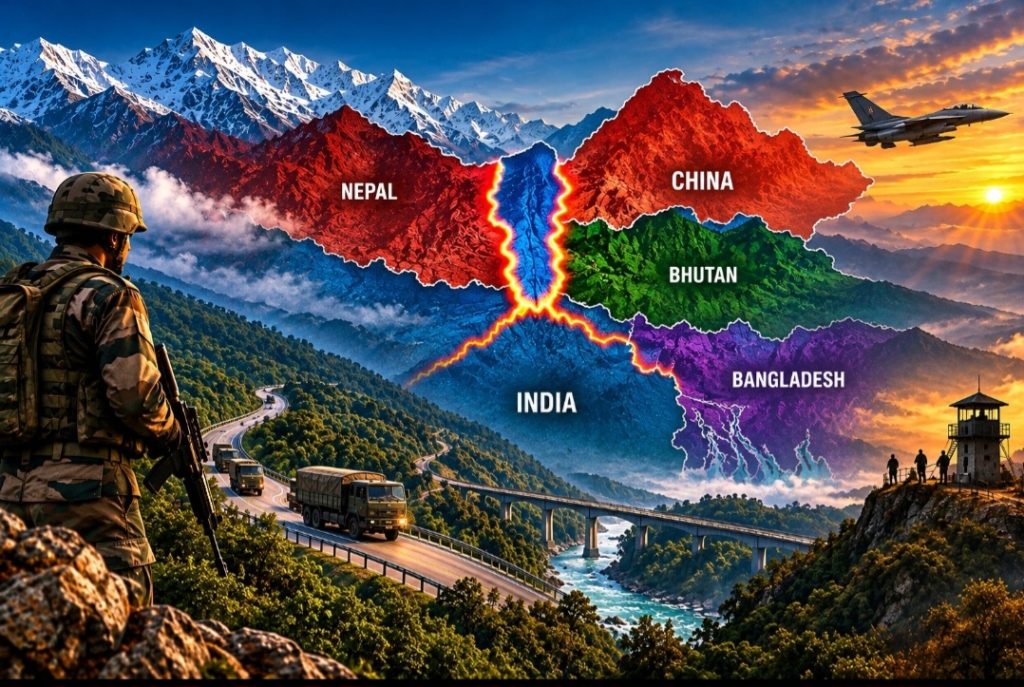
The difficulties are not limited to criminal networks. Border communities also face disputes over agricultural land, grazing areas and access to river water. The geography itself is constantly changing, particularly along riverine stretches where erosion and the emergence of chars can alter the physical landscape.
Migration has also become a politically and socially sensitive issue in several border districts. Changes in population patterns have contributed to local tensions, while allegations surrounding illegal migration have periodically become intertwined with wider political and communal disputes. Such issues require careful distinction between documented illegal entry, lawful migration and long-established cross-border family and economic connections.
The scale and complexity of these challenges mean that fencing and patrolling alone cannot provide a complete solution. Border management also depends on economic opportunities for frontier communities, effective policing and sustained cooperation between Indian and Bangladeshi authorities.
Security, Human Rights and Use of Force:
The use of force along the border remains one of the most contentious aspects of India-Bangladesh relations. Human-rights organisations and Bangladeshi authorities have repeatedly raised concerns about deaths and alleged excessive use of force during operations against suspected smugglers and illegal cross-border entrants.
Indian security agencies, however, argue that their personnel operate in difficult and high-risk conditions and that confrontations often occur while attempting to prevent smuggling, infiltration and other serious cross-border crimes. From the security agencies’ perspective, individual incidents must be examined alongside the broader operational environment in which personnel are required to protect a heavily trafficked international boundary.
The competing concerns underline the need for both effective enforcement and accountability. Action against organised criminal networks operating across the border, combined with transparent investigations into allegations of excessive force, would be essential to building greater confidence between communities and security institutions on both sides.
Counterfeit Currency, Narcotics and Radicalisation Concerns:
Counterfeit Indian currency has also featured in investigations into criminal networks operating in border areas. Malda’s Kaliachak region, among other locations, has repeatedly appeared in investigations involving counterfeit currency and associated criminal activity.
Narcotics and arms seizures have added to concerns about the diversification of cross-border criminal networks. Security agencies have also raised concerns about the use of modern technologies, including commercial drones and encrypted communications, by criminal and extremist groups.
The political changes in Bangladesh since 2024 have further intensified Indian security concerns about the possible revival of extremist networks. West Bengal’s Special Task Force has previously arrested individuals suspected of links to the Jamaat-ul-Mujahideen Bangladesh (JMB). Security officials and analysts have warned that extremist organisations could seek to exploit existing trafficking, smuggling and informal communication networks along the frontier.
These concerns require careful assessment, however, because the existence of criminal or extremist networks does not in itself establish a direct connection between ordinary border communities and such organisations.
Technology and the Future of Border Management:
Recognising that conventional fencing cannot fully address the challenges posed by rivers, wetlands and shifting terrain, the Ministry of Home Affairs has increasingly turned towards technology-driven border surveillance.
The Comprehensive Integrated Border Management System seeks to combine physical infrastructure with sensors, thermal imagers, surveillance equipment, communications networks and other technologies. The Border Electronics Locating and Observation System — BOLD-QIT — was first deployed along vulnerable riverine stretches of the Brahmaputra in Assam’s Dhubri district and represents an effort to monitor areas where conventional fencing is difficult or impossible.
Similar technology-based solutions are expected to play a greater role in West Bengal’s riverine and unfenced sectors, particularly where geography limits the effectiveness of conventional barriers.
Co-operation Between India and Bangladesh:
Ultimately, the security of the West Bengal frontier cannot depend solely on one side of the border. Smuggling, trafficking, narcotics, counterfeit currency and infiltration networks frequently involve actors, routes and financial links extending across both countries.
Regular Director General-level meetings between the Border Security Force (BSF) and Bangladesh’s Border Guard Bangladesh (BGB), intelligence-sharing and coordinated operations therefore remain important components of border management. Greater cooperation can help target organised networks rather than placing the entire burden of enforcement on frontline personnel.
At the domestic level, coordination among the BSF, state police, intelligence agencies, customs authorities and other enforcement bodies is equally important. Border crime often involves networks that extend well beyond the immediate frontier, requiring investigations into finance, transportation, communications and local facilitators.
Recent measures indicate movement in this direction. Following a change of government in West Bengal, the state administration approved the transfer of roughly 600 acres of land to the BSF to facilitate pending fencing work, with officials indicating that the handover would be completed within 45 days. New Delhi has also continued expanding technology-based surveillance in vulnerable riverine areas.
The Human Face of the Frontier:
For residents of Malda, Murshidabad, Nadia, Cooch Behar and North 24 Parganas, the India-Bangladesh border is not simply a line on a map or a national-security statistic. It is the landscape in which they farm, trade, travel and raise their families.
That reality makes border management particularly complicated. Security agencies must prevent organised crime and unauthorised cross-border movement, while authorities must also ensure that legitimate residents are not treated solely through the prism of security.
The long-term challenge is therefore one of balance: stronger surveillance and fencing where necessary; better intelligence and coordinated enforcement against organised criminal networks; accountability when force is used; and sustained economic development in communities that live closest to the frontier.
The India-Bangladesh border in West Bengal will remain a difficult frontier to secure because its challenges are shaped as much by geography and local livelihoods as by organised crime and national security. Effective management will ultimately require more than fences, sensors and manpower. It will require sustained cooperation between New Delhi and Dhaka, closer coordination between the BSF and BGB, stronger action against criminal networks and greater economic opportunity for the communities that live alongside one of South Asia’s most complex international borders.
