



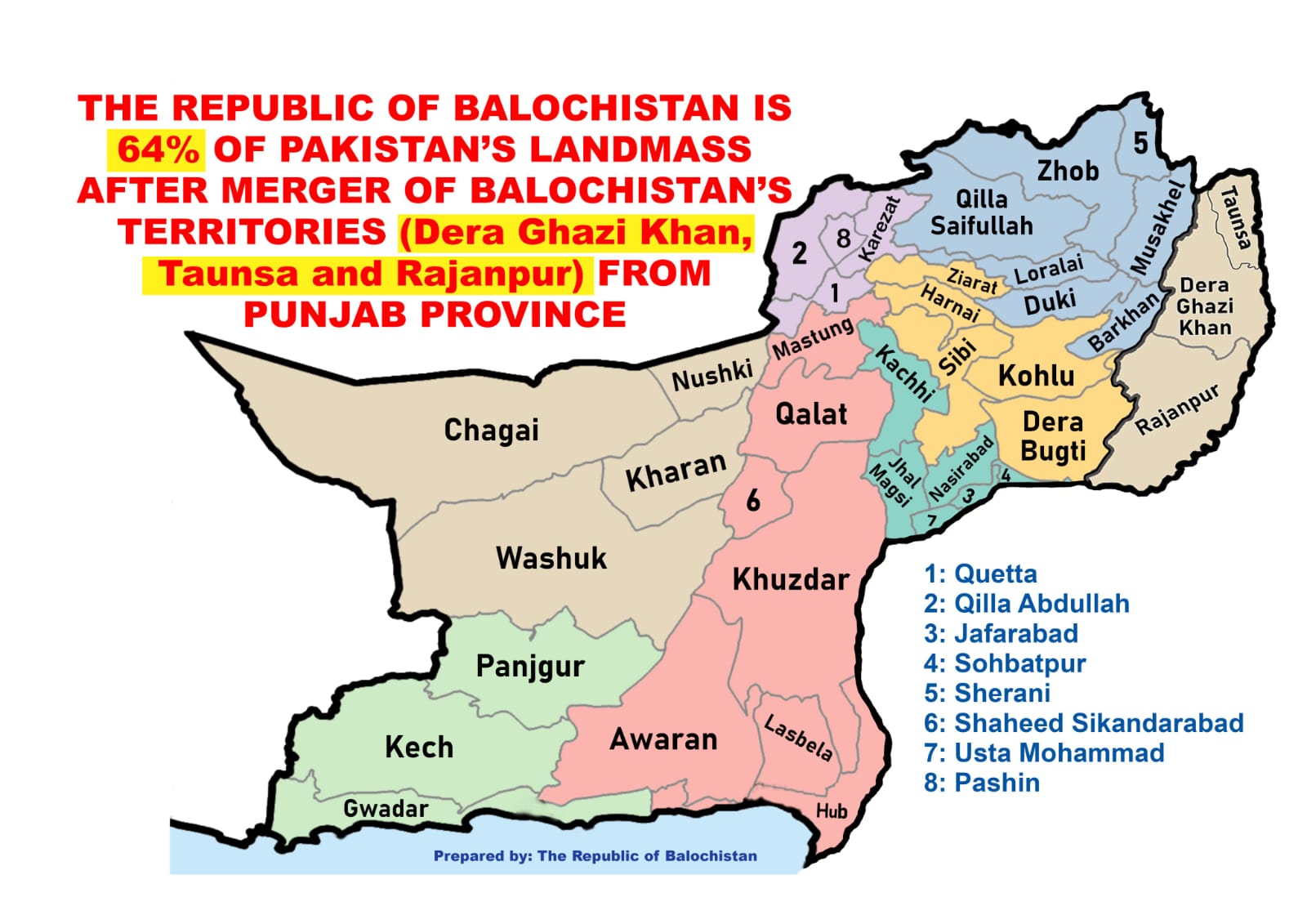
The self-declared Republic of Balochistan has announced a nationwide campaign concerning certain areas of Pakistan’s Punjab province that it says have historical, cultural and linguistic associations with Balochistan.
In a statement attributed to Baloch leader Mir Yar Baloch, the campaign referred to Taunsa Sharif, Dera Ghazi Khan and Rajanpur, which it described as areas with significant Baloch populations and historical connections to the Baloch community.
The statement called on Baloch communities in the region, including the Laghari, Khosa, Mazari, Drishak, Qaisrani, Buzdar, Gorchani, Sukhani, Khetran, Rind, Lashari, Hot, Dashti, Jamali and Jatoi tribes and sub-tribes, to highlight their historical, cultural and linguistic ties with Balochistan.
The campaign also urged residents of the areas it identified to use Balochistan rather than Punjab as their place of affiliation on official documents, including identity cards, passports, domiciles and educational and birth certificates.
It further called for the territories to be placed under what the statement described as the “direct control” of Balochistan and reflected on its proposed map of the region.
The statement cited the 2024 Baloch Long March, claiming that communities in parts of Punjab had welcomed participants and voiced support for closer political and cultural ties with Balochistan.
Separately, the statement put forward a broader historical-geographical interpretation of Balochistan’s territory, claiming that the region should account for approximately 64 per cent of Pakistan, rather than the 44 per cent figure it attributed to official Pakistani descriptions. It called on international media and geographical institutions to recognise this interpretation.
The territorial and administrative assertions outlined in the statement represent the political position of the self-declared Republic of Balochistan.They do not constitute a recognised alteration of Pakistan’s existing territorial or administrative boundaries.
