



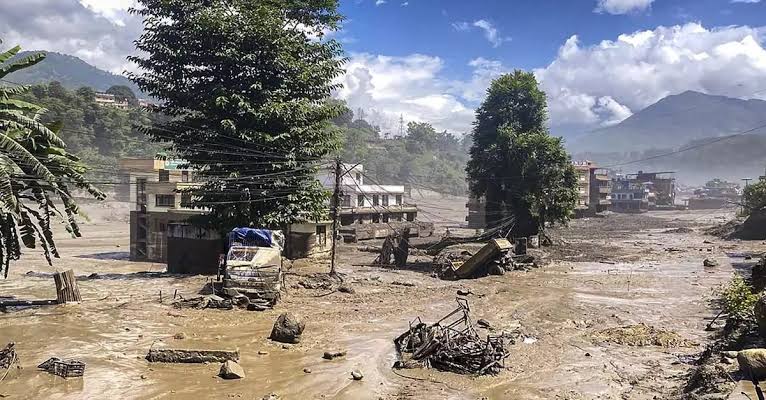
At least 105 Indian nationals are among hundreds of people reported missing after a massive flash flood swept through Nepal’s Rasuwa district near the Tibet border on Wednesday, triggering a large-scale search and rescue operation across several districts.
According to a preliminary situation update from the Nepal Tourism Board (NTB), 384 travellers, including 291 foreign nationals and 93 Nepali citizens, have been reported missing from the affected areas. The list includes 105 Indians and 37 non-resident Indians, with a large number of Indian nationals believed to have been travelling towards Tibet for the Kailash Manasarovar Yatra.
The disaster struck the Bhote Koshi river system in the Rasuwa region, close to the Nepal-Tibet border, at around 8:30-9 am local time. The sudden surge of water swept through settlements, roads and infrastructure before affecting neighbouring districts, including Dhading, Nuwakot and Chitwan.
Sudden flood devastates border region:
Rasuwa, particularly the areas around Timure, Syapru Besi and Rasuwagadhi, was among the worst affected. The floodwaters damaged bridges, roads, buildings and hydropower infrastructure, cutting off several areas and complicating rescue efforts.
Initial reports attributed the disaster to an earthquake-induced avalanche or rockslide in the mountainous region, which caused a sudden surge of water into the river system. Later assessments indicated that a large rockslide near the Nepal-Tibet border caused the flood to enter the Trishuli river through the Bhote Koshi at Timure.
The sudden nature and scale of the flooding left little time for people in settlements and along the riverbanks to move to safety. Communications have also been disrupted in several areas, making it difficult for authorities to establish the whereabouts of those who remain unaccounted for.
The casualty figures have continued to change as rescue teams gain access to previously isolated areas. Early reports put the number of recovered bodies at 46, while later updates from Nepal indicated a substantially higher toll as bodies were recovered downstream across multiple districts.
Indian tourists among those missing:
The presence of a large number of Indian travellers has emerged as one of the major concerns in the aftermath of the disaster.
The NTB said India accounted for the largest group among the foreign nationals listed as missing, with 105 Indian nationals and 37 NRIs included in the preliminary data. Travellers from the United States, United Kingdom, Australia, Malaysia, South Africa and the Netherlands have also been reported missing.
Many of the Indian travellers were believed to be on their way to Tibet for the Kailash Manasarovar pilgrimage, which involves travelling through Nepal and crossing the border region affected by the disaster.
The figures remain provisional, however, as Nepalese authorities, tourism agencies, guides and security personnel continue to verify the status of those listed as missing. The NTB has been coordinating with travel companies and local authorities to establish whether individuals are safe, stranded or still unaccounted for.
Search and rescue operations underway:
Nepal has mobilised security forces and rescue agencies to locate missing people and evacuate those stranded in affected areas. Rescue operations have been hampered by damaged roads and bridges, disrupted communications, difficult terrain and continuing adverse weather conditions.
Security personnel themselves have also been affected. Earlier reports indicated that dozens of Nepal Police and Armed Police Force personnel deployed in the region had gone out of contact, underlining the scale of the disaster and the risks faced by rescue teams.
Authorities are also assessing damage to hydropower facilities and other critical infrastructure along the river corridor. The flooding has affected settlements and transport links in several districts, while debris and mud have made access to some areas difficult.
Nepal government steps up response:
Nepal Prime Minister Balendra Shah has held consultations with federal lawmakers representing the affected areas to review the extent of damage and the ongoing rescue and relief operations.
Earlier, Shah convened a meeting of the National Council for Disaster Risk Reduction and Management to assess the flood situation and coordinate search, rescue and relief measures.
The government has also been monitoring the potential downstream impact of the flooding and issuing alerts in areas that could be affected by further rises in river levels.
Tourism authorities issue emergency contacts:
The Nepal Tourism Board has urged tourists and their families to remain calm and rely on official information while rescue agencies continue efforts to locate those missing.
The board has issued emergency contacts for people seeking assistance, including the toll-free number 1234, hotline 1144 and Tourist Police number 9851289445.
The Indian Embassy in Kathmandu has also been coordinating with Nepalese authorities regarding the safety and rescue of Indian nationals affected by the floods. It has issued emergency contact numbers for Indian citizens and families seeking information.
As search teams continue to move into the worst-hit areas, authorities are working to reconcile the preliminary lists of missing people with those rescued or confirmed safe. With communications still disrupted in parts of the disaster zone, the final scale of the tragedy is expected to become clearer only after rescue teams reach more isolated settlements and conduct detailed searches.
The flash flood has emerged as one of the most serious disasters to hit Nepal’s Himalayan border region in recent years, with its impact extending beyond local communities to international travellers, pilgrimage routes and critical infrastructure connecting Nepal with Tibet.
(Image courtesy: AIR)
