



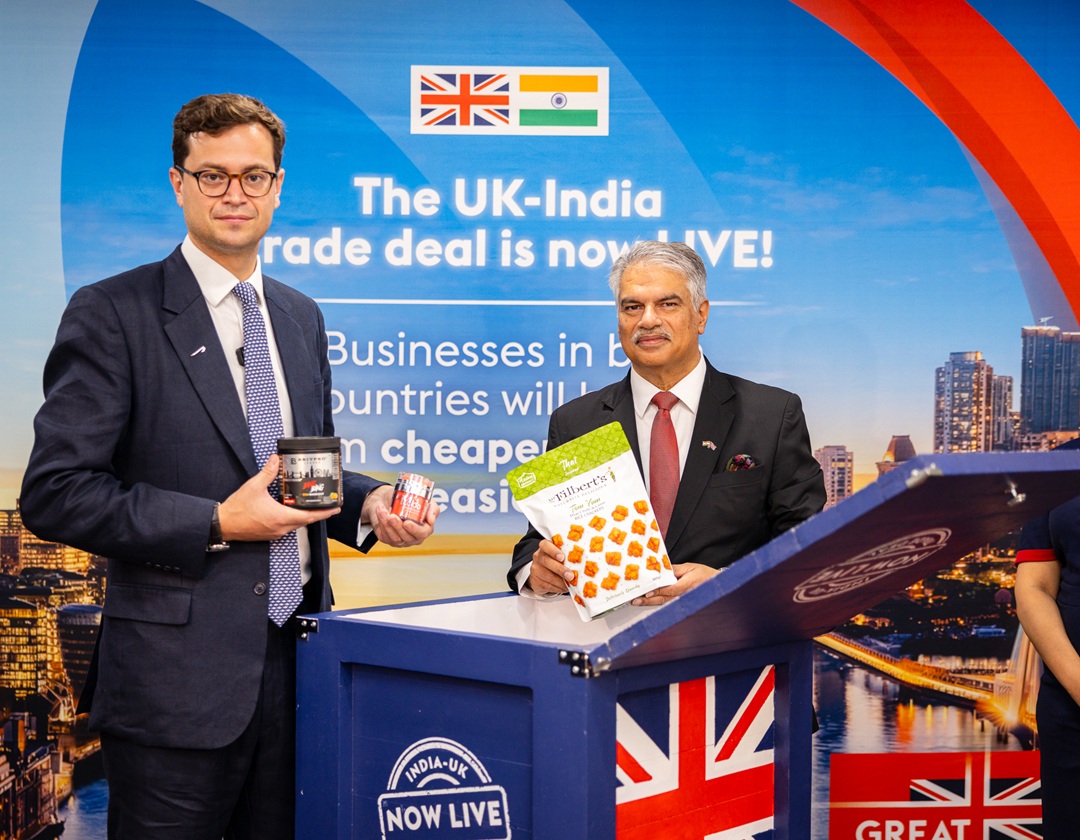
The landmark UK-India Free Trade Agreement (FTA) officially came into effect on Tuesday, marking a significant milestone in the economic partnership between the two countries. The agreement is expected to make trade cheaper, faster and more accessible for businesses and consumers by reducing or eliminating tariffs on a wide range of goods.
To mark the occasion, a special consignment of British products arrived at the British Deputy High Commission in Mumbai aboard a British Airways flight. The shipment, which included cosmetics, food products and alcoholic beverages that will benefit from reduced tariffs under the agreement, was unveiled by Harjinder Kang, His Majesty’s Trade Commissioner for South Asia and British Deputy High Commissioner for Western India, along with David Wright, General Manager of British Airways in India.
Describing the agreement as a “watershed moment” in UK-India relations, Kang said the trade deal would benefit businesses and consumers from the first day by making trade between the two countries cheaper, quicker and easier.
British Airways’ General Manager in India, David Wright, said India remains one of the airline’s most important markets. He noted that the carrier currently operates 63 weekly flights between the two countries, with services set to increase to 70 flights a week by the end of the summer. According to Wright, the agreement reinforces the long-term potential of the UK-India corridor and is expected to create new opportunities for trade, investment and tourism.
Under the agreement, 99 per cent of Indian goods entering the UK will be duty-free, while 90 per cent of UK goods exported to India will either become duty-free or attract lower tariffs. The FTA is expected to benefit sectors including automotive, manufacturing, consumer goods, creative industries and medical technology.
The UK Government is also organising a series of events to celebrate the implementation of the agreement, including business receptions in New Delhi, Mumbai, Bengaluru and at Lancaster House in London.
According to official estimates, the trade deal is expected to increase bilateral trade by £25.5 billion annually in the long term. It is also projected to add £5.1 billion to India’s GDP and £4.8 billion to the UK’s GDP each year.
