



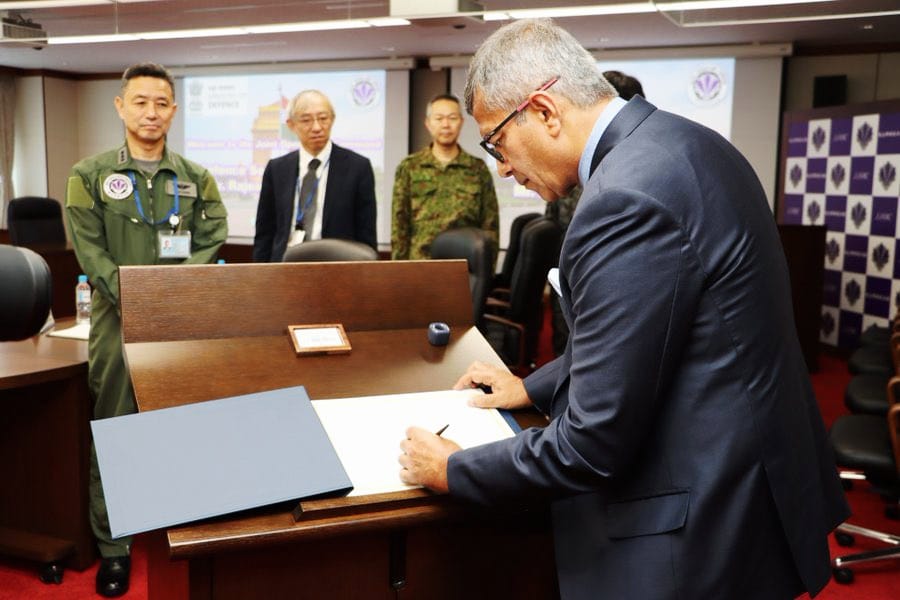
In a significant step towards strengthening the India-Japan strategic partnership, Defence Secretary Shri Rajesh Kumar Singh visited the Joint Operations Command of Japan on July 13, reaffirming the shared commitment of both countries to deepen defence cooperation amid an evolving security landscape in the Indo-Pacific.
The visit assumes added significance as it comes at a time when India and Japan are expanding defence engagements, enhancing interoperability between their armed forces and working together with like-minded partners to uphold a rules-based international order. Officials described the interaction as a reflection of the growing convergence in the strategic outlook of the two nations, particularly in ensuring peace, security and stability across the Indo-Pacific region.
A Milestone in Defence Co-operation:
During his visit to the Joint Operations Command, Shri Rajesh Kumar Singh was briefed on Japan’s integrated command structure and its operational mechanisms for coordinating activities across the Ground, Maritime and Air Self-Defense Forces. The discussions focused on operational coordination, emerging regional security challenges and avenues for strengthening military cooperation.
The visit highlighted the importance both nations attach to institutional exchanges between their defence establishments. With Japan establishing its Joint Operations Command earlier this year to enhance integrated military operations, India’s engagement with the new command reflects growing mutual interest in sharing best practices in jointness, theatre-level coordination and operational planning.
Shared Vision for a Free and Open Indo-Pacific:
India and Japan reiterated their commitment to advancing the vision of a Free and Open Indo-Pacific (FOIP)—a concept that emphasizes respect for international law, freedom of navigation, peaceful resolution of disputes and unimpeded lawful commerce across the maritime domain.
The Indo-Pacific has emerged as the world’s strategic and economic centre of gravity, accounting for a substantial share of global trade and maritime traffic. As two leading democracies in the region, India and Japan view close defence cooperation as an essential pillar for maintaining regional stability and ensuring that maritime commons remain secure, open and inclusive.
Both countries also underscored the importance of strengthening a rules-based order in accordance with international law, while promoting dialogue, cooperation and confidence-building measures among regional partners.
Expanding Defence Partnership:
India and Japan have witnessed remarkable growth in bilateral defence ties over the past decade. Their relationship has evolved from traditional diplomatic engagement into a comprehensive strategic and global partnership encompassing defence, maritime security, technology, logistics and defence industrial cooperation.
The two countries regularly conduct bilateral and multilateral military exercises, including the Army exercise Dharma Guardian, naval exercise JIMEX (Japan-India Maritime Exercise) and participation in the Malabar naval exercise alongside the United States and Australia.
The Acquisition and Cross-Servicing Agreement (ACSA), signed in 2020, has further strengthened logistical cooperation by enabling reciprocal provision of supplies and services between the armed forces of both nations during exercises, training and humanitarian operations.
Addressing Emerging Security Challenges:
The discussions during the Defence Secretary’s visit also reflected the growing complexity of the regional security environment. Increasing geopolitical competition, maritime security concerns, cyber threats and the need for coordinated responses to humanitarian assistance and disaster relief (HADR) operations have reinforced the importance of closer defence collaboration.
Officials noted that India and Japan are exploring greater cooperation in emerging domains such as cyber security, space, defence technology and resilient supply chains, in addition to expanding military exchanges and professional interactions.
Strategic Importance of the Visit:
The visit to Japan’s Joint Operations Command marks another milestone in the steadily deepening India-Japan defence relationship. It demonstrates both nations’ determination to enhance operational coordination, improve interoperability and contribute jointly to regional peace and stability.
As the Indo-Pacific continues to shape the global strategic landscape, India and Japan are expected to play an increasingly important role in promoting security, stability and prosperity through closer defence cooperation and stronger strategic coordination.
The Defence Secretary’s engagement sends a clear message that New Delhi and Tokyo remain committed to working together to address common security challenges while advancing their shared vision of a peaceful, secure and inclusive Indo-Pacific.
