



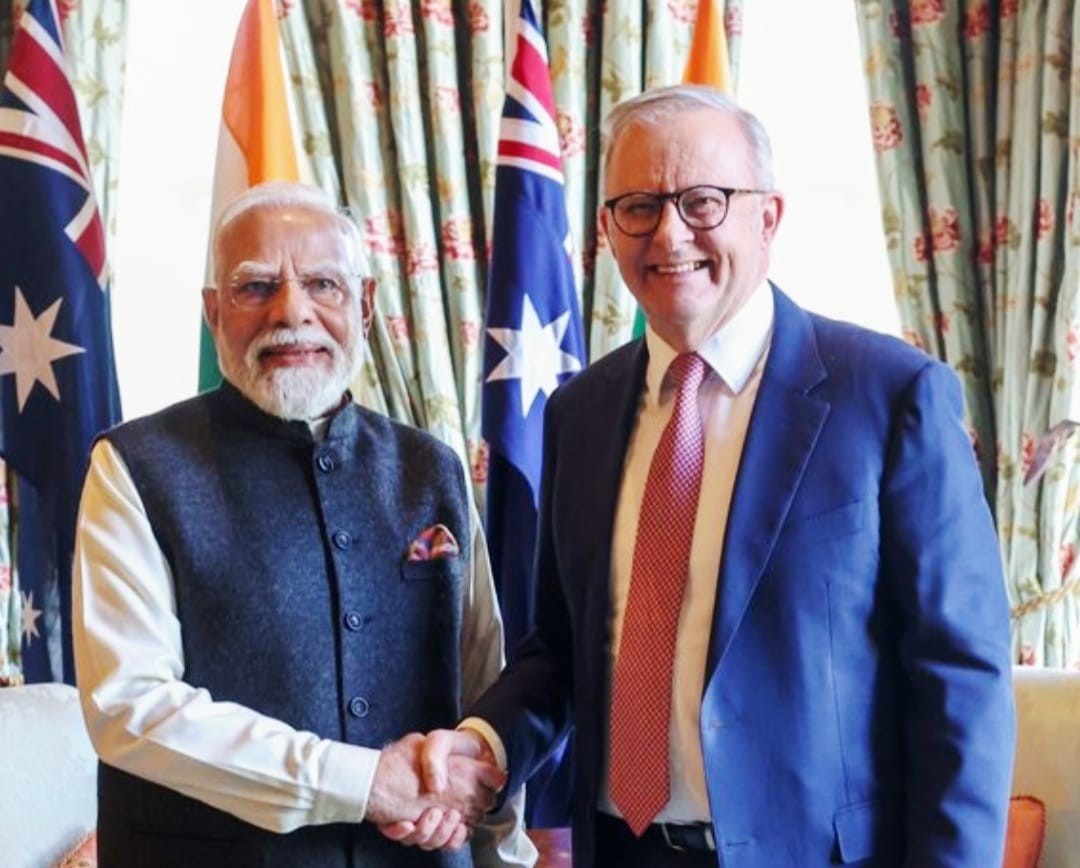
India and Australia have operationalised their Civil Nuclear Cooperation Agreement by finalising an Administrative Arrangement that will facilitate long-term exports of Australian uranium to India for peaceful civilian nuclear use under International Atomic Energy Agency (IAEA) safeguards.
The agreement was finalised during the Third India–Australia Annual Summit held in Melbourne recently, where Prime Minister Narendra Modi and his Australian counterpart reaffirmed the Comprehensive Strategic Partnership and expanded cooperation across maritime security, energy, cyber security, critical technologies, skill development and entrepreneurship.
The Administrative Arrangement establishes the framework for implementing the Civil Nuclear Cooperation Agreement signed in 2014 and brought into force in 2015. It enables a stable and predictable supply of Australian uranium, strengthening India’s long-term fuel security as it expands its nuclear power programme.
Australia, which holds more than one-third of the world’s known uranium reserves, is expected to become one of India’s key suppliers of nuclear fuel, ensuring uninterrupted operation of its Pressurised Heavy Water Reactors (PHWRs), which primarily use natural uranium.
The development assumes significance as India seeks to scale up its nuclear energy capacity under the Nuclear Energy Mission, which targets 100 GW of installed nuclear power capacity by 2047. It also complements the SHANTI Act, enacted in December 2025, allowing Indian private companies and joint ventures to participate in the construction, ownership and operation of nuclear power plants.
Officials said assured fuel availability would improve investor confidence, reduce supply uncertainties and support the timely implementation of upcoming nuclear projects.
India currently operates 24 nuclear reactors across seven sites with a combined installed capacity of 8.78 GW. Ten additional reactors with a total capacity of 8,000 MW are under construction, while pre-project activities have commenced for another 10 reactor units.
The country is simultaneously investing in advanced nuclear technologies. The Union Budget 2025–26 earmarked ₹20,000 crore for the research, development and deployment of indigenous Small Modular Reactors (SMRs), with the government aiming to commission at least five such reactors by 2033.
India is also advancing its three-stage nuclear programme centred on utilising its vast thorium reserves. A major milestone was achieved on April 6 this year when the indigenously developed 500 MWe Prototype Fast Breeder Reactor (PFBR) at Kalpakkam attained first criticality, marking the beginning of the second stage of the programme. The reactor is designed to generate more fissile material than it consumes and will eventually enable the use of thorium as a sustainable nuclear fuel.
The Administrative Arrangement further strengthens India’s clean energy ambitions by supporting the expansion of low-carbon nuclear power, an important component of the country’s strategy to achieve net-zero emissions by 2070 while meeting rising electricity demand.
The agreement also reflects Australia’s confidence in India’s non-proliferation credentials, with all uranium exports remaining subject to IAEA safeguards. Canberra reiterated its support for India’s membership of the Nuclear Suppliers Group (NSG), the 48-member body that regulates global nuclear exports.
Officials said the arrangement marks a new phase in India–Australia relations by adding a strong energy pillar to an already expanding partnership spanning trade, defence, critical minerals, emerging technologies and the Indo-Pacific, while providing a reliable foundation for peaceful nuclear cooperation in the decades ahead.
