



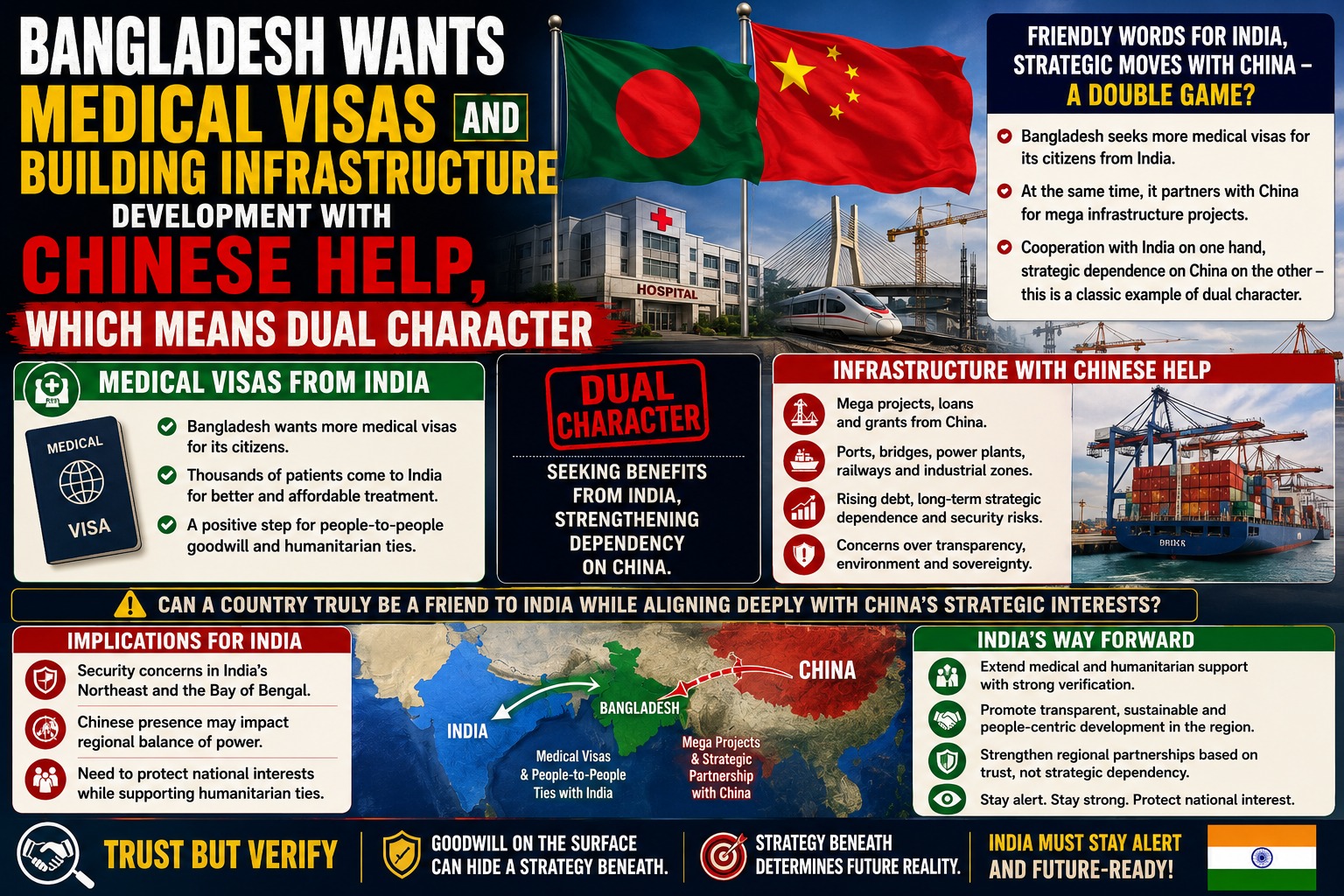
For more than five decades, India has demonstrated that its relationship with Bangladesh extends far beyond diplomacy. India played a pivotal role in Bangladesh’s Liberation War in 1971, sheltered millions of refugees, provided humanitarian assistance, expanded trade and connectivity, and opened its hospitals to thousands of Bangladeshi patients seeking affordable, world-class medical care. Very few countries have invested so consistently in the well-being of their neighbour.
Yet friendship is not sustained by goodwill alone. It rests on reciprocity, mutual respect, and sensitivity to each other’s core strategic interests.
Today, many Indians are asking whether New Delhi should continue extending the same level of concessions when Bangladesh’s strategic engagement with China appears to be deepening. Chinese participation in major infrastructure projects, including developments at Mongla Port and interest in projects such as the Teesta River initiative, has prompted legitimate debate within India’s strategic community. Reports and speculation regarding Chinese interest in facilities such as Lalmonirhat have further heightened concerns, even though there is no confirmed evidence that such a facility would become a Chinese military base.
China’s approach to South Asia is widely understood through the prism of long-term strategic influence. Across the region, Beijing has invested heavily in ports, transport corridors, energy projects, and critical infrastructure. While these investments are often presented as economic partnerships, many analysts argue that they can also enhance China’s geopolitical leverage. India cannot afford to ignore these developments in its immediate neighbourhood.
India’s Generosity Must Be Matched by Reciprocity:
No sovereign nation can be expected to separate humanitarian policy entirely from national security. Medical visas are an act of compassion, not an obligation. They reflect India’s civilizational ethos of caring for those in need. But compassion should never come at the expense of prudence.
India must therefore review its medical visa policy in the context of the broader bilateral relationship. Such a review does not mean abandoning humanitarian values. Instead, it means ensuring that national security, reciprocity, and strategic interests are given due weight. Enhanced security screening, stricter eligibility criteria, and periodic policy assessments are reasonable measures for any responsible government.
Bangladesh is free to pursue its own foreign policy and partnerships. Likewise, India is fully entitled to shape its own policies according to its national interests. Friendship is a two-way commitment, not a one-sided expectation.
India has never hesitated to help its neighbours in times of crisis. That generosity has earned global respect. However, goodwill should inspire goodwill in return. If strategic choices made by a neighbour generate legitimate security concerns for India, New Delhi has every right to reassess policies that have long been extended as gestures of trust and friendship.
A confident India should remain compassionate—but it must also be clear-eyed. National interest should guide national policy. Humanitarianism and security are not mutually exclusive; they must coexist. The era of unconditional concessions is over. India’s generosity should be matched by reciprocity, respect, and recognition of its legitimate security concerns. That is not hostility—it is responsible statecraft.
(Views are author’s personal)
Image credit: Suman Munshi
