



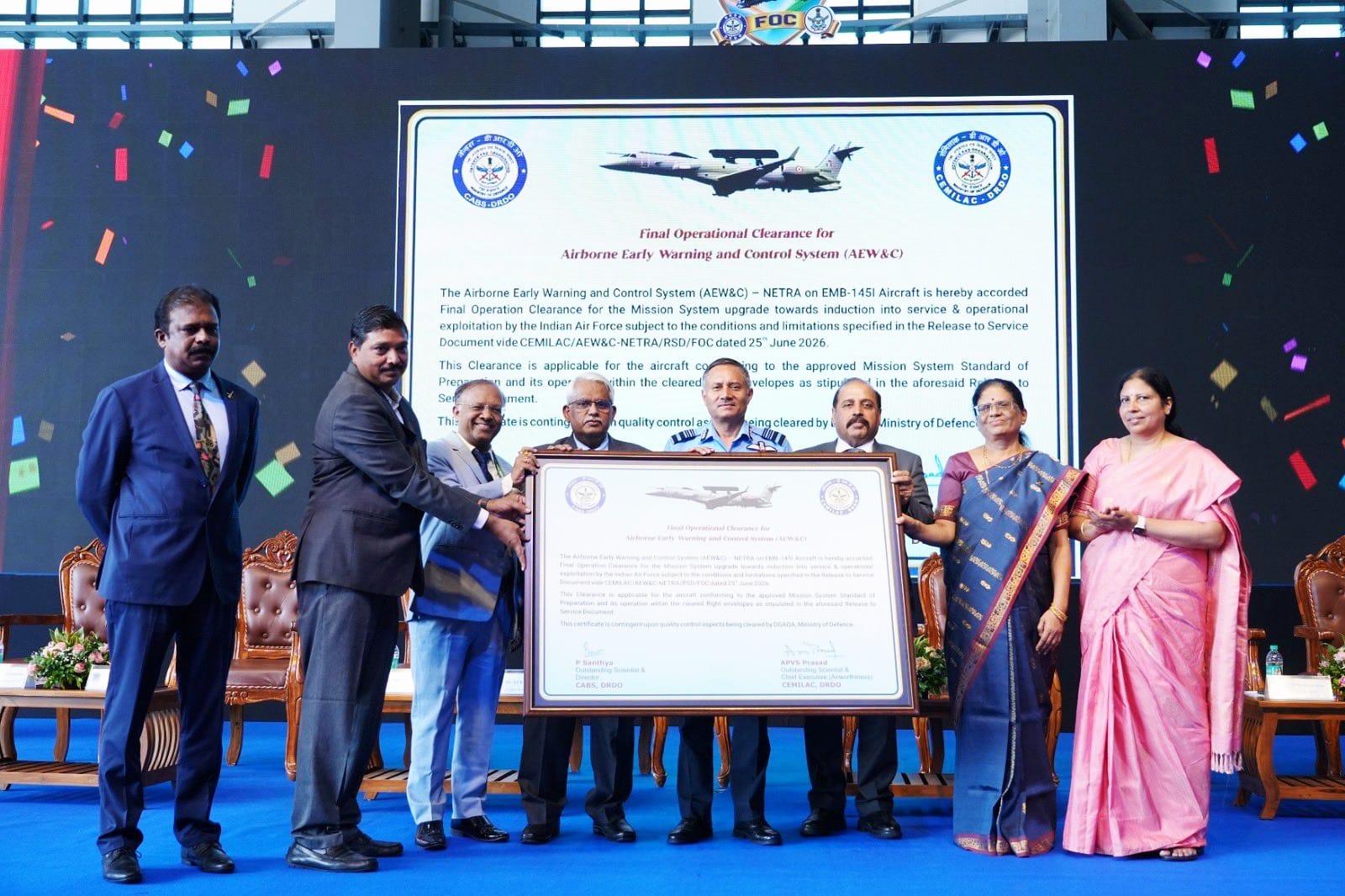
In a significant boost to India’s indigenous aerospace and defence capabilities, the Defence Research and Development Organisation (DRDO) has formally handed over the Final Operational Clearance (FOC) for the indigenous Netra Airborne Early Warning and Control (AEW&C) System to the Indian Air Force (IAF), marking the culmination of a decade-long effort to establish a sovereign airborne surveillance and battle management capability.
The milestone underscores India’s growing proficiency in developing complex airborne command-and-control systems and represents a critical advancement in the nation’s pursuit of defence self-reliance under the vision of Atmanirbhar Bharat.
The FOC certificate was presented during a ceremony held in Bengaluru on June 25, presided over by Deputy Chief of the Air Staff Air Marshal Awadhesh Kumar Bharti. The event brought together serving and retired military leaders, senior DRDO scientists, programme architects, and industry partners who played key roles in the development and operationalisation of the platform.
The Netra AEW&C programme, jointly developed through close collaboration between the IAF, DRDO, and Indian industry, is designed to provide real-time airborne surveillance, early warning, airspace monitoring, threat detection, and battle management support. By extending the Air Force’s sensor horizon far beyond ground-based radar coverage, the system significantly enhances situational awareness and operational responsiveness across the battlespace.
Having received Initial Operational Clearance (IOC) in 2017, the platform has since undergone extensive operational evaluation and mission deployment, culminating in the award of Final Operational Clearance.
Proven in Operations:
Highlighting the system’s operational maturity, Air Marshal Bharti noted the crucial role played by Netra during key military operations, including the Balakot air strikes and Operation Sindoor. He emphasised that indigenous systems provide the armed forces with unparalleled flexibility to rapidly modify and upgrade capabilities in response to evolving operational requirements and emerging threats.
He praised the seamless collaboration between DRDO, the IAF, and domestic industry, describing the programme as a model of successful civil-military-technological synergy.
A Triumph of Indigenous Engineering:
Addressing the gathering, Distinguished Scientist and Director General (Aeronautics) Dr K Rajalakshmi Menon traced the developmental journey of the Netra programme, highlighting the technological challenges overcome and the critical role of systems engineering in integrating sophisticated airborne sensors, mission systems, and flight-test campaigns.
Director General (Electronics) Dr BK Das described the Netra AEW&C as a defining example of India’s growing technological self-confidence, noting that close cooperation among stakeholders was instrumental in transforming an ambitious vision into an operationally proven capability.
Strategic Force Multiplier:
The induction of the Netra AEW&C system strengthens India’s network-centric warfare capabilities by enabling persistent aerial surveillance, real-time threat tracking, command-and-control functions, and enhanced coordination among air, land, and maritime assets.
In an increasingly contested air domain, airborne early warning platforms serve as critical force multipliers, providing commanders with the information dominance required to detect, deter, and defeat threats before they materialise.
Recognition of Programme Contributors:
The ceremony also recognised the contributions of various organisations, operational units, scientists, engineers, and industry partners whose collective efforts enabled the successful development and deployment of the system. Their work was acknowledged as central to transforming the Netra programme from a technology.
