



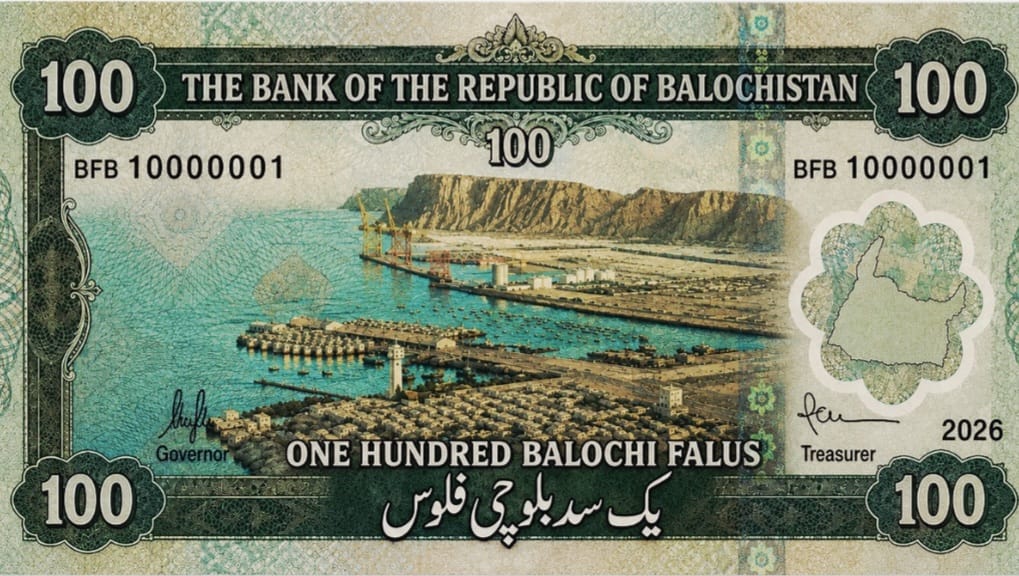
The unveiling of a proposed national currency known as the “Balochi Falus” by supporters of a future independent Balochistan has renewed discussion about the historic connection between currency and sovereignty.
Advocates of Baloch self-determination have presented the proposed currency as part of a broader vision of nationhood that includes a national flag, passport, anthem and governing institutions. While Balochistan is not recognized internationally as an independent state, supporters argue that such symbols serve as expressions of political identity and aspirations for self-rule.
The proposal has also drawn attention to a long-standing principle in political history: the relationship between monetary authority and state power.
Currency as a Symbol of Sovereignty:
Across civilizations, the ability to issue currency has been regarded as one of the clearest manifestations of sovereign authority. In South Asia, this concept is often reflected in the well-known political maxim:
“Sikka Jiska, Sarkar Uska” (He who issues the coin is the one who governs):
For centuries, rulers established legitimacy not only through military or administrative control but also by minting coins bearing their names, emblems and official insignia. Currency functioned as both an economic instrument and a public declaration of political authority.
The proposed Balochi Falus is being viewed by supporters through this historical lens—as a symbolic assertion of a distinct political identity rather than merely a financial instrument.
Historical Precedents in State Formation:
Observers have noted similarities with several historical movements that sought to establish the institutions of statehood before achieving full political recognition.
One frequently cited example is the Provisional Government of Free India (Azad Hind) established by Netaji Subhas Chandra Bose in 1943. The government sought to create key institutions associated with an independent state, including the Azad Hind Bank and plans for an autonomous financial system.
Although wartime conditions limited the practical implementation of these initiatives, historians often regard them as important symbolic expressions of sovereign ambition and nation-building.
Lessons from Bangladesh’s Independence Movement:
The discussion has also drawn comparisons with the Mujibnagar Government, which led the political struggle for Bangladesh’s independence during the 1971 Liberation War.
While the wartime administration did not introduce a separate currency during the conflict, it established administrative and political structures that later formed the foundation of an independent state. Following independence, Bangladesh introduced the Bangladeshi Taka, a move widely seen as reinforcing its newly acquired sovereignty and economic independence.
The example is frequently cited to illustrate how state institutions and national symbols often evolve alongside broader political transformations.
Economic and Strategic Considerations:
Supporters of Baloch nationalism argue that the region possesses significant economic potential, citing extensive reserves of natural gas, copper, gold and other mineral resources. They also point to the strategic location of Gwadar Port, situated along critical maritime trade routes in the Arabian Sea.
These factors are often presented as evidence that an independent Balochistan could potentially support its own economic and financial framework.
However, economists and political analysts note that the viability of any national currency depends on a range of factors, including institutional capacity, monetary governance, economic stability and international engagement.
Beyond Symbols: The Requirements of Statehood:
While the introduction of a proposed currency carries considerable symbolic significance, experts emphasize that statehood is determined by a broader set of political and legal realities.
Effective governance, territorial control, functioning institutions, economic sustainability and international recognition remain among the key elements typically associated with sovereign states under international norms.
In that context, the proposed Balochi Falus represents more than a monetary concept. It serves as a political statement reflecting aspirations for sovereignty and national identity.
Whether it remains a symbolic expression or evolves into part of a future state structure will depend on developments extending far beyond the creation of a currency itself, touching on the complex questions of governance, legitimacy and International recognition that continue to shape debates over nationhood around the world.
(With inputs from Mir Yar Baloch’s page: https://x.com/i/status/2068360006735728796)
